

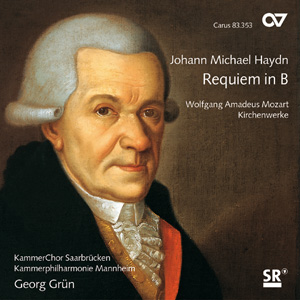
Johann Michael Haydn: Requiem in B (Grün)
Von den beiden Requiemvertonungen Johann Michael Haydns stand das fragmentarische Spätwerk in B bisher stets im Schatten des so genannten "Schrattenbach-Requiems" in c von 1771. Haydn, fast 70-jährig, schrieb sein zweites "solemnes Requiem" im Auftrag der österreichischen Kaiserin Marie Therese, konnte das Werk aber nur noch bis zum Beginn des "Dies irae" ausführen. Ganz ähnlich wie Mozarts Requiem-Fragment wurde auch Haydns Torso von einem "geistesverwandten" Musiker vervollständigt, da eine unvollständige Totenmesse liturgisch kaum brauchbar war. 1839 unterzog sich Pater Gunther Kronecker, regens chori im Benediktinerstift Kremsmünster, dieser verantwortungsvollen Aufgabe, wurde damit gleichsam zum "Süßmayr Michael Haydns". Seine Ergänzung - getragen von lyrisch-kantabler, stellenweise volksliedhafter Melodik - schlägt eine stilistische Brücke zur Musik Schuberts und des Wiener Biedermeier. Weltersteinspielung der Fassung Kronecker.
Ausgezeichnet mit dem MIDEM Classical Award
 Anhören
(19)
Anhören
(19)
- God is our refuge (Gott will uns Stärke und Zuversicht sein)
- Requiem aeternam
- Kyrie
- Dies irae
- Liber scriptus
- Rex tremendae
- Recordare
- Confutatis
- Lacrimosa
- Domine Jesu
- Hostias et preces
- Sanctus
- Benedictus
- Agnus Dei
- Lux aeterna
- Cum Sanctis tuis
- Misericordias Domini
- Venite populi
- Ave verum corpus
 Zusatz-Material
-
 Text (ohne Noten) zum Abdruck, html-Datei, Singtext, originalhtml-Datei, Singtext, original (Leseprobe)
Ave verum corpus
natum de Maria Virgine,
vere passum, immolatum
in cruce pro homine:
Cuius latus perforatum
unda fluxit et sanguine,
esto nobis praegustatum
in mortis examine.Liturgie, 14. Jahrhundert
...
-
Text (ohne Noten) zum Abdruck, html-Datei, Singtext, engl. Übersetzunghtml-Datei, Singtext, engl. Übersetzung (Leseprobe)
Hail, true body,
born of the Virgin Mary,
truly tormented, sacrificed
on the cross for mankind,
from whose pierced side
flowed blood and water:
be our strength in the trial of death.Liturgy, 14th century
...
-
Text (ohne Noten) zum Abdruck, html-Datei, Singtext, deutsche Übersetzunghtml-Datei, Singtext, deutsche Übersetzung (Leseprobe)
Sei gegrüßt, wahrer Leib,
geboren aus Maria, der Jungfrau,
wahrhaft gelitten, geopfert
am Kreuz für die Menschen.
Aus deiner durchstoßenen Seite
floss Blut und Wasser:
sei uns Stärkung für die Prüfung des Todes.Liturgie, 14. Jahrhundert
...
-
Text (ohne Noten) zum Abdruck, html-Datei, Einführungstext, französischhtml-Datei, Einführungstext, französisch (Leseprobe)Texte du livret du CD Carus 83.353
Armin Kircher
Traduction (abrégé) : Sylvie Coquillat« La musique sacrée était le genre favori de Mozart », écrit Franz Xaver Niemetschek dans sa biographie de Mozart parue en 1798 à Prague. En dehors des multiples impressions musicales au cours de ses voyages, il se confronta sciemment à la tradition salzbourgeoise. Il tenait notamment en grande estime les œuvres de musique sacrée de Johann Michael Haydn, dont il se fit envoyer des copies à Vienne.
Mozart écrit en 1765 à l’âge de neuf ans sa première composition d’un texte religieux à Londres, au cours d’un voyage de presque trois ans et demie à travers l’Europe de l’Ouest. La brève pièce chorale de 23 mesures God is our Refuge KV 20 est écrite sur le deuxième verset du Psaume 46 et s’inspire du style de la musique d’église traditionnelle anglaise d’alors. Wolfgang écrivit son unique composition d’un texte anglais sous la houlette paternelle
...
-
Text (ohne Noten) zum Abdruck, html-Datei, Einführungstext, englischhtml-Datei, Einführungstext, englisch (Leseprobe)Text from the CD Carus 83.353
Armin Kircher
Translation (abridged): John Coombs„Church music was Mozart’s favorite genre of composition” wrote Franz Xaver Niemetschek in his biography of Mozart published in Prague in 1798. Along with the many musical impressions gained during his journeys he studied closely the Salzburg tradition. He valued especially the church works of Michael Haydn, copies of which he asked to be sent to him in Vienna.
When he was nine years old Mozart composed his first setting of a sacred text in London in 1765 during the tour of western Europe which lasted for almost three and a half years. The short, 23-measure choral piece God is our Refuge, K. 20, is a setting of text from Psalm 46, and it is modelled on traditional English church music of the period. Wolfgang wrote this little choral work, his only setting of English words, under his father’s supervision, and as can
...
-
Text (ohne Noten) zum Abdruck, html-Datei, Einführungstext, deutschhtml-Datei, Einführungstext, deutsch (Leseprobe)Gekürzter Booklet-Text der CD Carus 83.353
Armin Kircher
„Kirchenmusik war das Lieblingsfach Mozarts“ schrieb Franz Xaver Niemetschek in seiner im Jahr 1798 in Prag erschienenen Biographie Mozarts. Zeitlebens beschäftigte sich Mozart mit der geistlichen Musik. Neben den vielfältigen musikalischen Eindrücken auf seinen Reisen setzte er sich auch bewusst mit der Salzburger Tradition auseinander. Besonders schätzte er die kirchenmusikalischen Werke Johann Michael Haydns, von denen er sich Abschriften nach Wien schicken ließ.
Die erste Vertonung eines geistlichen Textes schuf Mozart 1765 im Alter von neun Jahren, auf der fast dreieinhalb Jahre dauernden Reise durch Westeuropa in London. Das kurze, 23-taktige Chorstück God is our Refuge KV 20 ist über den zweiten Vers aus Psalm 46 gearbeitet und nimmt den Stil der traditionellen englischen Kirchenmusik der Zeit zum Vorbild. Unklar ist, welcher Gattung das Werk zuzurechnen
...
-
Text (ohne Noten) zum Abdruck, html-Datei, Singtext, originalhtml-Datei, Singtext, original (Leseprobe)
Introitus 1. Requiem aeternam (Solo S, Coro) Requiem aeternam dona eis, Domine:
et lux perpetua luceat eis.
Te decet hymnus, Deus, in Sion,
et tibi reddetur votum in Jerusalem:
exaudi orationem meam,
ad te omnis caro veniet.
Requiem aeternam dona eis, Domine:
et lux perpetua luceat eis.2. Kyrie (Coro) Kyrie eleison.
Christe, eleison.
Kyrie eleison.Sequenz 3. Dies irae (Soli SA, Coro) Dies irae, dies illa
solvet saeclum in favilla:
teste David cum Sibylla.
Quantus tremor est futurus,
...
-
Text (ohne Noten) zum Abdruck, html-Datei, Singtext, engl. Übersetzunghtml-Datei, Singtext, engl. Übersetzung (Leseprobe)
Introitus 1. Requiem aeternam (Solo S, Coro) Lord, grant them eternal rest,
and let the perpetual light shine upon them.
Thou shalt have praise in Zion, oh God,
and homage shall be paid to Thee in Jerusalem.
Hear my prayer.
All flesh shall come before Thee.
Lord, grant them eternal rest,
and let the perpetual light shine upon them.2. Kyrie (Coro) Lord, have mercy upon us.
Christ, have mercy upon us.
Lord, have mercy upon us.Sequenz 3. Dies irae (Soli SA, Coro) This day, this day of wrath
shall consume the world in ashes,
as foretold David and the Sibyl.
What trembling there shall be
...
-
Text (ohne Noten) zum Abdruck, html-Datei, Singtext, deutsche Übersetzunghtml-Datei, Singtext, deutsche Übersetzung (Leseprobe)
Introitus 1. Requiem aeternam (Solo S, Coro) Gib ihnen die ewige Ruhe, Herr,
und das ewige Licht leuchte ihnen.
Dir gebührt ein Lobgesang, Gott, in Zion,
und dir erfülle man sein Gelübde in Jerusalem.
Erhöre mein Gebet.
Zu dir kommt alles Fleisch.
Gib ihnen die ewige Ruhe, Herr,
und das ewige Licht leuchte ihnen.2. Kyrie (Coro) Herr, erbarme dich.
Christus, erbarme dich.
Herr, erbarme dich.Sequenz 3. Dies irae (Soli SA, Coro) Tag des Zornes, jener Tag
legt die Welt in glühende Asche,
wie David und die Sibylle bezeugen.
Welch ein Beben wird herrschen,
...
-
Text (ohne Noten) zum Abdruck, html-Datei, Einführungstext, französischhtml-Datei, Einführungstext, französisch (Leseprobe)Texte du CD Carus 83.353
Armin Kircher
« Tout amateur de musique et de sa littérature sait [...] que Michael Haydn, en tant que compositeur d’église, compte parmi les premiers du genre [...] », écrit avec enthousiasme le poète et compositeur romantique E. T. A. Hoffmann dans la revue musicale Leipziger Allgemeine Musikalische Zeitung (1812). Johann Michael Haydn naquit le 13 septembre 1737 à Rohrau (Basse-Autriche) et, comme son frère aîné de cinq ans Joseph, accomplit sa formation musicale à la maîtrise de la cathédrale Saint-Étienne de Vienne. Après un premier emploi auprès de l’évêque de Großwardein (aujourd’hui Oradea à la frontière roumano-hongroise), il s’établit en 1763 à Salzbourg où il resta au service de la cour des princes archévêques jusqu’à sa mort. A partir de 1780, sa création se concentra de la musique instrumentale sur le domaine vocal, surtout la musique
Traduction (abrégé) : Sylvie Coquillat...
-
Text (ohne Noten) zum Abdruck, html-Datei, Einführungstext, englischhtml-Datei, Einführungstext, englisch (Leseprobe)Text from the CD Carus 83.353
Armin Kircher
Translation (abridged): John Coombs“Everyone with knowledge of music and its literature knows [...] that Michael Haydn, as a composer for the church, is one of the finest artists in this field […],” wrote the romantic poet-composer E. T. A. Hoffmann almost euphorically in the Leipziger Allgemeine Musikalische Zeitung (1812). Johann Michael Haydn was born on 13 September 1737 at Rohrau (Lower Austria), and like his brother Joseph, who was five years older, he was trained musically at the choir school of St. Stephan’s in Vienna. After a first appointment under the Bishop of Grosswardein (now Oradea on the Romanian-Hungarian border) he went in 1763 to Salzburg, where he remained in the service of the prince-Archbishop’s Court until his death. From 1780 onwards, however, the emphasis of his compositional output was on vocal rather than instrumental music, especially
...
-
Text (ohne Noten) zum Abdruck, html-Datei, Einführungstext, deutschhtml-Datei, Einführungstext, deutsch (Leseprobe)Booklet-Text der CD Carus 83.353
Armin Kircher
„Jeder Kenner der Tonkunst und ihrer Literatur weiß, und wußte schon längst, daß Michael Haydn, als Kirchenkomponist, unter die ersten Künstler dieses Faches, aus jeder Zeit und jeder Nation gehört“, schreibt der romantische Dichter-Komponist E. T. A. Hoffmann geradezu euphorisch in der Leipziger Allgemeinen Musikalischen Zeitung (1812) über die Bedeutung des „Salzburger Haydn“. Geboren wurde Johann Michael Haydn am 13. September 1737 in Rohrau/Niederösterreich, und wie sein um fünf Jahre älterer Bruder Joseph wurde er im Kapellhaus zu St. Stephan in Wien musikalisch ausgebildet. Nach einer ersten Anstellung beim Bischof in Großwardein (heute Oradea, eine Stadt an der rumänisch-ungarischen Grenze), kam er 1763 nach Salzburg, wo er bis zu seinem Tod am fürsterzbischöflichen Hof bedienstet war, anfänglich als Konzertmeister, seit 1782 in der Nachfolge Mozarts
...
Inhaltsverzeichnis


-
Vorwortverfasser*in
Armin Kircher
| 1966-2015Armin Kircher leitete bis zu seinem Tod das Kirchenmusikreferat der Erzdiözese Salzburg und war seit 1992 organisatorischer Leiter der Österreichischen Werkwoche für Kirchenmusik. Außerdem war Armin Kircher Stiftskapellmeister an der Stiftskirche St. Peter in Salzburg und Organist an der Kajetanerkirche in Salzburg. Die besondere editorische Zuwendung Kirchers galt der liturgischen Musik sowie der Musik der Wiener Klassik, allen voran der noch unerschlossenen Musik Johann Michael Haydns, dessen zahlreiche Messkompositionen er für die heutige Zeit in wissenschaftlichen Ausgaben erschloss. Die von ihm herausgegebenen Sammlungen für die katholische Liturgie sind heute Standardwerke, insbesondere die Chorbücher Mozart – Haydn, das Chorbuch Kirchenjahr und die Veröffentlichungen für Orgel und Chöre zum neuen katholischen Gesangbuch „Gotteslob“. Auch als Arrangeur klangschöner Chor- und Orgel-Sätze hat sich Armin Kircher einen Namen gemacht. zur Person
-
Ensemble
KammerChor Saarbrücken
1990 von seinem Leiter Georg Grün gegründet, avancierte der KammerChor Saarbrücken schnell zu einem der besten Chöre Deutschlands und genießt einen ebenfalls ausgezeichneten internationalen Ruf. Dies belegen unzählige Auftritte bei Festivals im Inland und in vielen europäischen Ländern, den USA und Russland, CD-Einspielungen mit hervorragenden Kritiken, zahlreiche Rundfunkaufnahmen, nicht zuletzt der Gewinn vieler wichtiger internationaler Chorwettbewerbe und des Deutschen Chorwettbewerbs 1998 in Regensburg. Der Chor führt Werke aller Epochen auf. Im Bereich der Alten Musik arbeitet er mit professionellen Ensembles und Solisten zusammen, die sich der historischen Aufführungspraxis verpflichtet fühlen. Weitere Schwerpunkte sind die Interpretation romantischer Chorkompositionen sowie zunehmend auch Urauf füh rungen von Werken, die Komponisten eigens für das Ensemble schreiben. zur Person
-
Ensemble
Kammerphilharmonie Mannheim
-
Dirigent*in
Georg Grün
Georg Grün studierte Kirchenmusik, Schulmusik, katholische Theologie, Musikwissenschaft und Dirigieren und unterrichtete mehrere Jahre die Fächer Musik und katholische Religion an einem musischen Gymnasium. 2000 folgte er einem Ruf als Professor für Chorleitung an die Staatliche Hochschule für Musik und Darstellende Kunst Mannheim, mit dessen Kammerchor er ebenfalls erfolgreich tätig ist (u.a. Gewinn der Internationalen Chorwettbewerbe Cork und Maribor). Als Gastdirigent, Juror und Dozent ist Georg Grün im In- und Ausland tätig. Seit Oktober 2012 ist Georg Grün Professor für Chorleitung an der Hochschule für Musik Saar. zur Person
-
Sopran-Solo
Lydia Teuscher
-
Alt-Solo
Manami Kusano
-
Tenor-Solo
Julian Prégardien
-
Bass-Solo
Jens Hamann
Jens Hamann war Mitglied der Stuttgarter Hymnus-Chorknaben, des Kammerchor Stuttgart und der Gächinger Kantorei. Nach seinem Gesangsstudium bei Rudolf Piernay in Mannheim erhielt der Bariton 2006 den „Sonderpreis Alte Musik“ des Saarländischen Rundfunks. Die Weltersteinspielung von Michael Haydns Requiem (Carus 83.353), bei der er mitwirkte, wurde mit dem MIDEM Classical Award 2007 ausgezeichnet. Im Oratorienfach arbeitet er mit Helmuth Rilling, Georg Grün und Ralf Otto zusammen und folgte Einladungen zum Europäischen Musikfest Stuttgart und den Opernschlossfestspielen Hallwyl. zur Person
Rezensionen
[...] Der durchweg exzellente Kammerchor Saarbrücken und die Kammerphilharmonie Mannheim bieten eine hervorragende Interpretation. Ungemein leicht der Chor, womit er dem Wort „Kammer” im Namen alle Ehre macht. Sehr akkurat das Orchester. Tüchtig die Solisten. Historisch informiert, wie man heute gelegentlich sagt, der Klang. Dem engagierten Dirigenten Georg Grün, der als Professor für Chorleitung an der Musikhochschule Mannheim tätig ist, glückte eine Aufnahme mit Referenzcharakter.
Johann Michael Haydn: Das bedeutet Musik, die es lohnt, wieder entdeckt zu werden. Es ist an der Zeit, auch den weniger bekannten Haydn angemessen ins Musikleben zu integrieren - vielleicht sogar über die Kirchenkunst und übers Gedenkjahr hinaus.
Johannes Adam
Quelle: Badische Zeitung, 10.08.06, S. 11
[...] Die qualitätvolle Ersteinspielung dieses Werkes durch KammerChor Saarbrücken, assistiert von der Kammerphilharmonie Mannheim belegt eindrucksvoll, wie gekonnt die Vervollständigung des Werkes durch den Regens Chori im Stift Kremsmünster gemacht wurde und dass das Werk bisher zu Unrecht im Schatten des c-Moll-Requiem („Schrattenbach-Requiem”) stand. Eine wichtige und gute Aufnahme anlässlich des Haydn-Jahres, zu der Ausführende und Verlag in gleicher Weise zu beglückwünschen sind!
Walter Sengstschmid
Quelle: Singende Kirche Heft 3, 53.Jg. 2006, S. 216
[…] On s'émerveille en effet devant la structure intelligente du chœur, capable de dessiner un contrepoint parfait dans les fugues et de traduire une émotion sincère dans les moments clés du texte liturgique.
PiRath
Quelle : pizzicato 11/2006
Michael Haydn wurde von seinen Zeitgenossen als hervorragender Kirchenkomponist geschätzt. Seine Kirchenmusik, vor allem die Messen, galten als Musterkompositionen katholischer Kirchenmusik.[...]
Nach langem Dornröschenschlaf des ergänzten Requiems hat nun der Carus-Verlag das Werk in der Fassung Kronecker in sein Programm aufgenommen. Der KammerChor Saarbrücken und die Kammerphilharmonie Mannheim haben unter der Leitung von Georg Grün eine erfrischend vital musizierte Ersteinspielung unternommen. Insgesamt eine sehr gute Aufnahme, nicht zuletzt auch wegen der hervorragenden Solisten.
Cordula Scobel
Quelle: Musik und Kirche, Nov/Dez 2006
[...] Der Mannheimer Professor für Chorleitung Georg Grün lässt den ausgesprochen klangschönen Chor und das an der historischen Aufführungspraxis geschulte Kammerorchester durchsichtig und locker musizieren, das ausgeglichene Solistenquartett fügt sich nahtlos in den Stil der lebendigen, fein ausgearbeiteten Aufführung. [...]
Sixtus König
Quelle: www.klassik-heute.de, 04.04.2006
[...] The performances are very satisfying. Good notes and excellent SACD sound.
Bauman
Quelle: American Record Guide 2007
Bewertungen auf unserer Website können nur von Kund*innen mit registriertem Nutzerkonto abgegeben werden. Eine Überprüfung, ob die bewerteten Produkte tatsächlich erworben wurden, findet nicht statt.
Häufige Fragen zum Werk
 An dieser Stelle gibt es noch gar keine Fragen und Antworten zum Werk oder Ihre spezifische Frage zum Werk wurde noch nicht beantwortet? Klicken Sie hier und reichen Sie Ihre werkspezifische Frage bei unserem Kundenservice ein!