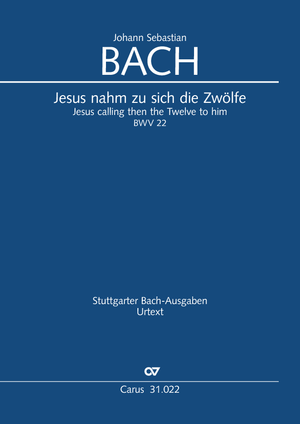
Jesus nahm zu sich die Zwölfe
Cantate pour le dimanche Estomihi BWV 22, 1723
La cantate Jesus nahm zu sich die Zwölfe (Jésus prit avec lui les Douze) a été jouée avec la cantate BWV 23 le dimanche de la Quinquagésime 1723 pour la candidature de Johann Sebastian Bach au poste de cantor de Leipzig. Les deux cantates ont ensuite été reprises dans le cadre du premier cycle de cantates de Leipzig de Bach. Cette cantate expressive se contente d’un effectif instrumental modeste ce qui n’empêche pas Bach d’écrire une pièce très inhabituelle, concernant sa forme aussi, avec instruments obligés depuis l’arioso du début, en passant par l’accompagnato central et jusqu’au choral final.
Découvrir
 Consulter


 Compléments
- Acheter des compléments au format téléchargement.
-
 Texte numérique (sans notes), licence d'impression incluse, fichier html, paroles, traduction en anglaisfichier html, paroles, traduction en anglais (Extrait)1 Arioso e Coro
Jesus calling then the Twelve to him, said:
2 Aria (Alto)
Come now, we go up hence to Jerusalem
and thuswise all things will happen,
all things be thus accomplished
which where prophesied of the Son of man.
But they understood not his meaning,
Nor did they know what things he spoke to them.My Saviour take me, take thou me,
3 Recitativo (Basso)
I would away with thee today
and in Jerusalem would share thy cross with thee.
Ah me! ‘twere well I know the price
that thou hast paid, thy sacrifice,
to gain me paradise,
ah! this were well for me.Lord Jesus, bid me go, and I will hasten,
tho’ flesh and blood cannot well apprehend,
as thy disciples then, all that thy words portend....
-
Texte numérique (sans notes), licence d'impression incluse, fichier html, paroles, originalfichier html, paroles, original (Extrait)??1 Arioso e Coro
Jesus nahm zu sich die Zwölfe und sprach:
2 Aria (Alto)
Sehet, wir gehn hinauf gen Jerusalem,
und es wird alles vollendet werden,
das geschrieben ist von des Menschen Sohn.
Sie aber vernahmen der keines
und wussten nicht, was das gesaget war.Mein Jesu ziehe mich nach dir,
3 Recitativo (Basso)
ich bin bereit, ich will von hier
und nach Jerusalem zu deinen Leiden gehn.
Wohl mir, wenn ich die Wichtigkeit
von dieser Leid- und Sterbenszeit
zu meinem Troste kann durchgehends wohl verstehn.Mein Jesu, ziehe mich, so werd ich
...
-
Texte numérique (sans notes), licence d'impression incluse, fichier html, Texte introductif, en anglaisfichier html, Texte introductif, en anglais (Extrait)Foreword of the Edition Carus 31.022/03
Ulrich Leisinger
Translation: John Coombs
The cantata Jesus nahm zu sich die Zwölfe (“Jesus took unto him the twelve”), BWV 22, is one of the two test pieces which Johann Sebastian Bach submitted in February 1723 when applying for the position of Kantor of St. Thomas in Leipzig. Comparison between the texts and those of the test pieces submitted by Christoph Graupner, who had completed his examination for the same post a few weeks earlier, suggests that the texts to be set by the candidates for the position of successor to Johann Kuhnau had been selected by the Leipzig clergy, so that the conditions would be the same for each candidate. Bach’s cantata Jesus nahm zu sich die Zwölfe was intend ed for use on the Sunday Estomihi, the last Sunday before Lent, which in 1723 fell on the 7th February. It was suit able as the principal music performed before the sermon, where as the cantata Du wahrer Gott und Davids Sohn, BWV 23, was probably sung after the sermon, during the Communion. A publication of the texts of the church music used at Leipzig shows that BWV 22 was performed again on the corresponding Sunday of the following year, the 20th February 1724.
...
-
Texte numérique (sans notes), licence d'impression incluse, fichier html, Texte introductif, en allemandfichier html, Texte introductif, en allemand (Extrait)Vorwort der Ausgabe 31.022/03
Ulrich Leisinger
Die Kantate Jesus nahm zu sich die Zwölfe BWV 22 ist eines der beiden Probestücke, mit denen sich Johann Sebastian Bach im Februar 1723 um das Leipziger Thomaskantorat bewarb. Ein Vergleich der Texte mit denen der Bewerbungskompositionen Christoph Graupners, der wenige Wochen zuvor seine Probe abgelegt hatte, lassen vermuten, dass den Kandidaten um die Nachfolge Johann Kuhnaus die Texte von der Leipziger Geistlichkeit gestellt wurden, um gleichwertige Prüfungsbedingungen zu schaffen. Bachs Kantate Jesus nahm zu sich die Zwölfe diente offenbar am Sonntag Estomihi, der im Jahre 1723 auf den 7. Februar fiel, als Hauptmusik vor der Predigt, wohingegen die Kantate Du wahrer Gott und Davids Sohn BWV 23 nach der Predigt, während der Austeilung des Abendmahls, erklungen sein dürfte. Durch einen Textdruck zur Leipziger Kirchenmusik ist eine Wiederaufführung bereits für den entsprechenden Sonntag des Folgejahres, den 20. Februar 1724, belegt. Da die Originalstimmen verschollen sind, lassen sich für weitere Aufführungen keine zuverlässigen Anhaltspunkte gewinnen.
Der namentlich nicht bekannte Textdichter geht vom Sonntagsevangelium aus Lukas 18 aus; zwei Verse daraus werden der
...
Acheter
Informations complémentaires sur l'œuvre
-
Compositeur
Johann Sebastian Bach
| 1685-1750Jean-Sébastien Bach compte parmi les compositeurs les plus importants de l'histoire de la musique occidentale. Il était issu d'une dynastie de musiciens très ramifiée, qui a donné naissance à de nombreux musiciens municipaux et organistes dans la région de Thuringe et de Saxe.
Bach vocal
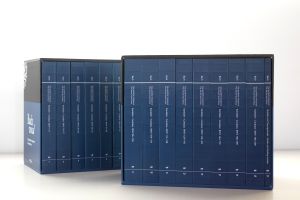
Depuis la création des éditions Carus, l’édition des œuvres de Jean-Sébastien Bach constitue pour nous une priorité particulière. À l’occasion de l’année commémorative de la Réforme, nous avons achevé le projet « Bach vocal ». La musique vocale sacrée de Bach est désormais disponible dans son intégralité sous forme d’éditions modernes « Urtext », accompagnées du matériel d’exécution. Une édition complète de toutes les partitions, présentée dans un coffret de grande qualité, est également disponible. Traduit avec DeepL.com (version gratuite)
Plus d'information sur la personne
-
Éditeur
Ulrich Leisinger
-
Traducteur
Henry Drinker
Critiques
Joh
Joh. Seb. Bach:Jesus nahm zu sich die Zwölfe
Die Kantate „Jesus nahm zu sich die Zwölfe” BWV 22 ist eines der beiden Probestücke, mit denen sich Bach im Februar 1723 um das Leipziger Thomaskantorat bewarb. Der namentlich nicht bekannte Textdichter geht vom Evangelium aus Lukas 18 aus, dem Aufbruch Jesu nach Jerusalem. Bach geht wie gewohnt sensibel auf den Text ein und macht auch von der musikalischen Ausdeutung einzelner Worte Gebrauch. Setzt einen leistungsfähigen Chor voraus, der auch etwas mit der historischen Aufführungspraxis vertraut ist.
Quelle: Singen und Musizieren im Gottesdienst 2/2002, S. 80
Les évaluations sur notre site web ne peuvent être effectuées que par des clients disposant d'un compte d'utilisateur enregistré. Il n'est pas vérifié si les produits évalués ont été effectivement achetés.
Aucune évaluation disponible pour ce produit.
Questions fréquentes sur l'œuvre
 Il n'y a pas encore de questions et réponses concernant cette œuvre ou vous n'avez pas trouvé la réponse à votre question sur l'œuvre ? Cliquez ici et envoyez votre question spécifique à notre service clients.