

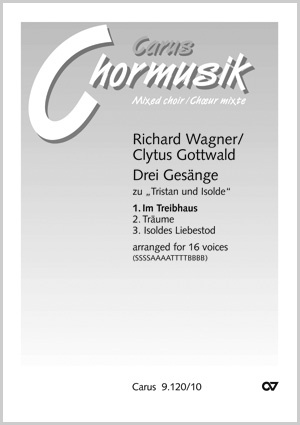
Im Treibhaus. Vocal transcription by Clytus Gottwald
Etude pour « Tristan et Iseut » 1857/2004
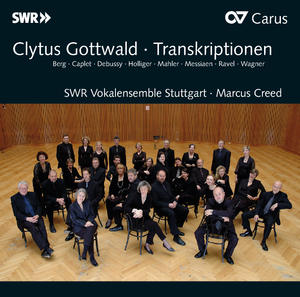
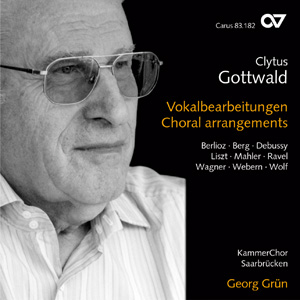
The sophisticated choral arrangements by Clytus Gottwald have found a place in concert life throughout the world. Here Gottwald has arranged two of Richard Wagner’s Wesendonck Lieder, “Im Treibhaus” and “Träume”, for 16-voice choir a cappella. In his choral transcriptions Gottwald has transferred to traditional music the compositional techniques from new music which he developed during his long tenure as founder and director of the chamber choir Schola Cantorum. He makes audible the structures of the works he transcribes through the use of a finely differentiated sound.
Découvrir
 Consulter
 Ecouter
(1)
Ecouter
(1)
- Im Treibhaus. Vocal transcription by Clytus Gottwald
 Compléments
- Acheter des compléments au format téléchargement.
-
 Texte numérique (sans notes), licence d'impression incluse, fichier html, paroles, originalfichier html, paroles, original (Extrait)Unbenanntes Dokument Im Treibhaus
Hochgewölbte Blätterkronen, Baldachine von Smaragd,
Kinder ihr aus fernen Zonen, saget mir, warum ihr klagt?
Schweigend neiget ihr die Zweige, malet Zeichen in die Luft
und der Leiden stummer Zeuge, steiget aufwärts süßer Duft.
Weit in sehnendem Verlangen breitet ihr die Arme aus
und umschlinget wahnbefangen öde Leere, nichtgen Graus.
Wohl ich weiß es, arme Pflanze, ein Geschicke teilen wir,
ob umstrahlt von Licht und Glanze, unsre Heimat ist nicht hier!
Und wie froh die Sonne scheidet von des Tages leerem Schein,
hüllet der, der wahrhaft leidet, sich in Schweigens Dunkel ein.
Stille wirds, ein säuselnd Weben füllet bang den dunklen Raum.
Schwere Tropfen seh ich schweben an der Blätter grünem Saum....
-
Texte numérique (sans notes), licence d'impression incluse, fichier html, paroles, traduction en anglaisfichier html, paroles, traduction en anglais (Extrait)Unbenanntes Dokument In the greenhouse
High-arched crowns of leaves, emerald canopies,
you children of distant regions, tell me, why do you lament?
Silently you bend the branches, painting symbols in the air,
and of suffering mute witness, sweet fragrance ascending.
In yearning desire you spread wide your arms
and, caught up in delusion, embrace the desolate void, devastating
horror.
Well I know, poor plant, one fate we share,
though illuminated by light and brightness, our home is not here!
And as happily the sun parts the day’s idle lustre,
he, who truly suffers, shrouds himself in the darkness of silence.
It becomes still, a murmur weaving, filling anxiously the dark room....
-
Texte numérique (sans notes), licence d'impression incluse, fichier html, paroles, traduction françaisefichier html, paroles, traduction française (Extrait)Unbenanntes Dokument Dans la Serre
Hautes voûtes, couronnes de feuillage, baldaquins d’émeraude,
enfants de zones éloignées, dites moi, pourquoi vous plaindre ?
En silence vous penchez vos branches, peignant des signes dans
les airs,
et la peine de témoins muets élève vers les cieux de doux parfums.
En un désir ardent largement vous ouvrez vos bras
et enlacez, ô chimère, un ennuyeux vide d’horreur futile.
Oui, je sais, pauvre plante nous partageons un même destin,
même dans la lumière et l’éclat notre patrie n’est pas ici !
Et comme avec joie le soleil quitte la lumière stérile du jour,
qui souffre vraiment, se drape dans le sombre silence.
Le calme vient, un murmure tremblant remplit inquiet la sombre...
Acheter
Informations complémentaires sur l'œuvre
-
Compositeur
Richard Wagner
| 1813-1883Born in 1813 in Leipzig, Richard Wagner grew up in a family very fond of theatre and he himself fell under its spell early. After failure in school and a mainly self-taught musical training (earliest compositions ~ 1830, Symphony in C 1832) 1833 initial employment as choir director in Wurzburg (completion of his first entire opera Die Feen). Start of years as a journeyman: Konigsberg, Riga, Paris, then as a court music director in Dresden, as a fugitive revolutionary in Zurich and finally as a protege of King Ludwig II. in Munich and Bayreuth, death in Venice in 1883. Plus d'information sur la personne
-
Parolier/Librettiste
Mathilde Wesendonck
-
Arrangeur
Clytus Gottwald
| 1925-2023Le chef de chœur, compositeur et musicologue Clytus Gottwald (1925 - 2023) a apporté des contributions essentielles à la musique chorale contemporaine. En tant que rédacteur de musique contemporaine à la radio Südfunk de Stuttgart et fondateur et directeur de la Schola Cantorum Stuttgart, il a eu des échanges productifs avec ses contemporains fondateurs de la musique contemporaine, Pierre Boulez, Mauricio Kagel, György Ligeti, Luigi Nono, Karlheinz Stockhausen et bien d'autres. Avec sa Schola Cantorum, un ensemble vocal de chambre à 16 voix, Gottwald a marqué de manière décisive la culture chorale a cappella, devenue aujourd'hui une évidence, au plus haut niveau technique. Ses transcriptions de lieder ou de pièces instrumentales pour chœur à plusieurs voix a cappella, dont l’écriture inspirée de Ligeti est musicalement très exigeante, sont appréciées par les chœurs du monde entier. Clytus Gottwald a été récompensé à plusieurs reprises pour ses mérites, notamment par le Kulturpreis Baden-Württemberg en 2009, le Preis der Europäischen Kirchenmusik 2012 et la Verdienstkreuz der Bundesrepublik Deutschland 2014. Son importance pour le développement de la musique chorale contemporaine ne peut être surestimée. Plus d'information sur la personne
Les évaluations sur notre site web ne peuvent être effectuées que par des clients disposant d'un compte d'utilisateur enregistré. Il n'est pas vérifié si les produits évalués ont été effectivement achetés.
Aucune évaluation disponible pour ce produit.
Questions fréquentes sur l'œuvre
 Il n'y a pas encore de questions et réponses concernant cette œuvre ou vous n'avez pas trouvé la réponse à votre question sur l'œuvre ? Cliquez ici et envoyez votre question spécifique à notre service clients.