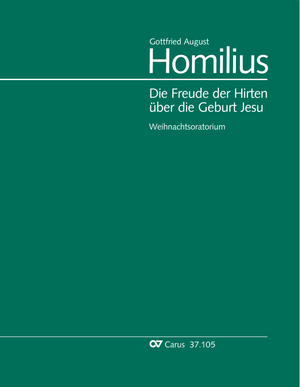

Die Freude der Hirten über die Geburt Jesu. Weihnachtsoratorium
Gott, dich rühmen unsere Lieder HoWV I.1

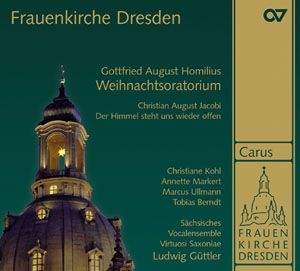
„Die Freude der Hirten über die Geburt Jesu“ HoWV I.1 est, après la cantate de la Passion „Ein Lämmlein geht und trägt die Schuld“ de 1775 HoWV I.2, la deuxième grande oeuvre vocale de Homilius imprimée de son vivant. Avec un instrumentarium exceptionnellement varié, Homilius met en musique le sujet des pâtres , fort apprécié à l’époque, de façon très originale. Chaque mouvement constitue un tableau à l’atmosphère particulière. Entre autres : les différentes musiques pastorales ainsi que l’ange représentant la puissance de Dieu, apparaissant avec trompettes et timbales.
Découvrir
 Ecouter
(21)
- Gott, dich rühmen unsre Lieder
- Nein, Hirten, nein
- Fürchtet euch nicht
- Die Engel frohlocken unsterbliche Lieder
- Hier schlummert er!
- Schlaf, Sohn aus Davids Stamm
- Wie göttlich lächelt er!
- Kind, ich liebe dich!
- Wie wallt mein Herz!
- Heil dem besten Hirten
- Homilius: Heil dem besten Hirten, aus "Weihnachtsoratorium"
- Coro. Gott, dich ruehmen unsre Lieder
- Recitativo. Nein, Hirten, nein
- Aria. Fuerchtet euch nicht
- Aria. Die Engel frohlocken
- Recitativo. Hier schlummert er
- Coro. Schlaf, Sohn aus Davids Stamm
- Accompagnato. Wie goettlich laechelt er
- Aria. Kind, ich liebe dich Die Freude der Hirten über die Geburt Jesu. Weihnachtsoratorium - Aria. Kind, ich liebe dich
- Recitativo. Wie wallt mein Herz
- Coro. Heil dem besten Hirten Die Freude der Hirten über die Geburt Jesu. Weihnachtsoratorium - Coro. Heil dem besten Hirten
 Compléments
- Acheter des compléments au format téléchargement.
-
 Texte numérique (sans notes), licence d'impression incluse, fichier html, paroles, traduction en anglaisfichier html, paroles, traduction en anglais (Extrait)1. Coro
God, our songs praise you
2. Recitativo (Soprano, Alto, Tenore)
in the nighttime,
joyfully we thank you again
when day breaks.
Beasts and mankind are sleeping,
only you do not sleep.
Protect us, God, while sleeping
and be our light.Soprano: No, shepherds, no, the fields around Bethlehem
have never looked so lovely,
you know how often we went astray at night,
perhaps the God of the shepherds comes now,
as, in ancient times,
the seers of God prophesied.
Come, heavenly shepherd, down to earth and restore to us the time of innocence.Alto:
...
-
Texte numérique (sans notes), licence d'impression incluse, fichier html, paroles, originalfichier html, paroles, original (Extrait)
1. Coro Gott, dich rühmen unsre Lieder
2. Recitativo (Soprano, Alto, Tenore)
in der Mitternacht,
freudig danken wir dir wieder,
wenn der Tag erwacht.
Tier und Menschen sind entschlafen,
nur du schlummerst nicht.
Schütze, Gott, uns bei den Schafen
und sei unser Licht.Soprano:
Nein, Hirten, nein, so schön hat noch nicht die Flur um Bethlehem gesehn;
ihr wisst, wie oft wir uns zur Mitternacht verirrten,
vielleicht kömmt jetzt der Gott der Hirten,
dies haben ja seit langer Zeit
die Seher Gottes prophezeit.
Komm, göttlicher Hirte, zur Erde hernieder
und schenke die Zeiten der Vorwelt uns wieder.Alto:
...
-
Texte numérique (sans notes), licence d'impression incluse, fichier html, Texte introductif, françaisfichier html, Texte introductif, français (Extrait)Avant-propos de l'édition Carus 37.105
Uwe Wolf
Traduction (abrégée) : Sylvie CoquillatGottfried August Homilius, fils de pasteur, naît le 2 février 1714 à Rosenthal (Saxe). En mai 1735, Homilius s’inscrit comme étudiant en droit à l’Université de Leipzig. Il y participe aux représentations des œuvres vocales de Johann Sebastian Bach et fait sans doute partie du cercle direct de ses élèves.
En 1742, Homilius revêt la fonction d’organiste de la nouvelle église Notre-Dame à Dresde et succède enfin en 1755 à Theodor Christian Reinhold au poste de cantor de la Croix et de directeur musical des principales églises de Dresde, fonction qu’il conservera jusqu’à sa mort, le 2 juin 1785.
A leur époque, les compositions d’Homilius sont extrêmement appréciées et très diffusées. Quelques années seulement après sa mort (1790), le lexicographe Ernst Ludwig Gerber en arrive même à dire : « Il fut sans conteste notre plus grand compositeur de musique sacrée ». Aujourd’hui encore, quelques 1400 copies pour la plupart contemporaines de ses cantates témoignent à elles seules de leur diffusion à l’époque.
La musique de Noël Die Freude der Hirten über die Geburt Jesu HoWV I.1 est mise
...
-
Texte numérique (sans notes), licence d'impression incluse, fichier html, Texte introductif, en anglaisfichier html, Texte introductif, en anglais (Extrait)Foreword of the Edition Carus 31.105
Uwe Wolf
Translation (abridged): John CoombsGottfried August Homilius was born on 2 February 1714 at Rosenthal (Saxony), the son of a clergyman. In May 1735 he entered Leipzig University to study law. There he participated in performances of the vocal works of Johann Sebastian Bach, and he probably became one of Bach’s pupils. In 1742 Homilius was appointed organist of the new Frauenkirche in Dresden, and in 1755 he succeeded Theodor Christian Reinhold as Kreuzkantor and director of music at the principal Dresden churches, remaining in that post until his death on 2 June 1785.
The compositions of Homilius were greatly loved and widely circulated in his lifetime. A few years after Homilius’ death, in 1790, the lexicographer Ernst Ludwig Gerber wrote that: “He was indisputably our greatest church composer”. Some 1400 copies of his cantatas, mainly contemporary, which still exist, demonstrate their widespread popularity.
The Christmas work Die Freude der Hirten über die Geburt Jesu HoWV I.1 was printed at Frankfurt/Oder in 1777; after the Passions-Cantate “Ein Lämmlein geht und trägt die Schuld” of 1775, HoWV I. 2 (recorded on CD Carus 83.262), it was the second major vocal
...
-
Texte numérique (sans notes), licence d'impression incluse, fichier html, Texte introductif, en allemandfichier html, Texte introductif, en allemand (Extrait)Vorwort der Ausgabe Carus 37.105
Uwe Wolf
Gottfried August Homilius wurde am 2. Februar 1714 in Rosenthal (Sachsen) als Sohn eines Pfarrers geboren, erhielt seine Schulausbildung aber überwiegend an der Annen-Schule in Dresden, wo er bereits als Schüler zeitweilig den Organistendienst übernahm. Im Mai 1735 wurde Homilius als Jurastudent an der Universität Leipzig immatrikuliert. Auch in Leipzig war er musikalisch aktiv und vertrat offenbar zeitweilig den Nikolai-Organisten Johann Schneider. Dabei wirkte er auch an den Aufführungen der Vokalwerke Johann Sebastian Bachs mit. Laut Johann Adam Hiller zählte er in Leipzig zum direkten Schülerkreis Bachs.
1742 konnte Homilius das Amt des Organisten an der neuen Dresdner Frauenkirche übernehmen. Er erwarb sich in seiner Zeit als Frauenkirchenorganist den Ruf eines hervorragenden Orgelvirtuosen. 1755 schließlich trat Homilius die Nachfolge Theodor Christian Reinholds als Kreuzkantor und Musikdirektor der Dresdner Hauptkirchen an, ein Amt, das er bis zu seinem Tod am 2. Juni 1785 innehatte.
Die Kompositionen von Homilius – erhalten sind zahlreiche Motetten, Kirchenkantaten, Oratorien, Magnificat, Choralsätze, Orgel-Kompositionen, überwiegend Choralvorspiele (teilweise mit
...
Acheter
Informations complémentaires sur l'œuvre
Sommaire

-
Compositeur
Gottfried August Homilius
| 1714-1785Gottfried August Homilius, the son of a pastor, was born in Rosenthal (Saxony) on 2 February 1714. In May 1735 he enrolled as a law student at Leipzig University. Likewise, it was probably at this time that Homilius was a pupil of Johann Sebastian Bach; the latter fact had been attested to by Johann Adam Hiller. Apart from Bach, Homilius also had contact with Johann Schneider, a Bach pupil and organist at the Nicolaikirche, for whom he also substituted. After unsuccesfully applying for a post as organist in Bautzen, Homilius was appointed organist at the Dresden Frauenkirche in 1742. In 1755 Homilius succeeded Theodor Christlieb Reinhold as Kreuzkantor and music director of the three main churches in Dresden, a position that he occupied until his death on 2 June 1785. Plus d'information sur la personne
-
Parolier/Librettiste
Ernst August Buschmann
Les évaluations sur notre site web ne peuvent être effectuées que par des clients disposant d'un compte d'utilisateur enregistré. Il n'est pas vérifié si les produits évalués ont été effectivement achetés.
Aucune évaluation disponible pour ce produit.
Questions fréquentes sur l'œuvre
 Il n'y a pas encore de questions et réponses concernant cette œuvre ou vous n'avez pas trouvé la réponse à votre question sur l'œuvre ? Cliquez ici et envoyez votre question spécifique à notre service clients.