Packard Humanities Institute
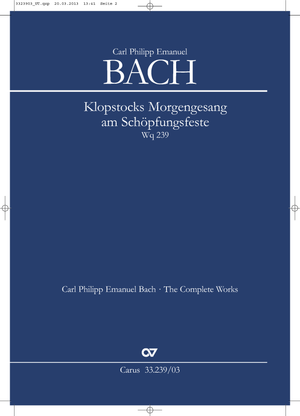
"Klopstocks Morgengesang am Schöpfungsfeste"
BR-CPEB G 1 (Wq 239), 1783
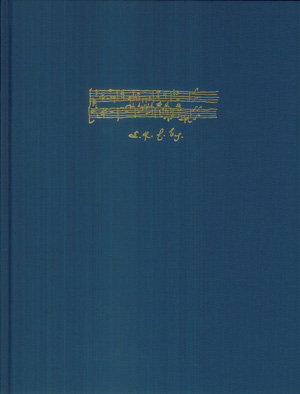
Vol. VI, 4 of the C.P.E. Bach Complete Edition, edited by the Packard Humanities Institute
The “Morgengesang am Schöpfungsfeste” Wq 239 resulted from the personal friendship between the poet F.G. Klopstock and the composer. It exudes the spirit of the end of the 18th century like almost no other work. In keeping with the spirit of the Enlightenment, a natural event – sunrise – is used as an allegory for the resurrection, giving expression to it. The natural spectacle also forms the starting point for Bach’s composition, an eight-part, through-composed cantata for two sopranos, chorus, flutes, strings, and continuo. The term “Schöpfungsfest”, or “festival of creation”, refers to Sunday as the day which commemorates the seventh day of creation. This volume of the Complete Edition contains the “Morgengesang”, the wedding cantata, and arias and chamber cantatas. The performance material for the edition contains just the "Morgengesang".
Découvrir


Acheter
Informations complémentaires sur l'œuvre
-
Compositeur
Carl Philipp Emanuel Bach
| 1714-1788L'immense oeuvre de Carl Philipp Emanuel Bach (1714–1788) jouissait, de son vivant déjà, de la faveur générale et d'une diffusion hors du commun. Ses oeuvres de jeunesse sont encore influencées par l'école de Berlin. Dans ses compositions plus tardives, il développa un style de plus en plus individuel, indépendant des courant de mode de l'époque, style que l'on trouve surtout dans les oeuvres vocales sacrées composées pendant son activité de directeur de la musique à Hambourg (1768–1788). Plus d'information sur la personne
-
Parolier/Librettiste
Friedrich Gottlieb Klopstock
| 1724-1803
Critiques
Hier warten neue Aufgaben auf ambitionierte Chorleiter. Überflüssig, die Qualität der Neuausgabe zu kommentieren: Das sprichwörtliche Carus-Niveau kennt und schätzt längst jeder seriöse Musiker.
Friedrich Storfinger, Musica Sacra, 5/2014
Die Ausgaben tragen hoffentlich dazu bei, dass die Musik am Übergang zwischen Barock und Klassik wieder mehr Beachtung findet.
Württembergische Blätter für Kirchenmusik, 6/2014
Les évaluations sur notre site web ne peuvent être effectuées que par des clients disposant d'un compte d'utilisateur enregistré. Il n'est pas vérifié si les produits évalués ont été effectivement achetés.
Aucune évaluation disponible pour ce produit.
Questions fréquentes sur l'œuvre
 Il n'y a pas encore de questions et réponses concernant cette œuvre ou vous n'avez pas trouvé la réponse à votre question sur l'œuvre ? Cliquez ici et envoyez votre question spécifique à notre service clients.