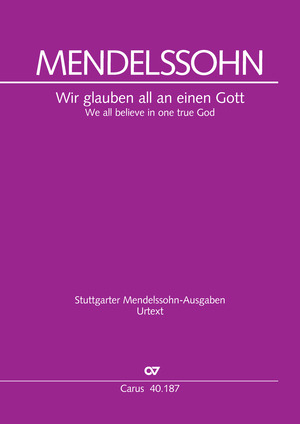
Wir glauben all an einen Gott is one of eight chorale cantatas which Mendelssohn composed to hymns. Martin Luther wrote this hymn, basing it on an older melody, and included it in services in place of the creed. Mendelssohn was enthused by the power of the old Lutheran hymns and retained their melodies as far as possible. His chorale cantatas were also inspired by his close study of the works of J.S. Bach. In order to express the power of the cantata, all the singers must be sure of their notes and enter confidently. Particularly in the first verse, it is worth holding up the tension in the long phrases and supporting it well. This only works if everything else is well-rehearsed!
Simply practice. Anytime. Everywhere.
Whether at home on your tablet or PC or on the road on your smartphone: with carus music, the Choir Coach, you always have your choral works with you to practice! With the carus music choir app, you can listen to your score together with a first-class recording on any device and easily practice your own choir part with a coach. With carus music, your concert preparation is easy, efficient and fun to master!
Performers: Kammerchor Stuttgart – Frieder Bernius
Simply practice. Anytime. Everywhere.
Whether at home on your tablet or PC or on the road on your smartphone: with carus music, the Choir Coach, you always have your choral works with you to practice! With the carus music choir app, you can listen to your score together with a first-class recording on any device and easily practice your own choir part with a coach. With carus music, your concert preparation is easy, efficient and fun to master!
Performers: Kammerchor Stuttgart – Frieder Bernius
Découvrir
 Ecouter
(3)
Ecouter
(3)
- Wir glauben all an einen Gott
- Wir glauben auch an Jesum Christ
- Wir glauben an den Heilgen Geist
 Compléments
- Acheter des compléments au format téléchargement.
-
 Texte numérique (sans notes), licence d'impression incluse, fichier html, paroles, originalfichier html, paroles, original (Extrait)1. Wir glauben all an einen Gott
Wir glauben all an einen Gott,
2. Wir glauben auch an Jesum Christ
Schöpfer Himmels und der Erden,
der sich zum Vater geben hat,
dass wir seine Kinder werden.
Er will uns allzeit ernähren,
Leib und Seel auch wohl bewahren;
allem Unfall will er wehren,
kein Leid soll uns widerfahren;
er sorget für uns, hüt‘ und wacht,
es steht alles in seiner Macht.Wir glauben auch an Jesum Christ,
seinen Sohn und unsern Herren,
der ewig bei dem Vater ist,
gleicher Gott von Macht und Ehren;
von Maria, der Jungfrauen,
ist ein wahrer Mensch geboren
durch den Heilgen Geist im Glauben;
für uns, die wir warn verloren,
...
-
Texte numérique (sans notes), licence d'impression incluse, fichier html, paroles, traduction en anglaisfichier html, paroles, traduction en anglais (Extrait)1. We all believe in one true God
We all believe in one true God,
2. And we believe in Jesus Christ
maker of the earth and heaven,
who is our Father and our Lord,
that we may be called his children.
He will at all times sustain us.
Soul and body’s watchful guardian
from all evil will defend us,
that sorrow have no dominion;
and keep us in his love and care,
for all creatures are in his power.And we believe in Jesus Christ,
his own son and our Redeemer,
who dwells with God the Father blest,
like to him in power and honor,
who of Mary, virgin lowly,
as true man was born among us
by god’s spririt, hope most holy,
redemption from sin to bring us,
...
-
Texte numérique (sans notes), licence d'impression incluse, fichier html, Texte introductif, françaisfichier html, Texte introductif, français (Extrait)Texte du livret du CD Carus 83.216
Thomas Schmidt-Beste
Traduction (abrégée) : Sylvie CoquillatÀ partir de 1820, Félix Mendelssohn Bartholdy, alors âgé de onze ans, suit les cours de composition de Carl Friedrich Zelter, chef de la Singakademie de Berlin. La méthode d’enseignement favorite est dès le début l’étude et l'imitation créative de compositeurs et d’œuvres considérés comme exemplaires ; un parti pris naturellement logique pour la musique sacrée, étant donné que les genres correspondants étaient de toute manière plus étroitement liés à la tradition que les genres « modernes » comme le quatuor à cordes ou la symphonie. Rappelons que Mozart avait déjà étudié Haendel et Bach, et que le début du 19ème siècle est en général une époque de retour historique à la musique sacrée « ancienne ». Le contrepoint rigoureux était resté quoi qu’il en soit un élément indispensable de la polyphonie vocale. Rien d’étonnant donc au fait de trouver aussi des
...
-
Texte numérique (sans notes), licence d'impression incluse, fichier html, Texte introductif, en anglaisfichier html, Texte introductif, en anglais (Extrait)Text from the CD Carus 83.216
Thomas Schmidt-Beste
Translation (abridged): Elizabeth RobinsonBeginning in 1820, when he was eleven years old, Felix Mendelssohn Bartholdy received composition lessons from the director of the Berlin Singakademie, Carl Friedrich Zelter. From the beginning, the preferred method of teaching was the study and creative imitation of composers and works considered exemplary; for sacred music, the links to the relevant forms of the tradition were much closer than with the “modern” genres such as the string quartet or symphony. After all, Mozart had immersed himself in the works of Handel and Bach, and the early 19th century is generally regarded as the period of historical reassessment of “early” church music. And it goes without saying that strict counterpoint had always remained an essential component of vocal polyphony. So it is not surprising that sacred works were amongst the earliest independent
...
-
Texte numérique (sans notes), licence d'impression incluse, fichier html, Texte introductif, en allemandfichier html, Texte introductif, en allemand (Extrait)Booklet-Text der CD Carus 83.216
Thomas Schmidt-Beste
Seit 1820 erhielt der zu diesem Zeitpunkt elfjährige Felix Mendelssohn Bartholdy Kompositionsunterricht bei dem Leiter der Berliner Singakademie, Carl Friedrich Zelter. Die bevorzugte Lehrmethode war von Anfang an das Studium und die kreative Nachahmung von als vorbildhaft verstandenen Komponisten und Werken; für die geistliche Musik lag dies natürlich besonders nahe, da die entsprechenden Gattungen der Tradition ohnehin weit enger verbunden waren als die ‚modernen’ Genres, etwa Streichquartett oder Sinfonie. Immerhin hatte sich schon Mozart mit Händel und Bach befasst, und das frühe 19. Jahrhundert ist generell die Zeit der historistischen Rückbesinnung auf ‚alte’ Kirchenmusik – nicht nur die Händels und Bachs, sondern auch die noch weiter zurückliegender Epochen, bis hin zu Giovanni Pierlugi da Palestrina und Tomás Luis de Victoria. Und der strenge Kontrapunkt war
...
Acheter
Informations complémentaires sur l'œuvre

-
Compositeur
Felix Mendelssohn Bartholdy
| 1809-1847Felix Mendelssohn Bartholdy (1809-1847) compte parmi les compositeurs les plus importants du romantisme musical. Son œuvre allie la clarté formelle du classicisme viennois à la puissance expressive propre au XIXe siècle. Son étude de la musique de Jean-Sébastien Bach a eu une influence particulièrement marquante ; il a d’ailleurs largement contribué à la redécouverte de cette œuvre en organisant l’exécution de la Passion selon saint Matthieu en 1829.
Parmi ses compositions vocales les plus célèbres figurent ses deux oratorios, Paul et Élie, ainsi que sa cantate chorale « Verleih uns Frieden gnädiglich ». Par ailleurs, Mendelssohn a exercé les fonctions de chef d’orchestre, de pianiste et de pédagogue musical, et a contribué de manière significative à la professionnalisation du monde des concerts ainsi qu’au développement du Conservatoire de Leipzig. Son œuvre occupe une place centrale dans l’histoire de la musique du XIXe siècle et allie le respect de la tradition à l’esthétique sonore romantique.
Plus d'information sur la personne
-
Compositeur de melodie
Martin Luther
| 1483-1546
-
Parolier/Librettiste
Martin Luther
| 1483-1546
-
Chœur
Kammerchor Stuttgart
The Kammerchor Stuttgart is regarded as one of the best ensembles of its kind. Over its fifty-year existence, Frieder Bernius has developed the choir into an exceptional ensemble acclaimed by audiences and press alike. This has led to invitations for the choir to perform at all the important European festivals. In Germany the chamber choir performs at festivals and in concert halls in repertoire ranging from the 17th to the 21st century. Frieder Bernius and his ensemble have received numerous accolades for their contribution to new music. The Kammerchor Stuttgart has made over 80 CDs and LPs, numerous of which have been awarded international recording prizes (including the Edison award, Diapason d’or, Gramophone Choice, Classical Internet Award, International Classical Music Award, and German Record Critics’ Award prizes). The International Federation for Choral Music has invited the ensemble to sing at the 1st, 4th and 10th World Symposia on Choral Music in Vienna, Sydney and Seoul. Regular tours of North America and Asia since 1988 and a South America tour reflect the Kammerchor Stuttgart’s international reputation. Since 1984 the top ensemble has also been invited to Israel biennially. Plus d'information sur la personne
-
Chef d'orchestre
Frieder Bernius
| 1947Le travail de Frieder Bernius jouit d’une grande reconnaissance à l’échelle mondiale. Il est très sollicité à l’international, tant comme chef d’orchestre que comme professeur. Ses partenaires artistiques sont principalement le Chœur de chambre de Stuttgart, l’Orchestre baroque de Stuttgart, la Hofkapelle de Stuttgart et la Philharmonie classique de Stuttgart. C’est en 1968, avec la création du Chœur de chambre de Stuttgart, qu’il a posé les bases de sa carrière exceptionnelle, qu’il a rapidement fait de cet ensemble l’un des plus éminents de son genre. Qu’il s’agisse d’œuvres vocales de Monteverdi, Bach, Haendel, Mozart, Beethoven, Fauré et Ligeti, de musiques de théâtre de Mendelssohn ou de symphonies de Haydn, Burgmüller et Schubert, le travail de Frieder Bernius vise toujours un son à la fois fidèle à l’idéal sonore original et d’une personnalité incomparable. Il se consacre aussi bien à la redécouverte d’opéras du XVIIIe siècle qu’aux créations de compositions contemporaines. Il porte un intérêt particulier à l’histoire de la musique du sud-ouest de l’Allemagne. Le travail de Frieder Bernius est largement documenté sur disques et CD sous le label Carus. De nombreux enregistrements ont été récompensés par des prix internationaux. Dans le cadre du Festival choral allemand de Stuttgart, Frieder Bernius s’est vu décerner un CD d’or par les éditions Carus pour son intégrale de la musique vocale sacrée de Felix Mendelssohn Bartholdy. Plus d'information sur la personne
Les évaluations sur notre site web ne peuvent être effectuées que par des clients disposant d'un compte d'utilisateur enregistré. Il n'est pas vérifié si les produits évalués ont été effectivement achetés.
Aucune évaluation disponible pour ce produit.
Questions fréquentes sur l'œuvre
 Il n'y a pas encore de questions et réponses concernant cette œuvre ou vous n'avez pas trouvé la réponse à votre question sur l'œuvre ? Cliquez ici et envoyez votre question spécifique à notre service clients.