

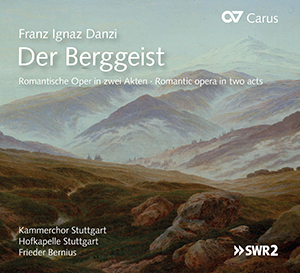
Der Berggeist
Romantische Oper in zwei Akten
 Ecouter
(21)
Ecouter
(21)
- Ouverture
- Szene (Rübezahl, Der Geist, Chor der Gnomen)
- Chor der Jünglinge und Mädchen
- Lied (Anne, Chor)
- Septett (Jacob und Marthe, Anne und Heinrich, Rübezahl, Konrad und Hanns)
- Arie (Jacob)
- Rezitativ und Arie (Anne)
- Duett (Anne, Heinrich)
- Finale 1. Akt (Die Nixen, Pux, Meerungeheuer)
- Lied der Gnomen (Url, Chor)
- Terzett (Jacob, Anne, Heinrich)
- Terzett (Jacob, Konrad, Marthe)
- Arie (Pux)
- Arie (Heinrich)
- Chor der Gnomen
- Szene (Anne)
- Chor (Chor der Gnomen, Anne, Eine Stimme, Heinrichs Stimme)
- Rezitativ und Arie (Rübezahl, Chor)
- Orchesterstück
- Nachtwächter
- Finale
Sommaire
-
Compositeur
Franz Danzi
| 1763-1826
-
Parolier/Librettiste
Karl von Lohbauer
-
L'auteur de l'avant-propos
Joachim Kremer
-
L'auteur de l'avant-propos
Bernd Schmitt
-
Chœur
Kammerchor Stuttgart
The Kammerchor Stuttgart is regarded as one of the best ensembles of its kind. Over its fifty-year existence, Frieder Bernius has developed the choir into an exceptional ensemble acclaimed by audiences and press alike. This has led to invitations for the choir to perform at all the important European festivals. In Germany the chamber choir performs at festivals and in concert halls in repertoire ranging from the 17th to the 21st century. Frieder Bernius and his ensemble have received numerous accolades for their contribution to new music. The Kammerchor Stuttgart has made over 80 CDs and LPs, numerous of which have been awarded international recording prizes (including the Edison award, Diapason d’or, Gramophone Choice, Classical Internet Award, International Classical Music Award, and German Record Critics’ Award prizes). The International Federation for Choral Music has invited the ensemble to sing at the 1st, 4th and 10th World Symposia on Choral Music in Vienna, Sydney and Seoul. Regular tours of North America and Asia since 1988 and a South America tour reflect the Kammerchor Stuttgart’s international reputation. Since 1984 the top ensemble has also been invited to Israel biennially. Plus d'information sur la personne
-
Orchestre
Hofkapelle Stuttgart
La Hofkapelle Stuttgart, créée en 2006 par Frieder Bernius pour compléter le Barockorchester Stuttgart, se consacre au répertoire du 19ème siècle sur des instruments historiques. Un centre de gravité est la redécouverte de trésors de l’histoire de la musique, notamment dans la région du sud-ouest de l’Allemagne (Kalliwoda, Knecht, Holzbauer). Hofkapelle et Barockorchester Stuttgart sont les hôtes réguliers de festivals internationaux (Rome, Salzbourg, Göttingen, Dresde). Leurs productions pour le CD se sont vues décerner des prix à plusieurs reprises : la Missa Dei Patris de Jan Dismas Zelenka a été nominée pour le Cannes Classical Award, la musique de scène du Songe d’une Nuit d’été de Félix Mendelssohn Bartholdy d’après Shakespeare a été distinguée par Rondo et a remporté l’Étoile du mois de la revue Fono Forum. Le Requiem de W.A. Mozart a obtenu le Diapason d’or de l’année 2003, l’opéra de Johann Gottlieb Naumann Aci e Galatea a été nommé enregistrement d’opéra de l’année dans la revue spécialisée Opernwelt, l’Oratorio de Pâques de Bach figure dans la liste des meilleurs enregistrements du prix de la Critique allemande du disque. L’enregistrement de la Messe en si mineur de Bach a été editors choice de la revue Gramophone. Plus d'information sur la personne
-
Chef d'orchestre
Frieder Bernius
| 1947Le travail de Frieder Bernius jouit d’une grande reconnaissance à l’échelle mondiale. Il est très sollicité à l’international, tant comme chef d’orchestre que comme professeur. Ses partenaires artistiques sont principalement le Chœur de chambre de Stuttgart, l’Orchestre baroque de Stuttgart, la Hofkapelle de Stuttgart et la Philharmonie classique de Stuttgart. C’est en 1968, avec la création du Chœur de chambre de Stuttgart, qu’il a posé les bases de sa carrière exceptionnelle, qu’il a rapidement fait de cet ensemble l’un des plus éminents de son genre. Qu’il s’agisse d’œuvres vocales de Monteverdi, Bach, Haendel, Mozart, Beethoven, Fauré et Ligeti, de musiques de théâtre de Mendelssohn ou de symphonies de Haydn, Burgmüller et Schubert, le travail de Frieder Bernius vise toujours un son à la fois fidèle à l’idéal sonore original et d’une personnalité incomparable. Il se consacre aussi bien à la redécouverte d’opéras du XVIIIe siècle qu’aux créations de compositions contemporaines. Il porte un intérêt particulier à l’histoire de la musique du sud-ouest de l’Allemagne. Le travail de Frieder Bernius est largement documenté sur disques et CD sous le label Carus. De nombreux enregistrements ont été récompensés par des prix internationaux. Dans le cadre du Festival choral allemand de Stuttgart, Frieder Bernius s’est vu décerner un CD d’or par les éditions Carus pour son intégrale de la musique vocale sacrée de Felix Mendelssohn Bartholdy. Plus d'information sur la personne
-
Solist - soprano
Sarah Wegener
-
Solist - soprano
Vincent Frisch
Vincent Frisch is a member of the boys' choir collegium iuvenum Stuttgart (cis). The choir was founded in 1989. Working with around about 180 boys and young men, the choir’s musical aims are to perpetuate the heritage and riches of sacred choral music from many epochs at the highest artistic level. As well as this, choral singing contributes greatly to the personal development of the singers. Friedemann Keck, a retired university music director, school and church musician, has directed the choir since 1990. The choir is supported by the Friends of the collegium iuvenum Stuttgart e.V. Plus d'information sur la personne
-
Solist - mezzo-soprano
Sophie Harmsen
-
Solist - ténor
Colin Balzer
Canadian born Colin Balzer studied singing with David Meek in Canada and Edith Wiens in Germany. He has participated in master classes given by Helmut Deutsch, Robert Tear, Elly Ameling, Brigitte Fassbaender and Christoph Prégardien. Colin Balzer has won a range of international prizes, and has embarked on a busy international concert schedule with a repertoire ranging from Monteverdi to Penderecki. He has been heard at Festivals in Baden-Baden, Aix-en-Provence and at the Early Music Festivals in Boston and Vancouver, and he regularly performs with various Canadian orchestras. He has also enjoyed considerable success as a lieder singer. He recorded his first CD, Hugo Wolf’s Italienisches Liederbuch, with Hartmut Höll. Plus d'information sur la personne
-
Solist - ténor
Tilman Lichdi
Tilman Lichdi grew up near Heilbronn; he started singing lessons with Alois Treml at the age of 18 and studied trumpet for four years with Günther Beetz in Mannheim. In 1999, he decided to study singing with Charlotte Lehmann in Würzburg, graduating with distinction. Tilman Lichdi is in demand worldwide for both concerts and opera roles. Plus d'information sur la personne
-
Solist - ténor
Robert Buckland
-
solist - baryton
Christian Immler
Christian Immler began his musical career in the Tölzer Knabenchor; he studied singing in Munich, Frankfurt and at the Department of Opera Studies of the Guildhall School of Music & Drama in London with Prof. Rudolf Piernay. In 2001, Christian Immler was awarded first prize in the Concours Nadia et Lili Boulanger in Paris. Christian Immler has performed in opera productions of the Early Music Festival in Boston, in Tel Aviv, Paris, Vienna, and at the Potsdam Opera. He also sang in the world premiere of Paul Clarke’s The Weather Man for Opera North. Most recently, he sang at the Teatro Colon in Buenos Aires and gave his debut at the BBC Proms in London. Christian Immler is passionately interested in the lied repertoire, with particular focus on the works of composers who were forced into exile. He was appointed Professor of Voice at the Conservatoire Lausanne/Fribourg. Plus d'information sur la personne
-
solist - baryton
Patrick Pobeschin
Patrick Pobeschin a étudié au Conservatoire de musique de Stuttgart auprès de Dunja Vejzovic ; d’autres impulsions importantes lui ont été données par Maria Sofianska, Carl Davis, Julia Hamari et Kathrin Prick. En qualité de pianiste et de chanteur, il a entrepris des tournées de concerts en France, en Italie, en Norvège, en Israël, au Canada et au Japon. En outre, il a participé à différentes productions pour le CD. Patrick Pobeschin est membre de l’ensemble du Staatstheater de Mayence, où il interprète entre autres Papageno dans La Flûte enchantée et Marcello dans La Bohème. Il a aussi participé à la création de l’opéra contemporain Melancholia de Georg Friedrich Haas (*1954) à l’Opéra de Paris. Plus d'information sur la personne
-
solist - baryton
Philip Niederberger
-
solist - baryton
Daniel Ochoa
The baritone Daniel Ochoa from Leipzig was a member of the Gewandhaus Children’s and Youth Choir. He studied singing with Anthony Baldwin and Hanns-Joachim Beyer. He is working closely with Michael Rhodes. Daniel Ochoa has performed in renowned concert halls; in addition, he has been invited to sing at various festivals. Concert tours have taken him to many European countries as well as to Japan. Ochoa was awarded first prize at the Albert Lortzing Competition in Leipzig, and received a scholarship from the Richard Wagner Foundation. Plus d'information sur la personne
-
Narrateur
Bernd Schmitt
Critiques
Frieder Bernius hat mit Kammerchor und Hofkapelle Stuttgart [...] die Weltersteinspielung gewagt. Die Rollen – und das sind ziemlich viele! – sind solide mit jungen Sängern besetzt [...].
ich-habe-gehoert.blogspot.de, 3. September 2016
Frieder Bernius directs with imagination and attention to detail. He has been doing great things in Stuttgart and continues the list of accomplishment here. He has a fine, youthful cast around him, equipped with refined, clear often Mozartian-sounding voices. […] This is a very enjoyable romantic opera, deeply rooted in folkloric soil, and splendidly performed.
Jonathan Woolf, musicweb-international – Recording of the month, März 2014
Frieder Bernius […] setzt sich mit seiner ganzen dirigentischen Kompetenz für diese Wiederentdeckung ein, hält das junge Solistenensemble zu vorbildlicher Textverständlichkeit an, überzeug durchweg bei der Wahl der Tempi.
Frederik Hanssen, Opernwelt, Juli 2013
Die Einspielung macht Lust auf mehr […]
Mannheimer Morgen, 25. Juli 2013
Ein Atout der Aufführung ist - neben dem wie immer hervorragenden Stuttgarter Kammerchor - die exzellente Stuttgarter Hofkapelle.
Rémy Franck, pizzicato, Juni 2013
Es lohnt sich – nicht nur für Raritätensammler!
Benjamin Künzel, klassik.com, 4. August 2013
[…] schwingend und überzeugend dargeboten […]
G. Schunk, Das Opernglas, 5/2013
Preisfrage: Welche deutsche Oper darf man als erste romantisch nennen? Inbegriff des Genres bleibt natürlich Carl Maria von Webers geniale Förstermoritat "Der Freischütz" (1821), aber schon E.T.A. Hoffmanns Märchenspiel "Undine" (1816) wäre ein guter Kandidat. Nun bringt Frieder Bernius, unermüdlich im Aufspüren verschollener Schlüsselwerke, einen neuen Namen ins Spiel: Franz Danzi (1763 bis 1826), der beim berühmten Abbé Georg Joseph Vogler lernte, in München und Mannheim alle Tontricks übte und seine Laufbahn als Hofkapellmeister in Stuttgart - wo er auch Weber förderte - und Karlsruhe beschloss. Sensibel für die Wendungen des Zeitgeschmacks, erkannte Danzi früh, dass antike Stoffe, Serail-Eskapaden und französischer Pomp aus der Mode gerieten. Schon 1813, während der napoleonischen Besatzung, brachte er ein Singspiel über den urdeutschen Kraftkerl Rübezahl heraus. Gemütliche Melodien wechseln darin mit dräuender Schicksalsmacht; Geister und Nixen verbreiten Gruselstimmung und jagen mitunter die Tonarten im Rösselsprung, bis nach Blitz, Feuer und Melodrama die Welt von Menschen und Dämonen wieder einigermaßen im Lot ist. Die leicht gekürzte Ersteinspielung des Zweiakters "Der Berggeist" ist eine kleine Großtat, nicht zuletzt weil so ein weiterer musikalischer Ausgangspunkt jenes Komponisten nachzuerleben ist, der im Mai 1813 überhaupt erst geboren wurde: Richard Wagner.
Johannes Saltzwedel, KulturSPIEGEL 5/2013
Die Hofkapelle und der Kammerchor Stuttgart haben jetzt den […] Zweiakter unter Frieder Bernius aufgenommen – und zwar mit Sinn für die natürlichen und übernatürlichen Effekte von Libretto und Partitur. Etwas für das Raritätenkabinett.
Augsburger Allgemeine, 3. Mai 2013
Musikalisch erinnert diese Oper in ihrem frischen, unverkrampften, auf Natürlichkeit und Volkstümlichkeit achtenden Tonfall ebenfalls an Weber, aber eben auch an Schubert oder Schumann. Bernius lässt den Melodiker Danzi ganz zu seinem Recht kommen […]. Zuverlässig wie gewohnt der Kammerchor Stuttgart, und der Hofkapelle Stuttgart gelingt eine schlüssige Interpretation dieser Musik […].
Frank Pommer, Die Rheinpfalz, CD des Monats, 20. April 2013
Les évaluations sur notre site web ne peuvent être effectuées que par des clients disposant d'un compte d'utilisateur enregistré. Il n'est pas vérifié si les produits évalués ont été effectivement achetés.
Questions fréquentes sur l'œuvre
 Il n'y a pas encore de questions et réponses concernant cette œuvre ou vous n'avez pas trouvé la réponse à votre question sur l'œuvre ? Cliquez ici et envoyez votre question spécifique à notre service clients.