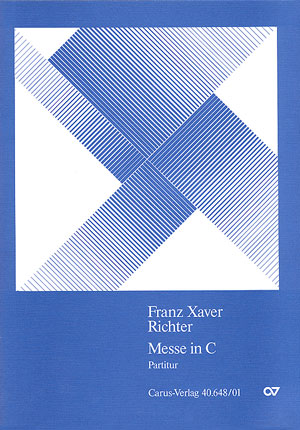
Messe en ut majeur
-
Compositeur
Franz Xaver Richter
| 1709-1789
-
Éditeur
Gerhard Weinberger
| 1948
Critiques
FRANZ XA VER RICHTER, Messe in C
Franz Xaver Richter: Messe in C
1709 im ostmährischen Holleschau geboren, ist Franz Xaver Richter der Nachwelt vor allem als führende Persönlichkeit der Mannheimer Schule und als Komponist von Symphonien und anderen Instrumentalwerken bekannt. Seine zahlreichen Kirchenmusikwerke sind demgegenüber in Vergessenheit geraten, wahrscheinlich vor allem deswegen, da die meisten als Kantatenmessen konzipierten Werke in der Liturgie nicht mehr einsetzbar waren und zum Unterschied von seinen Instrumentalwerken auch nicht im Druck erschienen sind. Vorliegende Messe in C, zum ersten Mal herausgegeben, hält sich diesbezüglich in Grenzen (Aufführungsdauer ca. 20 min); in kurzen Abschnitten werden Soll und Chor gegenübergestellt, nur zwei längere ariose Teile (Patrem omnipotentem - Basssolo, Benedictus -Sopransolo) und eine etwas länger ausgeformte Fuge fallen auf wie auch das Kyrie, wo auf den gesamten vertonten Kyrietext in 3/2-Takt (Lento) ein Allegro im 4/4-Takt folgt. Streicher, zwei Oboen und Basso continuo begleiten Soli und Chor, die meist homophon komponiert sind. Zur Aufnahme in das Repertoire unserer Chöre nur zu empfehlen, noch dazu, wo sich das Aufführungsmaterial durch Übersichtlichkeit und hervorragendes Druckbild auszeichnet.
W. Sengstschmid
Quelle: Singende Kirche 2/86, S. 92
Franz Xaver Richter, like most composers of the Mannheim School, is known today only through his instrumental compositions – symphonies, concertos, quartets, etc. However, his church music (over 100 compositions, including Masses, cantatas, motets, offertories, and psalms) „is at the heart of his creative work and is equal in quality to his secular instrumental music.” Scored for SATB chorus and soloists, two violins, viola, two oboes, and basso continuo (cello, bass, bassoon, and organ), the ”Mass in C” is a Missa brevis, probably an early work of the composer, who also favored the larger-scale cantata Mass. In this attractive work, Richter’s choral writing resembles that found in Hammerschmidt’s sacred concertos -cantabile melody, straight forward rhythm, and prevailingly homophonic texture. Fugues occur at the expected places, the longest at the end of the Credo, and there is an interesting harmonic treatment of the ”et incarnatus”, Richter’s choral style is not difficult: only the Benedictus solo needs a trained singer for its lengthy, ornamented lines. The edition, based on a set of non-autograph manuscript performance parts, is carefully done.
Jane Schatkin Hettrick
Quelle: The American Organist 3/1993, S. 75
Les évaluations sur notre site web ne peuvent être effectuées que par des clients disposant d'un compte d'utilisateur enregistré. Il n'est pas vérifié si les produits évalués ont été effectivement achetés.
Questions fréquentes sur l'œuvre
 Il n'y a pas encore de questions et réponses concernant cette œuvre ou vous n'avez pas trouvé la réponse à votre question sur l'œuvre ? Cliquez ici et envoyez votre question spécifique à notre service clients.