

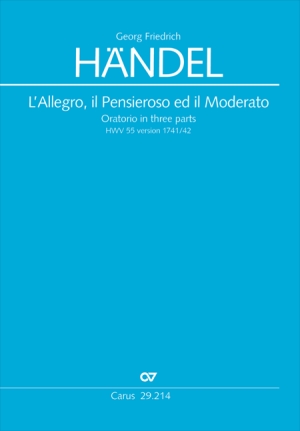
L'Allegro, il Pensieroso ed il Moderato
Oratorio in three parts HWV 55, 1740
C’est un des plus beaux oratorios écrits par Händel, et il reste encore trop rarement joué : L’Allegro, il Penseroso ed il Moderato date du début de 1740, un an avant le Messiah, alors que l’avènement de l’oratorio se superpose au déclin de l’opéra italien. Le titre italien et le découpage en trois parties de l’oratorio en anglais rappellent encore l’opéra. Discussion allégorique dont les première et deuxième parties décrivent les caractères opposés que sont allegro/la gaieté et pensieroso/la mélancolie, elle propose dans la troisième partie la synthèse moderato/modération comme un juste compromis. Charles Jennens, futur librettiste du Messiah, réarrange les poèmes L’Allegro et Il Penseroso de John Milton pour le livret et y ajoute une nouvelle troisième partie (Il Moderato). L’œuvre n’a pas d’intrigue, elle traite de l’effet de la musique et de l’humain, du trop humain : convivialité, bonne humeur, activités sociales, solitude, mélancolie, caractère songeur.
Händel accueille ce kaléidoscope de différentes humeurs avec un langage musical imagé où les instruments obligés tiennent un grand rôle. Air et partie instrumentale s’unissent, dans une chasse effrénée avec le cor solo, une charmante nuit avec une flûte gazouillante ou dans le duo As steels the morn avec soprano/hautbois et ténor/basson.
Cette édition est une réimpression révisée de l’édition de Friedrich Chrysander, la réduction piano-chant est de Helmut Bornefeld.
Découvrir

 Ecouter
(29)
Ecouter
(29)
- 3. Aria (Soprano): Come, thou goddess fair and free
- 9. Accompagnato (Soprano): Come, pensive nun
- 21. Aria (Soprano): Far from all resort of mirth
- 33. Aria (Tenore): There let Hymen oft appear
- Ouverture: Concerto grosso op. 6,1
- 1. Accompagnato (Tenore): Hence! loathed Melancholy
- 2. Accompagnato (Soprano): Hence! vain deluding Joys
- 4. Aria (Soprano): Come rather, goddess, sage and holy
- 5. Aria (Tenore): Haste thee, nymph
- 6. Chorus: Haste thee, nymph
- 7. Aria (Tenore): Come, and trip it
- 8. Chorus: Come, and trip it it
- 10. Aria (Soprano): Come, but keep thy wonted state
- 11. Accompagnato & Aria (Soprano): There held in holy passion still
- 12. Chorus: And join with thee
- 13. Recitativo (Tenore): Hence! loathed Melancholy
- 14. Recitativo (Soprano): And if I give thee honour due
- 15. Aria (Soprano): Mirth, admit me of thy crew
- 16. Accompagnato (Soprano): First, and chief, on golden wing
- 17. Aria (Soprano): Sweet bird, that shun’st the noise of folly
- 18. Recitativo (Basso): If I give thee honour due
- 19. Aria (Basso): Mirth, admit me of thy crew
- 20. Aria (Soprano): Oft on a plat of rising ground
- 22. Recitativo (Tenore): If I give thee honour due
- 23. Siciliana (Tenore): Let me wander, not unseen
- 24. Aria (Soprano): Straight mine eye hath caught new pleasures
- 25. Accompagnato (Basso): Mountains, on whose barren breast
- 26. Aria (Soprano): Or let the merry bells ring round
- 27. Chorus: And young and old come forth to play
 Compléments
- Acheter des compléments au format téléchargement.
-
 Texte numérique (sans notes), licence d'impression incluse, fichier html, paroles, originalfichier html, paroles, original (Extrait)
Parte Prima
L’Allegro 1. Accompagnato (Tenore) Hence! loathed Melancholy,
of Cerberus and blackest midnight born,
in Stygian Cave forlorn
’mongst horrid shapes, and shrieks,
and sights unholy!
Find out some uncouth cell,
where brooding darkness spreads
his jealous wings,
and the night Raven sings;
there under Ebon shades,
and lowbrow’d Rocks,
as ragged as thy Locks,
in dark Cimmerian desert ever dwell.Il Penseroso 2. Accompagnato (Soprano) Hence! vain deluding Joys,
dwell in some idle brain,
...
-
Texte numérique (sans notes), licence d'impression incluse, fichier html, Texte introductif, en anglaisfichier html, Texte introductif, en anglais (Extrait)Text from the CD Carus 83.395
Markus Schwering
Translation: David KosvinerThe winter of 1740 was a severe one for the Londoners: the British capital experienced the worst cold in human memory, and the Thames was frozen over for several weeks. In the figurative sense, too, Handel had every reason to tremble – namely for the success of the new vocal work which he had completed within 17 days in January. After all, the frost had already prevented a performance of Acis and Galatea. On 27 February however, for the premiere of L’Allegro, il Penseroso ed il Moderato, every conceivable strategic measure had been taken against the frost. As the Daily Post reported, several fires were blazing during the concert at the Theatre Royal in Lincoln’s Inn Fields – and the music must also have played a part in warming up the first audience to hear it. Its positive reception is demonstrated by the fact that L’Allegro was performed repeatedly during
...
-
Texte numérique (sans notes), licence d'impression incluse, fichier html, Texte introductif, en allemandfichier html, Texte introductif, en allemand (Extrait)Booklet-Text der CD Carus 83.395
Markus Schwering
Der Winter des Jahres 1740 war hart für die Londoner: Die britische Hauptstadt erlebte die schlimmste Kälte seit Menschengedenken, und die Themse war über Wochen hinweg zugefroren. Händel hatte allen Grund, auch im übertragenen Sinn zu zittern – nämlich um den Erfolg seines neuen Vokalwerks, das im Januar innerhalb von 17 Tagen fertiggestellt worden war. Der Frost hatte immerhin schon eine Aufführung von Acis und Galatea verhindert. Indes waren am 27. Februar, als L’Allegro, il Penseroso ed il Moderato seine Premiere hatte, alle nur denkbaren strategischen Maßnahmen gegen die Kälte ergriffen worden. Im Theatre Royal in Lincoln’s Inn Fields loderten, wie die London Daily Post berichtete, während des Konzerts mehrere Feuer. Eingeheizt haben muss den ersten Zuhörern aber auch die Musik. Dass diese gut ankam, ist allein
...
Acheter
Informations complémentaires sur l'œuvre
Sommaire
-
Compositeur
Georg Friedrich Händel
| 1685-1759Georg Friedrich Händel a démontré très tôt ses capacités de composition universelle exceptionnelles. Après s'être installé à Londres en 1712, il y créa - nommé Composer of Musick for His Majesty's Chapel Royal en 1723 - de nombreux chefs-d'œuvre pour la cour royale ainsi que ses grandes séries d'opéras : pendant des années, il connut des succès triomphants avec des opéras chantés par des interprètes d'exception ou avec des sérénades, plus tard aussi avec des oratorios comme "Saul" ou "Israel in Egypt". Au fil des années, la renommée de Haendel s'est étendue bien au-delà de son lieu de travail ; certaines de ses œuvres chorales, notamment le "Messiah", disposent d'une tradition d'exécution qui ne s'est jamais démentie et sont chantées par des chœurs du monde entier. Plus d'information sur la personne
-
Éditeur
Matthias Wamser
-
Éditeur
Friedrich Chrysander
| 1826-1901
-
Éditeur
Helmut Bornefeld
| 1906-1990Helmut Bornefeld wurde am 14. Dezember 1906 in Stuttgart-Untertürkheim geboren. Er studierte Komposition, Klavier und Kirchenmusik an der Musikhochschule in Stuttgart. Er war von 1937 bis 1971, mit einer sechsjährigen Unterbrechung durch Kriegsdienst, Kantor und Organist an der Pauluskirche in Heidenheim. 1951 übernahm er dort die Stelle als Kirchenmusikdirektor. Zusammen mit Siegfried Reda organisierte er 1946-1960 die „Heidenheimer Arbeitstage für Neue Kirchenmusik“. 1976 wurde er zum Professor ernannt. Helmut Bornefeld verstarb am 11. Februar 1990 in Heidenheim. Plus d'information sur la personne
-
Parolier/Librettiste
John Milton
| 1608-1674
-
Parolier/Librettiste
Charles Jennens
Critiques
[...] Matthias Wamser and Carus Verlag have done an excellent job in creating a new edition of the full score of this great work that combines the definitive text of the Chrysander edition with the scholarly transparency and convenience of the Hallische Händel-Ausgabe .
JAMES WINTLE Library of Congress
Quarterly Journal of the Music Library Association (U. S.), September 2010
Les évaluations sur notre site web ne peuvent être effectuées que par des clients disposant d'un compte d'utilisateur enregistré. Il n'est pas vérifié si les produits évalués ont été effectivement achetés.
Aucune évaluation disponible pour ce produit.
Questions fréquentes sur l'œuvre
 Il n'y a pas encore de questions et réponses concernant cette œuvre ou vous n'avez pas trouvé la réponse à votre question sur l'œuvre ? Cliquez ici et envoyez votre question spécifique à notre service clients.