

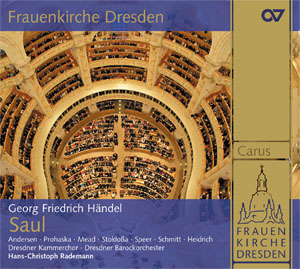
Saül fait partie des oratorios les plus dramatiques de Händel. Par son histoire poignante, l'œuvre se rapproche stylistiquement de l'opéra de l'époque comme presqu'aucun autre oratorio. Händel y transpose en musique toute la gamme des caractères, mettant aussi bien en lumière l'imprévisibilité de Saül que le tempérament vertueux de David. Le chœur est tout d'abord au centre de l'action dramatique, mais reprend également le rôle commentateur hérité des tragédies grecques. La partition demande l'orchestre le plus coloré chez Händel jusqu'alors : à l'orchestre d'opéra habituel s'ajoutent trombones, harpe, orgue, glockenspiel ainsi que timbales. Ce nouvel enregistrement, réalisé à la Frauenkirche de Dresde par d'excellents solistes, le Dresdner Kammerchor et le Dresdner Barockorchester sous la direction de Hans-Christoph Rademann, paraît dans le cadre de la série Händel.
Découvrir


 Ecouter
(86)
Ecouter
(86)
- Symphony
- Chorus: How excellent thy name
- Air (Soprano): An Infant rais’d
- Trio: Along the monster Atheist
- Chorus: The Youth inspir’d
- Chorus: How excellent
- Recit. (Michal): He comes, Air (Michal): O God-like youth!
- Recit. (Abner, Saul, David): Behold, O King
- Air (David): O King, your favours with delight
- Recit. (Jonathan): O early piety!
- Air (Merab): What abject thoughts
- Recit. (Merab): Yet think
- Air (Jonathan): Birth and fortune I despise!
- Recit. (High Priest): Go on, illustrious pair!
- Air (High Priest): While yet thy tide
- Recit. (Saul): Thou, Merab, first in birth
- Air (Merab): My soul rejects the thoughts
- Air (Michal): See with what a scornful air
- Air (Michal): Ah! lovely youth!
- Symphony
- Recit. (Michal): Already see
- Chorus: Welcome, welcome, mighty King!
- Accompagnato (Saul): What do I hear?
- Chorus: David his ten thousands slew
- Accompagnato (Saul): To him ten thousands!
- Air (Saul): With rage I shall burst
- Recit. (Jonathan, Michal): Imprudent women!
- Air (Michal): Fell rage and black despair
- Recit. (High Priest): This but the smallest part
- Accompagnato (High Priest): By thee
- Recit. (Abner): Rack’d with infernal pains
- Air (David): O Lord, whose mercies
- Symphony
- Recit. (Jonathan): ’Tis all in vain
- Air (Saul): A serpent in my bosom
- Recit. (Saul): Has he escaped my rage?
- Air (Merab): Capricious man
- Accompagnato (Jonathan): O filial piety!
- Air (Jonathan): No, cruel father, no!
- Air (High Priest): O Lord, whose providence
- Chorus: Preserve him for the glory
- Chorus: Envy! eldest born of Hell!
- Recit. (Jonathan): Ah! dearest friend
- Air (Jonathan): But sooner Jordan’s stream
- Recit. (David, Jonathan): O strange
- Air (David): Such haughty beauties
- Recit. (Jonathan): My father comes
- Recit. (Saul, Jonathan): Hast thou obey’d
- Air (Jonathan): Sin not, O King
- Air (Saul): As great Jehova lives
- Air (Jonathan): From cities storm’d
- Recit. (Jonathan, Saul): Appear, my friend
- Air (David): Your words, O King
- Recit. (Saul): Yes, he shall wed my daughter!
- Recit. (Michal): A father’s will
- Duet (Michal, David): O fairest
- Chorus: Is there a man, who all his ways
- Symphony
- Recit. (David): Thy father is as cruel
- Duet (David, Michal): At persecution
- Recit. (Michal, Doëg): Whom dost thou seek?
- Air (Michal): No, no; let the guilty tremble
- Recit. (Merab): Mean as he was
- Air (Merab): Author of peace
- Symphony
- Accompagnato (Saul): The time at length
- Recit. (Saul, Jonathan): Where is the son
- Chorus: O fatal consequence of rage
- Accompagnato (Saul): Wretch that I am
- Recit. and Accompagnato (Saul): ‘Tis said
- Recit. (Witch, Saul): With me what would’st
- Air (Witch): Infernal spirits
- Accompagnato (Samuel, Saul): Why hast thou
- Symphony
- Recit. (David, Amalekite): Whence comest
- Air (David): Impious wretch
- Dead March
- Chorus: Mourn, Israel
- Air (High Priest): O let it not in Gath be heard
- Air (Merab): From this unhappy day
- Air (David): Brave Jonathan his bow
- Chorus: Eagles were not so swift as they
- Air (Michal): In sweetest harmony
- Solo (David) and Chorus: O fatal day!
- Recit. (High Priest): Ye Men of Judah
- Chorus: Gird on thy sword
 Compléments
- Acheter des compléments au format téléchargement.
-
 Texte numérique (sans notes), licence d'impression incluse, fichier html, paroles, originalfichier html, paroles, original (Extrait)Symphony Act I Scene 1
An Epinicion, or Song of Triumph, for the victory over Goliah and the Philistines
1. Chorus of IsraelitesHow excellent thy name, O Lord,
2. Air (Soprano)
in all the world is known!
Above all heav’ns, O King ador’d,
how hast thou set thy glorious throne!An infant rais’d by thy command,
3. Chorus
to quell thy rebel foes,
could fierce Goliah’s dreadful hand
superior in the fight oppose.Along the monster atheist strode,
4. Chorus of Israelites
with more than human pride,
and armies of the living God
exulting in his strength defied.The youth inspir’d by thee, O Lord,
5. Chorus of Israelites
with ease the boaster slew;
our fainting courage soon restor’d,
and headlong drove that impious crew.How excellent thy name, O Lord,
Scene 2
in all the world is known!
Above all heav’ns, O King ador’d,
how hast thou set thy glorious throne!
Hallelujah.Saul, Jonathan, Merab, Michal, etc.; Abner introducing David; High Priest
6. Recitative (Michal)He comes, he
...
-
Texte numérique (sans notes), licence d'impression incluse, fichier html, Texte introductif, françaisfichier html, Texte introductif, français (Extrait)Texte du livret du CD Carus 83.243
David Vickers
Traduction : Sylvie CoquillatAu début des années 1730, Haendel commence à faire représenter des oratorios anglais pendant le carême, période où il était interdit de donner des opéras italiens. Jusqu’à l’été 1738, il devient évident que des représentations d’opéras italiens ne seraient pas réalisables durant la saison suivante, si bien que Haendel s’affaire à préparer une série de concerts au King’s Theatre, composée presque exclusivement d’œuvres dans le style d’oratorio. Il écrit la partition de Saül entre le 23 juillet et le 27 septembre 1738 ; son oratorio à l’intention dramatique ambitieuse inaugure la saison le 16 janvier 1739 pour être donné six fois en tout.
Charles Jennens (1699/1700–1773) rédige le livret de Saül. Il a suivi des cours à Oxford, mais un diplôme lui a été refusé car il n’a pas reconnu la légalité de la monarchie de Hanovre. Contrairement aux Jacobites
...
-
Texte numérique (sans notes), licence d'impression incluse, fichier html, Texte introductif, en anglaisfichier html, Texte introductif, en anglais (Extrait)Text from the CD Carus 83.243
David Vickers
In the early 1730s Handel began to perform English oratorios during Lent while Italian opera entertainments were forbidden. By summer 1738 it was evident that Italian opera ventures in London were not viable for the forthcoming season, so he set about preparing for a concert series at the King’s Theatre that almost entirely consisted of oratorio-style works. He composed the score of Saul between 23 July and 27 September 1738, and his ambitious dramatic oratorio opened the season on 16 January 1739, and ran for six performances.
The libretto of Saul was written by Charles Jennens (1699/1700–1773), who was educated at Oxford but prevented from gaining his degree because of his political opposition to the legitimacy of the Hanoverian monarchy. Unlike the “Jacobites,” who plotted to restore the Roman Catholic Stuarts from exile, Jennens was a staunch Protestant, and therefore
...
-
Texte numérique (sans notes), licence d'impression incluse, fichier html, Texte introductif, en allemandfichier html, Texte introductif, en allemand (Extrait)Booklet-Text der CD Carus 83.243
David Vickers
Übersetzung: Helga BesteIn den frühen 1730er Jahren begann Händel mit der Aufführung von englischen Oratorien während der Fastenzeit, während derer italienische Opern nicht aufgeführt werden durften. Bis zum Sommer 1738 wurde offensichtlich, dass Aufführungen italienischer Opern in der kommenden Saison nicht durchführbar sein würden, so dass Händel sich an die Vorbereitung einer Konzertreihe im King’s Theatre machte, die fast ausschließlich aus Werken im Oratoriumsstil bestand. Er schrieb die Partitur des Saul zwischen dem 23. Juli und 27. September 1738; sein ehrgeizig angelegtes dramatisches Oratorium eröffnete die Saison am 16. Januar 1739 und wurde sechs Mal aufgeführt.
Charles Jennens (1699/1700–1773) verfasste das Libretto für Saul. Er hatte eine Ausbildung in Oxford genossen; ein Abschluss blieb ihm jedoch verwehrt, da er die Rechtmäßigkeit der Hannoverschen Monarchie
...
-
Texte numérique (sans notes), licence d'impression incluse, fichier html, paroles, traduction allemandefichier html, paroles, traduction allemande (Extrait)Sinfonia Act I 1. Chorus
Wie groß und hehr ist, Gott, dein Nam’,
2. Air (Soprano)
ihn preiset alle Welt!
weit über alle Himmel, weit
strahlt deines hohen Thrones Glanz!Dem schwachen Jüngling rief der Herr:
3. Chorus
Erwach’ und dämpf’ der Feinde Mut.
Vergebens trotzte Goliath,
dem Gottgewählten ward der Sieg.Der Gottesleugner trat einher
4. Chorus
mit übermüt’gem Spott,
und des lebend’gen Gottes Heer,
hohnlachend trotzt der Frevler ihm.Der Jüngling stand in Gottes Kraft,
5. Chorus
erfechtend leichten Sieg.
Nun kehrt dem Heere Mut zurück,
da floh er ihm, der Frevler Schar.Wie groß und hehr ist, Gott, dein Nam’,
6. Recitative (Soprano)
ihn preiset alle Welt!
Weit über alle Himmel, weit
strahlt deines hohen Thrones Glanz!Er kommt, er kommt!
7. Air (Soprano)Heil! edler, bester Jüngling dir,
der Menschheit schönster Ruhm.
Unsterblich Heil! o Mädchen, dir,
die einst sein Arm als Braut umschließt.
Der Töchter Juda Seligste,
o wie...
Acheter
Informations complémentaires sur l'œuvre
Sommaire


-
Compositeur
Georg Friedrich Händel
| 1685-1759Georg Friedrich Händel a démontré très tôt ses capacités de composition universelle exceptionnelles. Après s'être installé à Londres en 1712, il y créa - nommé Composer of Musick for His Majesty's Chapel Royal en 1723 - de nombreux chefs-d'œuvre pour la cour royale ainsi que ses grandes séries d'opéras : pendant des années, il connut des succès triomphants avec des opéras chantés par des interprètes d'exception ou avec des sérénades, plus tard aussi avec des oratorios comme "Saul" ou "Israel in Egypt". Au fil des années, la renommée de Haendel s'est étendue bien au-delà de son lieu de travail ; certaines de ses œuvres chorales, notamment le "Messiah", disposent d'une tradition d'exécution qui ne s'est jamais démentie et sont chantées par des chœurs du monde entier. Plus d'information sur la personne
-
L'auteur de l'avant-propos
David Vickers
-
Chœur
Dresdner Kammerchor
Le Dresdner Kammerchor (Chœur de chambre de Dresde) – l’un des meilleurs chœurs d’Allemagne – est bien connu pour sa sonorité unique, faite d’une grande intensité et clarté. Rayonnement dynamique, homogénéité et transparence sonores souvent cités en exemple sont les points forts de cet ensemble demandé au niveau international. Le chœur a été créé en 1985 par Hans-Christoph Rademann et des étudiants du Conservatoire de musique « Carl Maria von Weber » de Dresde. De nombreuses tournées de concerts ont établi la notoriété de l’ensemble également hors d’Europe. En ont résulté des invitations régulières à d’importants festivals internationaux. Le répertoire du chœur va de la musique de la Renaissance à des compositions du 21ème siècle. Des interprétations de la musique chorale romantique et contemporaine ont été récompensées de prix spéciaux lors de concours internationaux, ainsi que du prix d’encouragement de la fondation Ernst von Siemens. En dehors de la pratique a cappella, le chœur de chambre se consacre intensément à la coopération avec le Dresdner Barockorchester et l’ensemble « Alte Musik Dresden », donnant des impulsions importantes à la pratique de la musique ancienne en Saxe. Une foule d’enregistrements pour la radio et pour le CD, ainsi que la coopération avec des orchestres allemands et étrangers viennent renforcer la renommée du Chœur de chambre de Dresde. Le CD paru aux Editions Carus de Stuttgart, avec le premier enregistrement mondial du Requiem en mi bémol majeur de Johann Adolf Hasse s’est vu décerner le prix de la Critique allemand du disque. Plus d'information sur la personne
-
Orchestre
Dresdner Barockorchester
Le Dresdner Barockorchester [Orchestre baroque de Dresde] a été créé en 1991 par des diplômés du Conservatoire de musique de Dresde. Au cours des années, les musiciens saxons ont révélé tout ce qu’il avaient de particulier à apporter à la scène de la musique ancienne : force émotionnelle et expressive, alliée à une musicalité éloquente, une interprétation sous un angle neuf, vivant. Les compositions de maîtres de chapelle et instrumentistes de la Chapelle de la cour de Dresde des 17ème et 18ème siècles comme Hasse, Heinichen, Zelenka, Quantz, Pisendel e. a. constituent un aspect important du répertoire du Dresdner Barockorchester. Le centre de gravité et le défi véritable pour l’ensemble est le vécu direct du concert. Plusieurs enregistrements pour le CD documentent autant l’art des interprètes que la pratique musicale éprise de magnificence de la cour baroque de Dresde. Des tournées ont conduit le Dresdner Barockorchester non seulement dans de nombreux centres musicaux d’Allemagne, mais aussi en Hollande, en Espagne, en Autriche et au Japon. Plus d'information sur la personne
-
Chef d'orchestre
Hans-Christoph Rademann
| 1965Conductor Hans-Christoph Rademann is an immensely versatile artist with a broad repertoire who devotes himself with equal passion and expertise both to the performance and rediscovery of early music and to the first performances and cultivation of Contemporary Music. Born in Dresden and raised in the Erzgebirge mountains, he was influenced at an early age by the great Central German kantorial and musical tradition. He was a student at the traditional Kreuzgymnasium, a member of the famous Kreuzchor, and studied choral and orchestral conducting at the Carl Maria von Weber University of Music in Dresden. During his studies, he founded the Dresdner Kammerchor and formed it into a top international choir which is still under his direction today. Since 2013, Hans-Christoph Rademann has been the academy director of the International Bach Academy Stuttgart. He regularly collaborates with leading choirs and ensembles of the international music scene. From 1999 to 2004 he was chief conductor of the NDR Choir and from 2007 to 2015 chief conductor of the RIAS Chamber Choir. Guest conducting engagements have led and continue to lead him to the Nederlandse Bachvereniging, the Collegium Vocale Gent, the Akademie für Alte Musik, the Freiburger Barockorchester, the Deutsche Radiophilharmonie Saarbrücken Kaiserslautern, the Sinfonieorchester Basel, the Orchestre Philharmonique de Luxembourg, among others. Hans-Christoph Rademann has been awarded prizes and honors for his artistic work, including the Johann Walter Plaque of the Saxon Music Council (2014), the Saxon Constitutional Medal (2008), the Sponsorship Prize as well as the Art Prize of the state capital Dresden (1994 and 2014 respectively). He received the Preis der Deutschen Schallplattenkritik several times for his numerous CD recordings (most recently in 2016), as well as the Grand Prix du Disque (2002), the Diapason d’Or (2006 & 2011), the CHOC de l’année 2011 and the Best Baroque Vocal Award 2014. In 2016 he was awarded the European Church Music Prize of the city of Schwäbisch Gmünd. His exemplary interpretation and recording of the complete works of Heinrich Schütz with the Dresdner Kammerchor in the Stuttgart Carus-Verlag, which was completed in 2019, was awarded the newly endowed Heinrich Schütz Prize as well as the OPUS KLASSIK 2020 in the same year. Hans-Christoph Rademann is professor of choral conducting at the Carl Maria von Weber University of Music in Dresden. He is also artistic director of the Musikfest Erzgebirge, ambassador of the Erzgebirge and patron of the Christian Hospice Service Dresden. Plus d'information sur la personne
-
Solist - soprano
Anna Prohaska
Anna Prohaska was born in Neu-Ulm on the Danube and grew up in a musical family. Whilst still at school, she took a preparatory course in singing at the Hochschule für Musik “Hanns Eisler” in Berlin. She was accepted for the Académie Européenne de Musique in Aix-en-Provence in 2003, the International Handel Academy, Karlsruhe in 2006 was an Eisler prizewinner for the interpretation of contemporary music in 2005. As well as a busy concert schedule, she has already sung in most of the major Berlin theatres. As a member of the Staatsoper unter den Linden in Berlin, she has sung roles including Papagena, Barbarina and the First Flowermaiden and First Esquire in Parsifal. Further afield, she has sung at the Mecklenburg-Vorpommern Festival, the Aachen Theatre with guest performances in Cologne, the Nationaltheater Mannheim and several times at the Lucerne Festival. Plus d'information sur la personne
-
Solist - soprano
Ditte Andersen
The young soprano Ditte Andersen was born in Copenhagen where she studied at the Royal Academy. Following her graduation in 2004, she has quickly established herself as one of the leading Scandinavian high lyric sopranos. She has performed at the Opéra Garnier in Paris, Opéra du Rhin in Strasbourg, in Brussels and Monaco. She sang the role of Blonde in Mozart’s Die Entführung aus dem Serail at the Théâtre des Champs Elysées in Paris and the Opéra de Lausanne. In Copenhagen she has sung roles in Gluck and Mozart operas. Ditte Andersen has also performed in many of the major concert halls. She joined the ensemble at the Deutsche Oper in Berlin in the 2006-07 season. Plus d'information sur la personne
-
Solist - alto
Tim Mead
Tim Mead a étudié la musicologie et le chant auprès de Charles Brett au King’s College de Cambridge. Il a ensuite obtenu plusieurs bourses au Royal College of Music de Londres et a pu y poursuivre sa formation auprès de Robin Blaze. Parmi ses plus récents engagements, entre autres les rôles-titres de Giulio Cesare pour le Glyndebourne Festival Opera et Siroe pour Oper der Zeit avec Andreas Spering, de même que le rôle-titre dans Orfeo ed Euridice de Gluck sous la direction de Marcus Creed avec l’ Akademie für Alte Musik et le rôle d’Ottone dans Il Coronazione di Poppea pour l’Opéra de Lyon sous la direction de William Christie. On a pu encore entendre Tim Mead avec l’Academy of Ancient Music sous la direction de Paul Goodwin dans la Missa Bruxellensis de Biber, dans le Messiah avec la Manchester Camerata et Nicholas Kraemer, et dans l’Occasional Oratorio avec The King’s Consort. Parmi ses enregistrements, des soli pour altus d’oeuvres chorales de Scarlatti, ainsi que des Odes de Purcell. Plus d'information sur la personne
-
Solist - ténor
Eric Stokloßa
Eric Stoklossa received his first musical training in the Dresdner Kreuzchor. He studied singing at the Hochschule für Musik “Carl Maria von Weber” in Dresden from 2000-06, graduating with a diploma. Whilst still studying, he performed in numerous productions and embarked on a busy concert schedule. He came to international attention at the Wiener Festwochen 2007 for his acclaimed portrayal of Aljeja in Janacek’s From the House of the Dead in Patrice Chéreau’s production, conducted by Pierre Boulez. He made his debut at the Holland Festival and the Aix-en-Provence Festival in this production, and will perform this role at the Teatro Massimo in Palermo, the Metropolitan Opera in New York and the Teatro alla Scala in Milan. In 2005 he was a prizewinner in masterclasses at the European Music Festival Stuttgart. Plus d'information sur la personne
-
Solist - ténor
Clemens Heidrich
Clemens Heidrich received his first musical training in the Knabenchor Dresden and later in the special music class at the Lessing-Gymnasium Hoyerswerda, Saxony. He graduated from the Hochschule für Musik “Carl Maria von Weber” in Dresden in 2002. Since then he has worked as a freelance singer, mainly in concert work. He has toured to Antwerp, Bergen (Norway), Jerusalem, Lisbon, Paris and to the “La folle journée” Festival in Tokyo. Clemens Heidrich has worked with ensembles including the Akademie für Alte Musik Berlin, Dresdner Barockorchester, Dresdner Kammerchor, Das Kleine Konzert, Kammerphilharmonie Bremen, Dresdner Kreuzchor, Dresdner Singakademie, Rheinische Kantorei and the Sächsische Staatskapelle Dresden. Plus d'information sur la personne
-
Solist - basse
Maximilian Schmitt
Maximilian Schmitt, tenor, discovered his love for music as a choirboy with the Regensburger Domspatzen. He studied singing at the Berlin University of the Arts from 1999. In 2005 and 2006 he was a member of the ‘Junges Ensemble’ at the Bayerische Staatsoper in Munich, during which period he made his solo debut at the Salzburg Landestheater as Tamino in Die Zauberflöte. Maximilian Schmitt has been engaged by the Staatstheater Mannheim from the 2008-09 season. As well as his passion for opera, he is in increasing demand as a concert singer. He has performed with the Akademie für Alte Musik Berlin, Concerto Köln, Basel Chamber Orchestra, Bavarian Radio and Mitteldeutscher Rundfunk [Central German Broadcasting] Symphony Orchestras and the Swedish Radio Symphony Orchestra. In 2009 he will once again tour with Helmuth Rilling and the Bachakademie, and will be working with the Leipzig Gewandhausorchester under Riccardo Chailly. Plus d'information sur la personne
-
Solist - basse
Yorck Felix Speer
The bass-baritone Yorck Felix Speer studied singing at the music conservatories in Hamburg and Lübeck. He has performed in numerous concerts with leading orchestras and choruses such as the Bach Collegium Munich, Staatsphilharmonie Rheinland-Pfalz [German Philharmonic Orchestra Rhineland-Palatinate] and the Norddeutscher Rundfunk Sinfonieorchester. He regularly performs throughout Europe, in France, Italy, Hungary, Austria and Switzerland. He made his debut in 2002 as Figaro in Mozart’s Le nozze di Figaro under Christian Kabitz. A further highlight was a tour with the Orchestre des Champs-Élysées and Philippe Herreweghe in autumn 2006. Yorck Felix Speer has been invited to sing the part of Christus in Bach’s St. Matthew Passion with Riccardo Chailly in 2009. Plus d'information sur la personne
Critiques
[...] Mit hervorragenden Solisten haben der Dresdner Kammerchor und das Dresdner Barockorchester unter Hans-Christoph Rademann Georg Friedrich Händels dramatisches Oratorium "Saul" eingespielt. [...]
Morgenpost am Sonntag, 11.1.2009
[...] Ohnehin ist die Art und Weise, in der Carus einige substanzielle Beiträge zum Händel-Jahr leisten will, recht sympathisch: Die Aufnahmen werden sorgfältig, detailgenau und mit erkennbarem Profil, aber nicht großspurig und marktschreierisch produziert. [...]
Matthias Hengelbrock
Fono Forum, 05/09
[...] Ein abwechslungsreiches, facettenreiches Oratorium mit dem Potenzial zu einem wirkungsvollen Bühnenstück. [...]
Musica Sacra, Heft 5/2009
Les évaluations sur notre site web ne peuvent être effectuées que par des clients disposant d'un compte d'utilisateur enregistré. Il n'est pas vérifié si les produits évalués ont été effectivement achetés.
Aucune évaluation disponible pour ce produit.
Questions fréquentes sur l'œuvre
 Il n'y a pas encore de questions et réponses concernant cette œuvre ou vous n'avez pas trouvé la réponse à votre question sur l'œuvre ? Cliquez ici et envoyez votre question spécifique à notre service clients.