
La Petite Messe solennelle est un morceau de circonstance, écrit pour l'inauguration de la chapelle privée d'un riche noble parisien. Rossini ne l'a lui-même jamais publiée. La rythmique typique de Rossini et la dramaturgie fluctuante à la manière d'un opéra offrent au chœur l'opportunité de montrer tout son savoir, à condition de maîtriser l'œuvre parfaitement.
Il suffit de s'exercer. Partout. A tout moment.
Que ce soit à la maison sur votre tablette ou votre PC ou en déplacement sur votre smartphone : avec carus music, the Choir Coach, vous avez toujours vos œuvres chorales avec vous pour vous entraîner ! Avec l'application chorale de carus music, vous pouvez écouter votre partition ainsi qu'un enregistrement de première qualité sur n'importe quel appareil et vous entraîner facilement à votre propre partie de chœur avec un coach. Avec carus music, la préparation de vos concerts est facile, efficace et amusante à maîtriser !
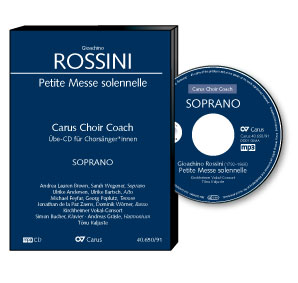
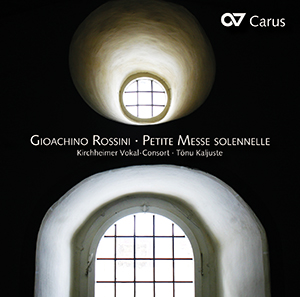
Interprètes: Andrea Lauren Brown, Sarah Wegener (soprano), Ulrike Andersen, Ulrike Bartsch (alto), Michael Feyfar, Georg Poplutz (tenore), Jonathan de la Paz Zaens, Dominik Wörner (basso) – Kirchheimer Vokal-Consort, Simon Bucher (piano), Andreas Gräsle (harmonium) – Tõnu Kaljuste
Découvrir
 Ecouter
(16)
Ecouter
(16)
- Acheter l´œuvre sous forme de CD ou de fichier à télécharger.
- Kyrie
- Gloria in excelsis Deo
- Et in terra pax
- Gratias agimus tibi
- Domine Deus
- Qui tollis
- Quoniam
- Cum Sancto Spiritu
- Credo in unum Deum
- Crucifixus
- Et resurrexit
- Et vitam venturi
- Offertorium (Prélude religieux)
- Sanctus
- O salutaris hostia
- Agnus Dei
 S`exercer
-
 carus music, the Choir Coach
Üben mit carus music
carus music, the Choir Coach
Üben mit carus music
-
Aides à l'apprentissage
-
Aides à l'apprentissage voix soprano
- Kyrie (Choir Coach)
- Gloria in excelsis Deo (Choir Coach)
- Et in terra pax (Choir Coach)
- Cum Sancto Spiritu (Choir Coach)
- Credo in unum Deum (Choir Coach)
- Et resurrexit (Choir Coach)
- Et vitam venturi (Choir Coach)
- Sanctus (Choir Coach)
- Agnus Dei (Choir Coach)
- Kyrie (Choir Coach, Slow mode)
- Gloria in excelsis Deo (Choir Coach, Slow mode)
- Et in terra pax (Choir Coach, Slow mode)
- Cum Sancto Spiritu (Choir Coach, Slow mode)
- Credo in unum Deum (Choir Coach, Slow mode)
- Et resurrexit (Choir Coach, Slow mode)
- Et vitam venturi (Choir Coach, Slow mode)
- Sanctus (Choir Coach, Slow mode)
- Agnus Dei (Choir Coach, Slow mode)
-
Aides à l'apprentissage voix alto
- Kyrie (Choir Coach)
- Gloria in excelsis Deo (Choir Coach)
- Et in terra pax (Choir Coach)
- Cum Sancto Spiritu (Choir Coach)
- Credo in unum Deum (Choir Coach)
- Et resurrexit (Choir Coach)
- Et vitam venturi (Choir Coach)
- Sanctus (Choir Coach)
- Agnus Dei (Choir Coach)
- Kyrie (Choir Coach, Slow mode)
- Gloria in excelsis Deo (Choir Coach, Slow mode)
- Et in terra pax (Choir Coach, Slow mode)
- Cum Sancto Spiritu (Choir Coach, Slow mode)
- Credo in unum Deum (Choir Coach, Slow mode)
- Et resurrexit (Choir Coach, Slow mode)
- Et vitam venturi (Choir Coach, Slow mode)
- Sanctus (Choir Coach, Slow mode)
- Agnus Dei (Choir Coach, Slow mode)
-
Aides à l'apprentissage voix tenore
- Kyrie (Choir Coach)
- Gloria in excelsis Deo (Choir Coach)
- Et in terra pax (Choir Coach)
- Cum Sancto Spiritu (Choir Coach)
- Credo in unum Deum (Choir Coach)
- Et resurrexit (Choir Coach)
- Et vitam venturi (Choir Coach)
- Sanctus (Choir Coach)
- Agnus Dei (Choir Coach)
- Kyrie (Choir Coach, Slow mode)
- Gloria in excelsis Deo (Choir Coach, Slow mode)
- Et in terra pax (Choir Coach, Slow mode)
- Cum Sancto Spiritu (Choir Coach, Slow mode)
- Credo in unum Deum (Choir Coach, Slow mode)
- Et resurrexit (Choir Coach, Slow mode)
- Et vitam venturi (Choir Coach, Slow mode)
- Sanctus (Choir Coach, Slow mode)
- Agnus Dei (Choir Coach, Slow mode)
-
Aides à l'apprentissage voix basse
- Kyrie (Choir Coach)
- Gloria in excelsis Deo (Choir Coach)
- Et in terra pax (Choir Coach)
- Cum Sancto Spiritu (Choir Coach)
- Credo in unum Deum (Choir Coach)
- Et resurrexit (Choir Coach)
- Et vitam venturi (Choir Coach)
- Sanctus (Choir Coach)
- Agnus Dei (Choir Coach)
- Agnus Dei (Choir Coach, Slow mode)
- Kyrie (Choir Coach, Slow mode)
- Gloria in excelsis Deo (Choir Coach, Slow mode)
- Et in terra pax (Choir Coach, Slow mode)
- Cum Sancto Spiritu (Choir Coach, Slow mode)
- Credo in unum Deum (Choir Coach, Slow mode)
- Et resurrexit (Choir Coach, Slow mode)
- Et vitam venturi (Choir Coach, Slow mode)
- Sanctus (Choir Coach, Slow mode)
-
 Compléments
- Acheter des compléments au format téléchargement.
-
 Texte numérique (sans notes), licence d'impression incluse, fichier html, paroles, traduction en anglaisfichier html, paroles, traduction en anglais (Extrait)1. Kyrie
Lord, have mercy on us.
2. Gloria
Christ, have mercy on us.
Lord, have mercy on us.Glory be to God on high.
And on earth peace to men
of good will.
We praise thee;
we bless thee;
we adore thee;
we glorify thee.
We give thee thanks
for thy great glory.
Lord God,
heavenly King,
God the almighty Father.
O Lord, the only begotten Son,
Jesus Christ,
O Lord God, Lamb of God,
...
-
Texte numérique (sans notes), licence d'impression incluse, fichier html, paroles, traduction allemandefichier html, paroles, traduction allemande (Extrait)1. Kyrie
Herr, erbarme dich unser.
2. Gloria
Christus, erbarme dich unser.
Herr, erbarme dich unser.Ehre sei Gott in der Höhe.
Und Friede auf Erden den Menschen,
die guten Willens sind.
Wir loben dich,
wir preisen dich,
wir beten dich an,
wir rühmen dich.Wir danken dir, denn groß ist deine Herrlichkeit.
Herr und Gott, König des Himmels,
Gott, allmächtiger Vater.
Herr Jesus Christus, eingeborener Sohn,
Herr und Gott, Lamm Gottes, Sohn des Vaters....
-
Texte numérique (sans notes), licence d'impression incluse, fichier html, paroles, originalfichier html, paroles, original (Extrait)1. Kyrie
Kyrie eleison.
2. Gloria
Christe eleison.
Kyrie eleison.Gloria in excelsis Deo.
Et in terra pax hominibus bonae voluntatis.
Laudamus te, benedicimus te, adoramus te, glorificamus te.
Gratias agimus tibi propter magnam gloriam tuam.
Domine Deus, Rex coelestis,
Deus Pater omnipotens.
Domine Fili unigenite, Jesu Christe.
Domine Deus, Agnus Dei, Filius Patris.
Qui tollis peccata mundi, miserere nobis.
Qui tollis peccata mundi, miserere nobis.
Qui tollis peccata mundi, suscipe deprecationem nostram.
Qui sedes ad dexteram Patris, miserere nobis.
Quoniam tu solus Sanctus,
tu solus Dominus, tu solus Altissimus, Jesu Christe.
Cum Sancto Spiritu, in gloria Dei Patris.
...
-
Texte numérique (sans notes), licence d'impression incluse, fichier html, Texte introductif, en anglaisfichier html, Texte introductif, en anglais (Extrait)Text from the CD Carus 83.406
Michael Wersin
Translation (abridged): Elizabeth RobinsonSacred music has evidently been entirely problematic ever since it first existed: the interconnection and intertwining of sublime texts representing the divine power of salvation, and charming melodies which directly transport the listener was already an ambivalent matter for St. Augustine throughout his life, although church music at that time was purely vocal and only in unison.
Almost a millennium and a half later, in 1863, an Italian opera composer called Gioachino Rossini was to write a setting of the Latin ordinary of the mass. He called this his Petite Messe solennelle and in a manuscript note at the beginning of the autograph score he described it as “Hélas le dernier peché mortel de ma vieillesse” (“Alas, the last mortal sin of my old age”). The ironically-intended self-criticism of the old mocker and blasphemer was by no means made in isolation, but basically reflected exactly that age-old aesthetic conflict surrounding the appropriate use of music in the liturgy, which erupted violently again in the 19th century.
Gioachino Rossini, who received a thoroughly conservative musical training at the Liceo in Bologna, and had
...
-
Texte numérique (sans notes), licence d'impression incluse, fichier html, Texte introductif, en allemandfichier html, Texte introductif, en allemand (Extrait)Booklet-Text der CD Carus 83.406
Michael Wersin
Geistliche Musik, insbesondere als Vertonung unmittelbar zur Liturgie gehöriger Texte, ist ganz offensichtlich ein „Problemfall“, seit es sie gibt: Das Mit- und Ineinander von erhabenen, das göttliche Heilswirken repräsentierenden Texten und reizvollen, den Zuhörer unmittelbar mitreißenden Melodien blieb schon für den heiligen Augustinus zeitlebens eine ambivalente Angelegenheit, obwohl Kirchenmusik damals nur einstimmig und rein vokal zu sein pflegte: „Ich schwanke […] zwischen der Gefahr des bloßen Vergnügens und der Feststellung einer heilsamen Wirkung […]. Wenn es mir jedoch zustößt, dass mich mehr der Gesang als die gesungene Sache bewegt, dann bekenne ich mich einer Sünde schuldig und würde den Sänger lieber nicht hören“, klagte er um 400 in seinen Confessiones.
Fast eineinhalb Jahrtausende später, im Jahre 1863, sollte ein italienischer Opernkomponist namens Gioachino Rossini seine von ihm selbst Petite Messe solennelle genannte Vertonung des lateinischen Messordinariums in einem handschriftlichen Vermerk am Beginn des Autographs als „leider letzte Tod-Sünde meines Alters“ („Hélas le dernier peché mortel de ma vieillesse“) bezeichnen. Die
...
Acheter
Informations complémentaires sur l'œuvre
Sommaire


-
Compositeur
Gioachino Rossini
| 1792-1868Gioachino Antonio Rossini était un compositeur italien, aujourd'hui surtout connu pour ses opéras. Rossini remporta ses premiers grands succès en 1813 à Venise avec l'opéra seria Tancredi et l'opéra buffa L'italiana in Algeri. Les années suivantes confirmèrent cette réussite. À partir de 1830, Rossini se retira presque complètement de la vie publique. Il composa encore de nombreuses œuvres, dont le Stabat mater, mais consacra principalement son temps à la bonne chère et aux plaisirs de la vie. Rossini jouit d'une immense renommée dans toute l'Europe de son vivant, mais aussi, grâce à son caractère manifestement humoristique et aimable, d'une grande popularité auprès de nombre de ses collègues. Plus d'information sur la personne
Les évaluations sur notre site web ne peuvent être effectuées que par des clients disposant d'un compte d'utilisateur enregistré. Il n'est pas vérifié si les produits évalués ont été effectivement achetés.
Aucune évaluation disponible pour ce produit.
Questions fréquentes sur l'œuvre
 Il n'y a pas encore de questions et réponses concernant cette œuvre ou vous n'avez pas trouvé la réponse à votre question sur l'œuvre ? Cliquez ici et envoyez votre question spécifique à notre service clients.