

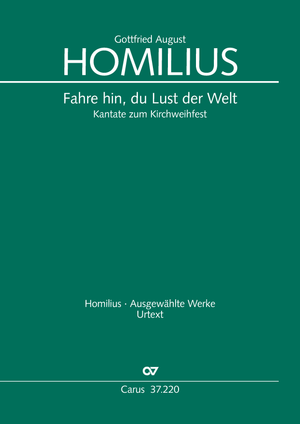
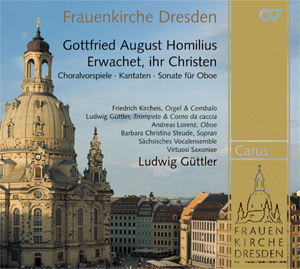
The cantata written for the consecration of a church, Fahre hin, du Lust der Welt, surely does not fit within the creative output of this Dresden Kreuzkantor. Whereas normally he was not sparing in his opulently scored, large choral movements, in spite of the festive occasion for the work, this chamber-music-like cantata of all three movements is a gem. However, Homilius composed it during the time when, as organist of the Dresden Frauenkirche he was not responsible for polyphonic music. Possibly this lively solo cantata was written on commission for a church in the suburbs of Dresden.
Découvrir
 Consulter

 Ecouter
(3)
Ecouter
(3)
- Allegro – Fahre hin, du Lust der Welt
- Recit.: Wohl dem, der seine Lebenszeit
- Allegretto – Liebster Zion
Acheter
Informations complémentaires sur l'œuvre
Sommaire
-
Compositeur
Gottfried August Homilius
| 1714-1785Gottfried August Homilius, the son of a pastor, was born in Rosenthal (Saxony) on 2 February 1714. In May 1735 he enrolled as a law student at Leipzig University. Likewise, it was probably at this time that Homilius was a pupil of Johann Sebastian Bach; the latter fact had been attested to by Johann Adam Hiller. Apart from Bach, Homilius also had contact with Johann Schneider, a Bach pupil and organist at the Nicolaikirche, for whom he also substituted. After unsuccesfully applying for a post as organist in Bautzen, Homilius was appointed organist at the Dresden Frauenkirche in 1742. In 1755 Homilius succeeded Theodor Christlieb Reinhold as Kreuzkantor and music director of the three main churches in Dresden, a position that he occupied until his death on 2 June 1785. Plus d'information sur la personne
-
Éditeur
Uwe Wolf
| 1961Uwe Wolf est un musicologue spécialisé dans les 17e et 18e siècles. Ses domaines de travail s'étendent de l'époque de Monteverdi et de Schütz au classicisme viennois en passant par Bach et la génération des fils et élèves de Bach. Depuis octobre 2011, il dirige le lectorat de la maison d'édition Carus. Auparavant, il a travaillé pendant plus de 20 ans dans la recherche sur Bach. Plus d'information sur la personne
-
Parolier/Librettiste
Erdmann Neumeister
| 1671-1756
Critiques
Homilius ist immer gut: für Ausführende, Hörende, für die Seele. Seine Musik strahlt etwas Positives aus - sie ist einfach erfreulich. ...
Friedrich Storfinger, Musica Sacra, 5/2014
... Wie bei Carus gewohnt, handelt es sich um eine hervorragend ausgestattete Ausgabe.
Gottfried Gille, Forum Kirchenmusik, Juli/August 2014
Les évaluations sur notre site web ne peuvent être effectuées que par des clients disposant d'un compte d'utilisateur enregistré. Il n'est pas vérifié si les produits évalués ont été effectivement achetés.
Aucune évaluation disponible pour ce produit.
Questions fréquentes sur l'œuvre
 Il n'y a pas encore de questions et réponses concernant cette œuvre ou vous n'avez pas trouvé la réponse à votre question sur l'œuvre ? Cliquez ici et envoyez votre question spécifique à notre service clients.