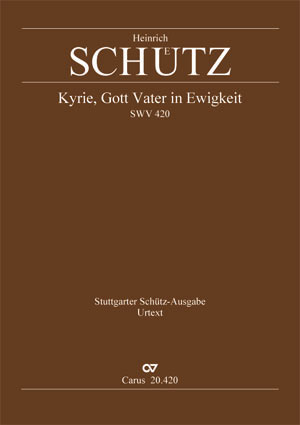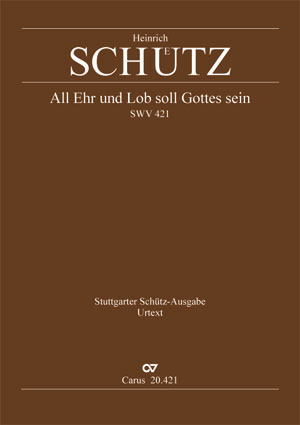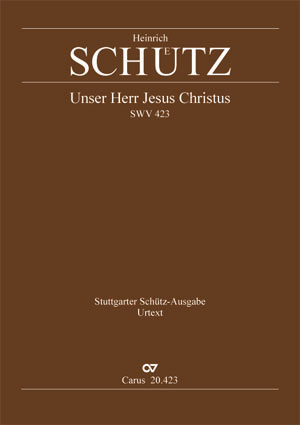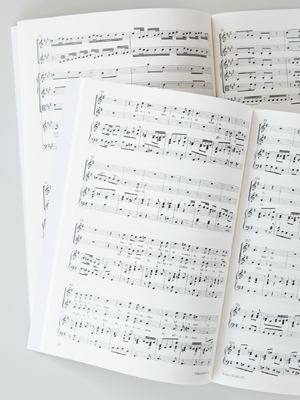
Je crois en un seul Dieu
Le Credo. Extrait de : Douze chants sacrés SWV 422, 1657

Découvrir
 Consulter
 Ecouter
(1)
Ecouter
(1)
- Je crois en un seul Dieu
 Compléments
- Acheter des compléments au format téléchargement.
-
 Texte numérique (sans notes), licence d'impression incluse, fichier html, paroles, traduction en anglaisfichier html, paroles, traduction en anglais (Extrait)
3. Ich glaube an einen einigen Gott
„Missa brevis“ deutsch – Das Credo (Nizänum) I believe in one God,
the Father Almighty,
who created earth and heaven,
and all things visible and invisible.
And I believe in one Lord Christ Jesus,
only begotten Son of God,
begotten of his Father before all the worlds,
God of God, Light of Light,
and very God from out of very God,
who was begotten, not made,
for the Son doth equal in substance the Father
by whom all things were made,
who for our salvation,
for all men and for our salvation
came down from heaven,
and who was incarnate by the Holy Ghost
of the Virgin Mary, and was made man.
...
-
Texte numérique (sans notes), licence d'impression incluse, fichier html, paroles, originalfichier html, paroles, original (Extrait)
3. Ich glaube an einen einigen Gott
„Missa brevis“ deutsch – Das Credo (Nizänum) Ich glaube an einen einigen Gott,
allmächtigen Vater,
Schöpfer Himmels und der Erden,
alles, was sichtbar und unsichtbar ist.
Und an einen einigen Herren Jesum Christum,
Gottes einigen Sohn,
der vom Vater geboren ist vor der ganzen Welt,
Gott von Gott, Licht vom Licht,
wahrhaftiger Gott vom wahrhaftigen Gott,
geboren, nicht geschaffen,
mit dem Vater einerlei Wesens,
durch welchen alles geschaffen ist,
welcher für uns Menschen
und um unsrer Seligkeit willen
vom Himmel kommen ist
und leibhaftig worden durch den Heiligen Geist
...
-
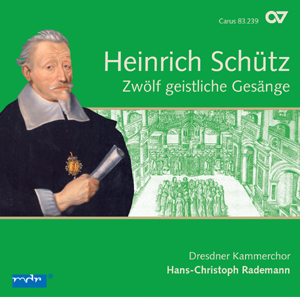
Texte numérique (sans notes), licence d'impression incluse, fichier html, Texte introductif, en anglaisfichier html, Texte introductif, en anglais (Extrait)Text from the CD Carus 83.239
Oliver Geisler
Translation: Liz RobinsonFor “practical use”: Introduction A glance at music history always reveals more than just music. For music can also be regarded as a mirror or the essence of a whole culture. Indeed, even more importantly, studying and listening to music means learning something about societies and people. How valuable, therefore, are those works which are all too readily labelled “Gebrauchsmusik” (functional music) and consigned to oblivion in favor of the compositional high points of an era. Such works offer a glimpse into the workshops, laboratories, studies and living rooms of a society. Churches, castles and reception rooms are beautiful and imposing, but they also dazzle – because they are always designed to impress. Functional music is concerned with the everyday and with “real life.” And precisely because of this, such works are still performed today, even if they at first appear less grand.
Of the Zwölf geistliche Gesänge it is said that Schütz “sketched them in his spare time.” Evidently
...
-
Texte numérique (sans notes), licence d'impression incluse, fichier html, Texte introductif, en allemandfichier html, Texte introductif, en allemand (Extrait)Booklet-Text der CD Carus 83.239
Oliver Geisler
Zum „nützlichen Gebrauch“: Einführung Ein Blick in die Musikgeschichte lässt einen immer mehr erkennen als nur Musik. Denn Musik kann auch als Spiegel oder Bündelung von Kultur insgesamt begriffen werden. Ja mehr noch: Musik zu betrachten und zu hören bedeutet, etwas über Gesellschaften zu erfahren und über Menschen. Wie wertvoll sind da jene Werke, die man als sogenannte „Gebrauchsmusik“ allzu gern zugunsten des kompositorischen Höhenkamms einer Epoche in die Versenkung schiebt! Kann man mit ihnen doch einen Blick in die Werkstätten, Experimentierstuben, Arbeits- und Wohnzimmer einer Gesellschaft erhaschen. Kirchen, Schlösser und festliche Säle sind schön und repräsentativ, sie blenden aber auch – weil sie immer schon auf Repräsentation angelegt sind. Gebrauchsmusiken haben etwas mit Alltag und dem „wahren Leben“ zu tun. Nicht zuletzt deshalb werden solche Werke auch heute noch gebraucht, auch wenn sie zunächst weniger glanzvoll
...
Acheter
Informations complémentaires sur l'œuvre
-
Compositeur
Heinrich Schütz
| 1585-1672Heinrich Schütz is regarded as the first German musician of European stature. As a choirboy from 1599 at the court of Landgrave Moritz of Hessen-Kassel, he received a thorough education. In 1608 he began a law degree in Marburg, but broke this off in 1609 in order, with the support of the Landgrave, to study composition with Giovanni Gabrieli, organist at St Mark’s in Venice. In 1613 Schütz returned to Kassel, but two years later was enticed away by Elector Johann Georg I of Saxony to the Dresden court as “Organist und Director der Musica”, where he held the position of Hofkapellmeister (court Kapellmeister) from 1617 until his death. Schütz’s great cycles of vocal works marked the high point of his reputation in Germany and northern Europe. But these represent only part of Schütz’s output; individual works are represented in printed collections with works by other composers, others only survive in manuscript, and much has been lost. The Stuttgart Schütz Edition makes available Schütz’s complete oeuvre, and all works are also published in practical Urtext editions. Plus d'information sur la personne
-
Éditeur
Günter Graulich
| 1926L'éditeur, cantor et pédagogue Günter Graulich est l'un des éditeurs importants de l'après-guerre en Allemagne. En 1972, il fonda avec son épouse Waltraud les Editions Carus-Verlag, qu'il fit évoluer d'un bureau de 2 personnes à une entreprise de près de 60 employés. Lui-même cantor pendant de longues années à l'église St Matthieu de Stuttgart, il dirigea pendant plus de 50 ans le Motettenchor Stuttgart. Il réalisa avec ce chœur plusieurs enregistrements sur disques vinyls et CD, et de nombreuses tournées à travers l'Europe et l'Amérique. Plus d'information sur la personne
-
Basse continue réalisée
Paul Horn
| 1922-2016Paul Horn war ein deutscher Kirchenmusiker, Organist, Komponist und Musikwissenschaftler. Er studierte Kirchenmusik und Orgel an der Evangelischen Kirchenmusikschule Esslingen am Neckar bei Hans-Arnold Metzger und Musikwissenschaft, Theologie und Geschichte an der Universität Tübingen. Seine berufliche Laufbahn begann als Kantor an der Evangelischen Michaelskirche in Stuttgart-Degerloch. 1954 wurde er Kantor an der Evangelischen Stadtkirche Ravensburg, eine Position, die er bis zu seiner Pensionierung innehatte. Als Musikwissenschaftler arbeitete Horn bis ins hohe Alter eng mit Carus zusammen. So stammen zahlreiche Carus-Klavierauszüge aus seiner Feder. Plus d'information sur la personne
-
Traducteur
Margaret Schubert
Les évaluations sur notre site web ne peuvent être effectuées que par des clients disposant d'un compte d'utilisateur enregistré. Il n'est pas vérifié si les produits évalués ont été effectivement achetés.
Aucune évaluation disponible pour ce produit.
Questions fréquentes sur l'œuvre
 Il n'y a pas encore de questions et réponses concernant cette œuvre ou vous n'avez pas trouvé la réponse à votre question sur l'œuvre ? Cliquez ici et envoyez votre question spécifique à notre service clients.