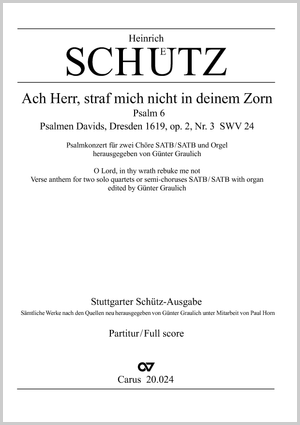
O Lord, rebuke me not in thy wrath
extrait de : Psaumes de David SWV 24, 1619
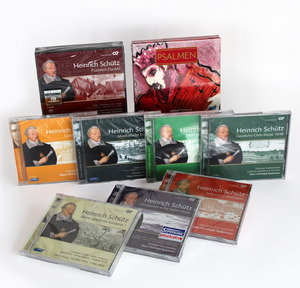
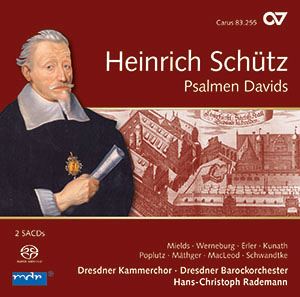
Nachdem Schütz nach dem Tode Gabrielis von seinem Aufenthalt in Venedig in seine Heimat zurückkehrte, begann er die erworbenen Eindrücke musikalisch zu verarbeiten. Vor allem das mehrchörige Musizieren war hierbei sehr wichtig, wofür die zwischen 1615 und 1619 entstandenen Psalmen Davids ein Beleg sind.
Découvrir
 Consulter
 Ecouter
(1)
Ecouter
(1)
- O Lord, rebuke me not in thy wrath
 Compléments
- Acheter des compléments au format téléchargement.
-
 Texte numérique (sans notes), licence d'impression incluse, fichier html, paroles, traduction en anglaisfichier html, paroles, traduction en anglais (Extrait)
O Lord, rebuke me not in thine anger, neither chasten me in thy hot displeasure. Have mercy upon me, O Lord; for I am weak: O Lord, heal me; for my bones are vexed. My soul is also sore vexed: but thou, O Lord, how long? Return, O Lord, deliver my soul: oh save me for thy mercies’ sake. For in death there is no remembrance of thee: in the grave who shall give thee thanks? I am weary with my groaning; all the night make I my bed to swim; I water my couch with my tears. Mine eye is consumed because of grief; it waxeth old because of all mine enemies. Depart from me, all ye workers of iniquity; for the Lord hath heard the voice of my weeping. The Lord hath heard my supplication; the Lord will receive my prayer. Let all mine enemies be ashamed and sore vexed: let them return and be ashamed suddenly.
Ps 6:2-11
Translation: King James Bible
Glory be to the Father and to the Son, and to the Holy Ghost, as it was in the beginning, is now,
...
-
Texte numérique (sans notes), licence d'impression incluse, fichier html, paroles, originalfichier html, paroles, original (Extrait)
Ach Herr, straf mich nicht in deinem Zorn und züchtige mich nicht in deinem Grimme. Herr, sei mir gnädig, denn ich bin schwach; heile mich, Herr, denn meine Gebeine sind erschrocken und meine Seele ist sehr erschrocken. Ach du, Herr, wie lang! Wende dich, Herr, und errette meine Seele, hilf mir um deiner Güte willen! Denn im Tode gedenket man dein nicht; wer will dir in der Hölle danken? Ich bin so müde von Seufzen; ich schwemme mein Bett die ganze Nacht und netze mit meinen Tränen mein Lager. Meine Gestalt ist verfallen vor Trauern und ist alt worden, denn ich allenthalben geängstet werde. Weichet von mir, alle Übeltäter; denn der Herr hört mein Weinen, der Herr hört mein Flehen, mein Gebet nimmt der Herr an. Es müssen alle meine Feinde zuschanden werden und sehr erschrecken; sich zurückekehren und zu Schanden werden plötzlich.
Ps 6,2–11
Ehre sei dem Vater und dem Sohn und auch dem...
-
Texte numérique (sans notes), licence d'impression incluse, fichier html, Texte introductif, en anglaisfichier html, Texte introductif, en anglais (Extrait)Text from the CD Carus 83.255
Oliver Geisler
Translation: Elizabeth Robinson“intended for singing”
The “Psalmen Davids” and the art of consolation Heinrich Schütz was fortunate. In the years around 1600 the number of portents of the end of the world increased. And this would also naturally affect the Dresden court, even if it sometimes seemed to be in a world of its own. Constellations of stars, curious events, cometary impacts – all these happenings were rapidly broadcast through the mass media of the Baroque – pamphlets and articles. And the more frequently there were signs giving cause for concern, the nearer the predicted end approached. In the mid-16th century, 2046 was marked out as the end. But at the time when Schütz took up his post in Dresden, the year 1625 was regarded as the point in time when the ‘last trumpet’ would sound. None of this happened – as stated, he was fortunate,...
-
Texte numérique (sans notes), licence d'impression incluse, fichier html, Texte introductif, en allemandfichier html, Texte introductif, en allemand (Extrait)Booklet-Text der CD Carus 83.255
Oliver Geisler
„zum singen gemeint“
Die Psalmen Davids und die Kunst des Zuspruchs Heinrich Schütz hatte Glück. In den Jahren um 1600 mehrten sich die Anzeichen für den Weltuntergang. Und der würde natürlich auch den Dresdner Hof betreffen, auch wenn dieser mitunter als eigener Kosmos erscheinen mochte. Sternenkonstellationen, kuriose Ereignisse, Kometeneinschläge – alle diese Geschehnisse verbreiteten sich rasant über die Massenmedien des Barock: Flugblätter und Sonderdrucke. Und je häufiger die besorgniserregenden Zeichen, desto näher rückte das prognostizierte Ende. Mitte des 16. Jahrhunderts war noch 2046 als Ende markiert. Zu jener Zeit, als Schütz in Dresden sein Amt antrat, galt das Jahr 1625 als Zeitpunkt, an dem die ‚letzte Posaune‘ erklingen würde. All das trat nicht ein – wie gesagt, er hatte Glück, aber eine Prognose bewahrheitete...
Acheter
Informations complémentaires sur l'œuvre
-
Compositeur
Heinrich Schütz
| 1585-1672Heinrich Schütz is regarded as the first German musician of European stature. As a choirboy from 1599 at the court of Landgrave Moritz of Hessen-Kassel, he received a thorough education. In 1608 he began a law degree in Marburg, but broke this off in 1609 in order, with the support of the Landgrave, to study composition with Giovanni Gabrieli, organist at St Mark’s in Venice. In 1613 Schütz returned to Kassel, but two years later was enticed away by Elector Johann Georg I of Saxony to the Dresden court as “Organist und Director der Musica”, where he held the position of Hofkapellmeister (court Kapellmeister) from 1617 until his death. Schütz’s great cycles of vocal works marked the high point of his reputation in Germany and northern Europe. But these represent only part of Schütz’s output; individual works are represented in printed collections with works by other composers, others only survive in manuscript, and much has been lost. The Stuttgart Schütz Edition makes available Schütz’s complete oeuvre, and all works are also published in practical Urtext editions. Plus d'information sur la personne
-
Éditeur
Günter Graulich
| 1926L'éditeur, cantor et pédagogue Günter Graulich est l'un des éditeurs importants de l'après-guerre en Allemagne. En 1972, il fonda avec son épouse Waltraud les Editions Carus-Verlag, qu'il fit évoluer d'un bureau de 2 personnes à une entreprise de près de 60 employés. Lui-même cantor pendant de longues années à l'église St Matthieu de Stuttgart, il dirigea pendant plus de 50 ans le Motettenchor Stuttgart. Il réalisa avec ce chœur plusieurs enregistrements sur disques vinyls et CD, et de nombreuses tournées à travers l'Europe et l'Amérique. Plus d'information sur la personne
-
Basse continue réalisée
Paul Horn
| 1922-2016Paul Horn war ein deutscher Kirchenmusiker, Organist, Komponist und Musikwissenschaftler. Er studierte Kirchenmusik und Orgel an der Evangelischen Kirchenmusikschule Esslingen am Neckar bei Hans-Arnold Metzger und Musikwissenschaft, Theologie und Geschichte an der Universität Tübingen. Seine berufliche Laufbahn begann als Kantor an der Evangelischen Michaelskirche in Stuttgart-Degerloch. 1954 wurde er Kantor an der Evangelischen Stadtkirche Ravensburg, eine Position, die er bis zu seiner Pensionierung innehatte. Als Musikwissenschaftler arbeitete Horn bis ins hohe Alter eng mit Carus zusammen. So stammen zahlreiche Carus-Klavierauszüge aus seiner Feder. Plus d'information sur la personne
-
Traducteur
David Scott
Les évaluations sur notre site web ne peuvent être effectuées que par des clients disposant d'un compte d'utilisateur enregistré. Il n'est pas vérifié si les produits évalués ont été effectivement achetés.
Aucune évaluation disponible pour ce produit.
Questions fréquentes sur l'œuvre
 Il n'y a pas encore de questions et réponses concernant cette œuvre ou vous n'avez pas trouvé la réponse à votre question sur l'œuvre ? Cliquez ici et envoyez votre question spécifique à notre service clients.