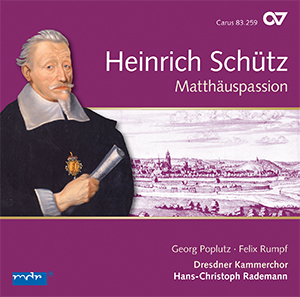
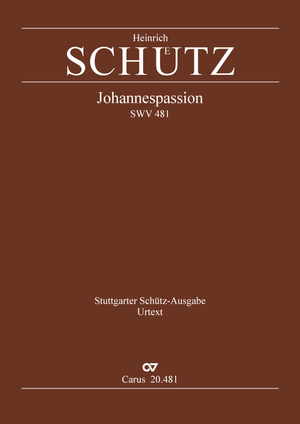
Passion selon Saint Jean
Récit des souffances et de la mort de notre Seigneur et Sauveur Jesus Christ d'après l'Evangile selon Saint Jean SWV 481, 1666
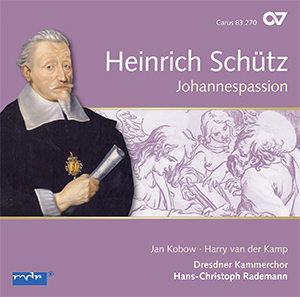
With his three purely a cappella Passions, Schütz closes his series of historical settings: text-oriented compositions that are both technically demanding and intensely expressive. These are works of maturity, which bring an entire musical period to a close. With the Stuttgarter Schütz Edition, Carus-Verlag offers the trilogy of Schütz’s Passions in critical editions with detailed information about their composition, transmission, and performance practice.
Découvrir
 Consulter
 Ecouter
(8)
Ecouter
(8)
- Introitus
- Gefangennahme Jesu (aus Vol. 13: Johannespassion)
- Jesus vor Hannas und Kaiphas, Verleugnung des Petrus
- Jesus vor Pilatus (aus Vol. 13: Johannespassion)
- Geißelung und Verspottung
- Jesu Verurteilung
- Kreuzigung und Tod
- Beschluss
 Compléments
- Acheter des compléments au format téléchargement.
-
 Texte numérique (sans notes), licence d'impression incluse, fichier html, paroles, traduction en anglaisfichier html, paroles, traduction en anglais (Extrait)
Introitus The Passion of our Lord and Saviour Jesus Christ, as we find it written in Holy Scripture in the Gospel of Saint John.
Jesus is taken prisoner Evangelist:
When Jesus had spoken these words, he went forth with his disciples over the brook Cedron, where was a garden, into the which he entered, and his disciples. And Judas also, which betrayed him, knew the place: for Jesus oft times resorted thither with his disciples. Judas then, having received a band of men and officers from the chief priests and Pharisees, cometh thither with lanterns and torches and weapons. Jesus therefore, knowing all things that should come upon him, went forth, and said unto them:
Jesus:
Whom seek ye?
Evangelist:
They answered him:
The Jews:
Jesus of Nazareth.
Evangelist:
Jesus saith unto them:
...
-
Texte numérique (sans notes), licence d'impression incluse, fichier html, paroles, originalfichier html, paroles, original (Extrait)??
Introitus Das Leiden unsers Herren Jesu Christi, wie uns das beschreibet der heilige Evangeliste Johannes.
Gefangennahme Jesu Evangelist: Da Jesus solches geredet hatte, ging er hinaus mit seinen J?ngern ?ber den Bach Kidron; da war ein Garte, darein ging Jesus und seine J?nger. Judas aber, der ihn verriet, wusste den Ort auch; denn Jesus versammlete sich oft daselbst mit seinen J?ngern. Da nun Judas zu sich genommen hatte die Schare und der Hohenpriester und Pharis?er Diener, k?mmt er dahin mit Fackeln, Lampen und mit Waffen. Da nun Jesus wusste alles, was ihm begegnen sollte, ging
...
Acheter
Informations complémentaires sur l'œuvre
Sommaire
-
Compositeur
Heinrich Schütz
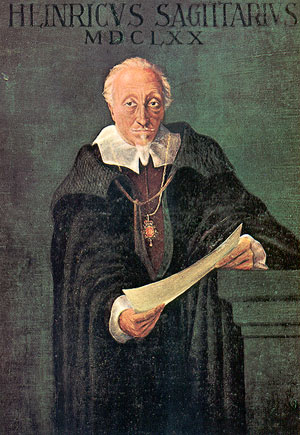
| 1585-1672Heinrich Schütz is regarded as the first German musician of European stature. As a choirboy from 1599 at the court of Landgrave Moritz of Hessen-Kassel, he received a thorough education. In 1608 he began a law degree in Marburg, but broke this off in 1609 in order, with the support of the Landgrave, to study composition with Giovanni Gabrieli, organist at St Mark’s in Venice. In 1613 Schütz returned to Kassel, but two years later was enticed away by Elector Johann Georg I of Saxony to the Dresden court as “Organist und Director der Musica”, where he held the position of Hofkapellmeister (court Kapellmeister) from 1617 until his death. Schütz’s great cycles of vocal works marked the high point of his reputation in Germany and northern Europe. But these represent only part of Schütz’s output; individual works are represented in printed collections with works by other composers, others only survive in manuscript, and much has been lost. The Stuttgart Schütz Edition makes available Schütz’s complete oeuvre, and all works are also published in practical Urtext editions. Plus d'information sur la personne
-
Éditeur
Günter Graulich
| 1926L'éditeur, cantor et pédagogue Günter Graulich est l'un des éditeurs importants de l'après-guerre en Allemagne. En 1972, il fonda avec son épouse Waltraud les Editions Carus-Verlag, qu'il fit évoluer d'un bureau de 2 personnes à une entreprise de près de 60 employés. Lui-même cantor pendant de longues années à l'église St Matthieu de Stuttgart, il dirigea pendant plus de 50 ans le Motettenchor Stuttgart. Il réalisa avec ce chœur plusieurs enregistrements sur disques vinyls et CD, et de nombreuses tournées à travers l'Europe et l'Amérique. Plus d'information sur la personne
-
Traducteur
Derek McCulloch
Les évaluations sur notre site web ne peuvent être effectuées que par des clients disposant d'un compte d'utilisateur enregistré. Il n'est pas vérifié si les produits évalués ont été effectivement achetés.
Aucune évaluation disponible pour ce produit.
Questions fréquentes sur l'œuvre
 Il n'y a pas encore de questions et réponses concernant cette œuvre ou vous n'avez pas trouvé la réponse à votre question sur l'œuvre ? Cliquez ici et envoyez votre question spécifique à notre service clients.