

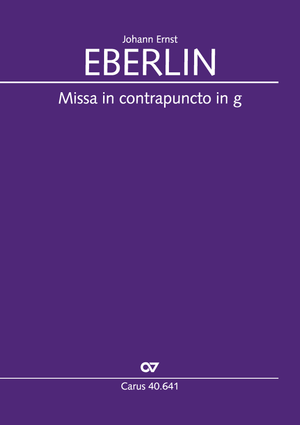
Missa in contrapuncto en sol mineur
 Consulter

-
Compositeur
Johann Ernst Eberlin
| 1702-1762
-
Éditeur
Thomas Kohlhase
| 1941
Critiques
JOHANN ERNST EBERLIN
JOHANN ERNST EBERLIN: Missa in contrapuncto, G-moll
As the title suggests, this Mass is written entirely in stile-antico style, i.e., 18th-century Fuxian counterpoint, scored for SATB chorus and basso continuo. Each movement is through-composed in motet style, and several make use of elaborate contrapuntal architecture, including double fugue, stretto. augmentation and a retrograde (cancrizans) canon in the Benedictus. This is the first edition of this Mass and one of the few of Eberlin’s more than 50 Masses available in print. The source is a set of manuscript parts copied by an unknown scribe - the editor does not mention the existence of any further sources. The pasteboard cover encasing the original partbooks bears the longer title ”Missa Caena Domini in Contra puncto”, indicating that the Mass was intended for Holy Thursday, the only day of the Lenten season that does not omit the Gloria. The shorter title used in the modern edition comes from the organ partbook. An effective performance of this Mass would depend on the ability of the singers to sustain the extended polyphonic structures of this pseudo-Renaissance style. But the music of this prolific Salzburg organist/ Kapellmeister is well worth the effort.
Jane Schatkin Hettrick
Quelle: The American Organist 3/93, S. 75
Missa in contrapuncto in g-Moll
Die Messe (Herbort Nr. V) wurde nach einer Quelle aus dem Kloster Weingarten, die 1741 von einem unbekannten Kopisten geschrieben und möglicherweise von Eberlin selbst dem Kloster Weingarten geschenkt wurde, ediert. Sie trägt den Verwendungsvermerk „Caena Domini” (für den Gründonnerstag) und enthält deshalb, im Gegensatz zu sonstigen Messen für die Advent- und Fastenzeit, auch die Vertonung des Gloria-Textes. Das Werk ist der alten vokalpolyphonen Tradition des „stilo antico” verpflichtet und im strengen kontrapunktischen Satz geschrieben. Das Benedictus ist als „Canon Cancrinus”(Krebskanon) zwischen Sopran und Tenor vertont. Die Singstimmen werden vom Generalbass (Violoncello, Contrabasso e Organo) begleitet und in der reinen Intonation unterstützt.
Quelle: Singende Kirche 3/2002, S. 144
Les évaluations sur notre site web ne peuvent être effectuées que par des clients disposant d'un compte d'utilisateur enregistré. Il n'est pas vérifié si les produits évalués ont été effectivement achetés.
Questions fréquentes sur l'œuvre
 Il n'y a pas encore de questions et réponses concernant cette œuvre ou vous n'avez pas trouvé la réponse à votre question sur l'œuvre ? Cliquez ici et envoyez votre question spécifique à notre service clients.