

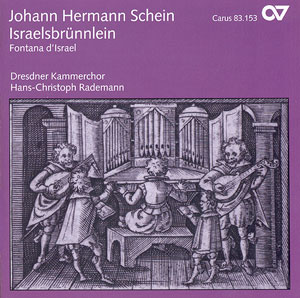
Israelsbrünnlein (Rademann)
Ce recueil de madrigaux sacrés est le pendant de la Musique sacrée pour chœur de 1648 de Heinrich Schütz, et un joyau musical de la première moitié du 17ème siècle. "Cette interprétation de 17 des 26 motets du recueil de Madrigaux par le Chœur de chambre de Dresde est remarquable ! Sonorité ronde et moelleuse, expression très intense, justesse parfaite, homogénéité du son ne sont que quelques unes de ses qualités ...." Singende Kirche, 2002
Découvrir
 Ecouter
(17)
Ecouter
(17)
- O Lord, I am your servant
- Rejoice with the wife of thy youth
- He who weeping soweth
- I will not let thee go
- Nevertheless I am continually with thee
- Turn thee unto me, have mercy upon me
- Zion said
- When Jacob had finished making
- Is Ephraim my dear son?
- My heart in God rejoices
- The days of our years are threescore and ten
- Lord, o let my cry now come before
- Behold, for peace I had great bitterness
- Three things are beautiful
- What has browed you down, o my spirit
- O, Lord Jesus Christ, do not forsake us
- Now thank we all our God
Acheter
Informations complémentaires sur l'œuvre
Sommaire


-
Compositeur
Johann Hermann Schein
| 1586-1630
-
L'auteur de l'avant-propos
Wolfram Steude
| 1931-2006
-
Chœur
Dresdner Kammerchor
Le Dresdner Kammerchor (Chœur de chambre de Dresde) – l’un des meilleurs chœurs d’Allemagne – est bien connu pour sa sonorité unique, faite d’une grande intensité et clarté. Rayonnement dynamique, homogénéité et transparence sonores souvent cités en exemple sont les points forts de cet ensemble demandé au niveau international. Le chœur a été créé en 1985 par Hans-Christoph Rademann et des étudiants du Conservatoire de musique « Carl Maria von Weber » de Dresde. De nombreuses tournées de concerts ont établi la notoriété de l’ensemble également hors d’Europe. En ont résulté des invitations régulières à d’importants festivals internationaux. Le répertoire du chœur va de la musique de la Renaissance à des compositions du 21ème siècle. Des interprétations de la musique chorale romantique et contemporaine ont été récompensées de prix spéciaux lors de concours internationaux, ainsi que du prix d’encouragement de la fondation Ernst von Siemens. En dehors de la pratique a cappella, le chœur de chambre se consacre intensément à la coopération avec le Dresdner Barockorchester et l’ensemble « Alte Musik Dresden », donnant des impulsions importantes à la pratique de la musique ancienne en Saxe. Une foule d’enregistrements pour la radio et pour le CD, ainsi que la coopération avec des orchestres allemands et étrangers viennent renforcer la renommée du Chœur de chambre de Dresde. Le CD paru aux Editions Carus de Stuttgart, avec le premier enregistrement mondial du Requiem en mi bémol majeur de Johann Adolf Hasse s’est vu décerner le prix de la Critique allemand du disque. Plus d'information sur la personne
-
Chef d'orchestre
Hans-Christoph Rademann
| 1965Conductor Hans-Christoph Rademann is an immensely versatile artist with a broad repertoire who devotes himself with equal passion and expertise both to the performance and rediscovery of early music and to the first performances and cultivation of Contemporary Music. Born in Dresden and raised in the Erzgebirge mountains, he was influenced at an early age by the great Central German kantorial and musical tradition. He was a student at the traditional Kreuzgymnasium, a member of the famous Kreuzchor, and studied choral and orchestral conducting at the Carl Maria von Weber University of Music in Dresden. During his studies, he founded the Dresdner Kammerchor and formed it into a top international choir which is still under his direction today. Since 2013, Hans-Christoph Rademann has been the academy director of the International Bach Academy Stuttgart. He regularly collaborates with leading choirs and ensembles of the international music scene. From 1999 to 2004 he was chief conductor of the NDR Choir and from 2007 to 2015 chief conductor of the RIAS Chamber Choir. Guest conducting engagements have led and continue to lead him to the Nederlandse Bachvereniging, the Collegium Vocale Gent, the Akademie für Alte Musik, the Freiburger Barockorchester, the Deutsche Radiophilharmonie Saarbrücken Kaiserslautern, the Sinfonieorchester Basel, the Orchestre Philharmonique de Luxembourg, among others. Hans-Christoph Rademann has been awarded prizes and honors for his artistic work, including the Johann Walter Plaque of the Saxon Music Council (2014), the Saxon Constitutional Medal (2008), the Sponsorship Prize as well as the Art Prize of the state capital Dresden (1994 and 2014 respectively). He received the Preis der Deutschen Schallplattenkritik several times for his numerous CD recordings (most recently in 2016), as well as the Grand Prix du Disque (2002), the Diapason d’Or (2006 & 2011), the CHOC de l’année 2011 and the Best Baroque Vocal Award 2014. In 2016 he was awarded the European Church Music Prize of the city of Schwäbisch Gmünd. His exemplary interpretation and recording of the complete works of Heinrich Schütz with the Dresdner Kammerchor in the Stuttgart Carus-Verlag, which was completed in 2019, was awarded the newly endowed Heinrich Schütz Prize as well as the OPUS KLASSIK 2020 in the same year. Hans-Christoph Rademann is professor of choral conducting at the Carl Maria von Weber University of Music in Dresden. He is also artistic director of the Musikfest Erzgebirge, ambassador of the Erzgebirge and patron of the Christian Hospice Service Dresden. Plus d'information sur la personne
-
Solist - soprano
Monika Frimmer
-
Solist - soprano
Kerstin Klein
-
Solist - alto
Kai Wessel
Kai Wessel a étudié la théorie musicale, la composition, le chant et la pratique d’exécution baroque. Il s’est produit avec des orchestres du monde entier, entre autres sous la direction de Cambreling, Christie, Corboz, Goebel, Harnoncourt, Haselböck, Henze, Herreweghe, Holliger, Koopman, McGegan, Rundel, Savall et Suzuki. Des engagements d’invité ont conduit Kai Wessel à chanter dans les plus grands festivals européens ainsi que dans les opéras de Barcelone, Nice, Dresde, Hambourg, Hanovre, Fribourg, Berlin et Bâle. Il y a chanté Theodora, Aus Deutschland, Giulio Cesare, Wie liegt die Stadt so wüste, Israel in Egypt et Actus tragicus ainsi que les créations de Schwarzerde de Klaus Huber et de Lost Highway d’Olga Neuwirth, Semele, le rôle d’Orfeo dans Orfeo ed Euridice. Plus d'information sur la personne
-
Solist - ténor
Hermann Oswald
-
Solist - basse
Andreas Scheibner
-
Solist - basse
Egbert Junghanns
-
solist - luth
Stefan Maass
Stefan Maass studied classical guitar and lute, specializing in music of the 17th and 18th centuries, both as a soloist and as a continuo player. He is Lord of Batzdorf Castle near Meißen and co-founder of the Batzdorf Hofkapelle. He regularly performs in the opera houses of Halle and Karlsruhe, the Semper Opera Dresden and the Gran Teatre del Liceu in Barcelona. His numerous CD productions include collaborations with the Dresdner Kammerchor conducted by Hans-Christoph Rademann and the Capella Sagittariana, the Dresdner Staatskapelle, Thomas Quasthoff, Daniel Hope and the contralto Britta Schwarz, as well as with the actors Corinna Harfouch and Michael Quast. Stefan Maass was awarded the prestigious Arras Prize for Art and Culture in Dresden in March 2000. Plus d'information sur la personne
-
Solist - orgue
Christine Hesse
-
Solist - violoncelle
Friedhelm Rentzsch
| 1955-2004Parcours musical : Né en 1955 à Dresde 1968-73 Fréquentation de l'école spéciale de musique de Dresde avec le violoncelle comme matière principale 1973-78 Etudes à l'école supérieure de musique de Dresde dans les matières composition et violoncelle 1978 Membre de l'orchestre philharmonique de Dresde, depuis 1990, parallèlement au service d'orchestre, actif dans le domaine de la musique ancienne en tant que violoncelliste baroque A partir de 1975, travail de composition continu, de la formation solo à l'œuvre orchestrale Plus d'information sur la personne
Les évaluations sur notre site web ne peuvent être effectuées que par des clients disposant d'un compte d'utilisateur enregistré. Il n'est pas vérifié si les produits évalués ont été effectivement achetés.
Aucune évaluation disponible pour ce produit.
Questions fréquentes sur l'œuvre
 Il n'y a pas encore de questions et réponses concernant cette œuvre ou vous n'avez pas trouvé la réponse à votre question sur l'œuvre ? Cliquez ici et envoyez votre question spécifique à notre service clients.