

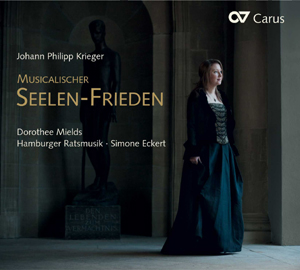
Musicalischer Seelen-Frieden. Geistliche Konzerte
 Ecouter
(16)
Ecouter
(16)
- Herr, auf dich trau ich
- Sonata Sesta - Largo
- Sonata Sesta - Vivace
- Sonata Sesta - Giacconna
- Es stehe Gott auf
- Sonata Quarta - Arioso
- Sonata Quarta - Largo
- Sonata Quarta - Presto
- Sonata Quarta - Adagio
- Sonata Quarta - Allegro
- Gott, man lobet dich in der Stille
- Sonata Quinta - Allegro
- Sonata Quinta - Allegro
- Sonata Quinta - Allegro
- Sonata Quinta - Courante
- Ecce nunc benedicite Domino
Sommaire
-
Compositeur
Johann Philipp Krieger
| 1649-1725Johann Philipp Krieger était un compositeur allemand important du haut baroque.
Il a montré très tôt son talent musical et a pris des cours de piano dès l'âge de huit ans. À 14 ans, il est parti à Copenhague pour étudier l'orgue et la composition musicale. Il a également passé deux ans en Italie pour poursuivre sa formation.
En 1677, il accepta le poste de musicien et organiste de chambre à la cour de Halle et devint vice-maître de chapelle un an plus tard. En 1680, il quitta la cour de Halle pour s'installer à Weißenburg, où il travailla comme maître de chapelle pendant 45 ans.
Pendant cette période, Krieger enregistra son répertoire sacré ainsi que des œuvres d'autres compositeurs allemands et italiens dans la collection 47 Jahrgänge Weißenburger Kirchenmusiken (47 ans de musique sacrée de Weißenburg). La majeure partie de l'œuvre de Krieger est constituée d'environ 2 500 cantates, dont 2 200 ont toutefois disparu aujourd'hui.
Krieger est considéré comme l'un des compositeurs allemands les plus importants de son époque. Son introduction des formes et des techniques de composition italiennes et françaises dans la musique allemande a eu une influence directe et déterminante sur les compositeurs qui lui ont succédé, tels que J.S. Bach et G.F. Händel.
Plus d'information sur la personne
-
L'auteur de l'avant-propos
Simone Eckert
When the 8-year-old Simone Eckert was asked what she wanted to become, she answered “a viola da gamba player.” She ignored all well-meaning exhortations to get a “real” job and now lives and works as a freelance musician close to Hamburg. Since she received her diploma in Early music in 1990 at the Schola Cantorum Basiliensis, she has been active as viola da gamba player, as artistic director, agent and manager of her ensemble Hamburger Ratsmusik, as musicologist, editor of newly rediscovered music for viola da gamba and as a music pedagogue in and around Hamburg. Simone Eckert performs at all the important festivals in Germany and in many European countries. Plus d'information sur la personne
-
Ensemble
Hamburger Ratsmusik
The ensemble Hamburger Ratsmusik has had a long and close association with Johann Philipp Krieger. After all, his operas were performed by the original group during the composer’s lifetime at the Oper am Gänsemarkt in Hamburg. Over a decade ago, the ensemble revived Krieger’s cantatas from the Bokemeyer Collection, performed them at Schloss Gottorf, and recorded them on CD. This exploratory work led to creative collaborations and friendships, as with the Krieger scholar Dr. Klaus-Jürgen Gundlach. The performance of the Musicalischer Seelen- Frieden in the place for which it was written, the Weissenfels Schlosskirche, was one of the highlights in this regard. However, the greatest surprise came from another Herr Krieger, who spoke to the Hamburger Ratsmusik musicians after a concert in Altdorf in Franconia, and then showed them his ancestors’ charter of nobility from Emperor Leopold. This CD, which the ensemble recorded with Doro thee Mields, forms part of this living tradition. In recording these concert her indescribable and committed singing, always guaranteed a thrilling experience. After 21 years of working together as an ensemble, 25 CDs – almost all world premiere recordings – numerous concerts, two Echo-Klassik awards and a growing enthusiasm for the music of the Renaissance, Baroque, and classical periods, Hamburger Ratsmusik is looking forward to more discoveries and projects. Plus d'information sur la personne
-
Chef d'orchestre
Simone Eckert
When the 8-year-old Simone Eckert was asked what she wanted to become, she answered “a viola da gamba player.” She ignored all well-meaning exhortations to get a “real” job and now lives and works as a freelance musician close to Hamburg. Since she received her diploma in Early music in 1990 at the Schola Cantorum Basiliensis, she has been active as viola da gamba player, as artistic director, agent and manager of her ensemble Hamburger Ratsmusik, as musicologist, editor of newly rediscovered music for viola da gamba and as a music pedagogue in and around Hamburg. Simone Eckert performs at all the important festivals in Germany and in many European countries. Plus d'information sur la personne
-
Solist - soprano
Dorothee Mields
Critiques
Beide CDs sind als Glanzstücke von Aufnahmen Alter Musik zu bewerten.
Klaus-Jürgen Gundlach, Forum Kirchenmusik, 6/2018
A conspicuously admirable disc.
Jonathan Woolf, musicweb-international, November 2013
No present-day singer understands German sacred music of the seventeenth century better than the soprano Dorothee Mields and, unsurprisingly therefore, no one sings it better. […] They are wonderfully engaging works, with particularly delightful interplay between instruments and solo voice. Mield's fresh, agile tone is ideal for this joyful, self-confident music. Her tuning is simply flawless […] Simone Eckert['s …] playing throughout the disc is both brilliant and sympathetic. […] a thoroughly delightful disc which is strongly recommended […]
Andrew O'Connor, International Record Review, Oktober 2013
Dorothee Mields ist die ideale Interpretin; Musik wie diese ist ihr auf den Leib geschrieben. Sie weiss jede Nuance im Text zu deuten. Dank ihrer exzellenten Diktion ist jedes Wort zu verstehen. Diese CD ist ein würdiges musikalisches Denkmal für einen grossen Meister des deutschen Barock.
Johan van Veen, Toccata, September 2013
Besser geht's nicht […] Dorothee Mields‘ hell glitzernder Sopran, der mit Leichtigkeit die anspruchsvollen Koloraturen interpretieren kann, schwebt überirdisch schön über dem Instrumentalsatz. […] Insgesamt bilden die fünf Instrumentalisten der Ratsmusik ein vollendet miteinander musizierendes Ensemble, dessen Spielfreude sich unwillkürlich auf den Hörer überträgt. Die CD ist ein absolutes Highlight dieses Jahres, dem möglichst viele Hörer zu wünschen sind.
Dr. Christiane Bayer, klassik.com, 9. Juni 2013
Lyrische Legato-Passagen werden dabei genauso bezaubernd gemeistert wie die Koloratur-Feuerwerke in den virtuosen Schlüssen der Psalmvertonungen.
BR-KLASSIK, 28. April 2013
Dorothee Mields erweckt sie mit ihrem in allen Lagen ausgewogenen Sopran ausdrucksvoll zu neuem Leben, zu dem nicht minder musikalisch gestenreich die beiden Violinen […] sowie die Continuogruppe beitragen. Unbeschwert versteht es das gesamte Ensemble, über weite Strecken Spannung aufzubauen, ohne an Lockerheit einzubüßen.
Die Tonkunst, April 2013
Mit der Kostprobe aus drei Triosonaten und vier Arien auf Psalmtexte stellt Simone Eckerts „Hamburger Ratsmusik” den mehr als achtbaren Barockmeister teils in Erstaufnahmen vor, und Dorothee Mields' herrlicher Sopran krönt die edle Tat.
Johannes Saltzwedel, Spiegel, März 2013
Les évaluations sur notre site web ne peuvent être effectuées que par des clients disposant d'un compte d'utilisateur enregistré. Il n'est pas vérifié si les produits évalués ont été effectivement achetés.
Questions fréquentes sur l'œuvre
 Il n'y a pas encore de questions et réponses concernant cette œuvre ou vous n'avez pas trouvé la réponse à votre question sur l'œuvre ? Cliquez ici et envoyez votre question spécifique à notre service clients.