

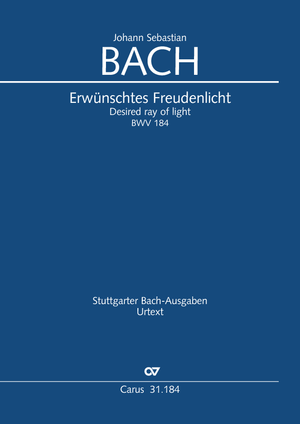
Erwünschtes Freudenlicht
Cantate pour le 3ème jour de la Pentecôte BWV 184 (BWV3 184.2), 1724
The Pentecost cantata Desired ray of light BWV 184 is based on a Köthen composition, probably a congratulatory cantata, whose instrumental parts (only these have survived) Bach reused in the Leipzig Pentecost cantata. Only the chorale setting was evidently newly composed. Despite the narrow leeway that the already finished composition left for the librettist, he nevertheless succeeded in crafting a coherent Pentecost text. The fact that the cantata begins with a long tenor accompagnato with two flutes followed by a pastoral duet is surprising. The placing of the chorale not at the end of the work but before the concluding chorus is unusual. Bach was evidently aware of the effect that the ending of this lively movement would have and wanted to retain this in its sacred form as well. The sacred version was first performed on the third day of Pentecost in 1724, probably after a parody version of another Köthen cantata (BWV 173) had already been performed on the second day of Pentecost.



Acheter
Informations complémentaires sur l'œuvre
-
Compositeur
Johann Sebastian Bach
| 1685-1750Jean-Sébastien Bach compte parmi les compositeurs les plus importants de l'histoire de la musique occidentale. Il était issu d'une dynastie de musiciens très ramifiée, qui a donné naissance à de nombreux musiciens municipaux et organistes dans la région de Thuringe et de Saxe.
Bach vocal
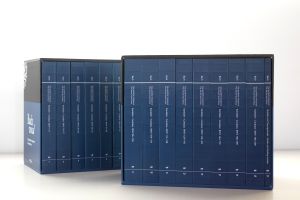
Depuis la création des éditions Carus, l’édition des œuvres de Jean-Sébastien Bach constitue pour nous une priorité particulière. À l’occasion de l’année commémorative de la Réforme, nous avons achevé le projet « Bach vocal ». La musique vocale sacrée de Bach est désormais disponible dans son intégralité sous forme d’éditions modernes « Urtext », accompagnées du matériel d’exécution. Une édition complète de toutes les partitions, présentée dans un coffret de grande qualité, est également disponible. Traduit avec DeepL.com (version gratuite)
Plus d'information sur la personne
-
Éditeur
Reinhold Kubik
| 1942-2024
-
Basse continue réalisée
Paul Horn
| 1922-2016Paul Horn war ein deutscher Kirchenmusiker, Organist, Komponist und Musikwissenschaftler. Er studierte Kirchenmusik und Orgel an der Evangelischen Kirchenmusikschule Esslingen am Neckar bei Hans-Arnold Metzger und Musikwissenschaft, Theologie und Geschichte an der Universität Tübingen. Seine berufliche Laufbahn begann als Kantor an der Evangelischen Michaelskirche in Stuttgart-Degerloch. 1954 wurde er Kantor an der Evangelischen Stadtkirche Ravensburg, eine Position, die er bis zu seiner Pensionierung innehatte. Als Musikwissenschaftler arbeitete Horn bis ins hohe Alter eng mit Carus zusammen. So stammen zahlreiche Carus-Klavierauszüge aus seiner Feder. Plus d'information sur la personne
-
L'auteur de l'avant-propos
Ulrich Leisinger
-
Traducteur
Vernon Wicker
| 1934-2024
Les évaluations sur notre site web ne peuvent être effectuées que par des clients disposant d'un compte d'utilisateur enregistré. Il n'est pas vérifié si les produits évalués ont été effectivement achetés.
Aucune évaluation disponible pour ce produit.
Questions fréquentes sur l'œuvre
 Il n'y a pas encore de questions et réponses concernant cette œuvre ou vous n'avez pas trouvé la réponse à votre question sur l'œuvre ? Cliquez ici et envoyez votre question spécifique à notre service clients.