

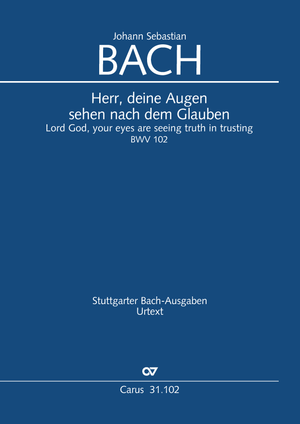
Herr, deine Augen sehen nach dem Glauben
Cantate pour le 10ème dimanche après la Trinité BWV 102, 1726
In 1726 Johann Sebastian Bach performed a series of cantatas by his Meiningen cousin Johann Ludwig, then continued this series with his own works, but remained faithful to the textual models used his cousin: a Meiningen cycle of texts by an unknown author from the early 18th century. All these texts share the characteristic of including two quotations from the bible: one from the Old Testament at the beginning, and another from the New Testament in the middle. These cantatas include "Herr, deine Augen sehen nach dem Glauben" (Lord God, your eyes are seeing truth in trusting) BWV 102. The opening chorus in several sections is one of Bach’s masterpieces of choral composition. The cantata is also one of those works on which Bach’s later reputation was based: performances are documented from 1776 in Hamburg and in Berlin by Zelter’s Sing-Akademie from 1813 onwards. In 1830 it was one of the very first cantatas by Bach to appear in print.
Découvrir
 Consulter

 Compléments
- Acheter des compléments au format téléchargement.
-
 Texte numérique (sans notes), licence d'impression incluse, fichier html, paroles, traduction en anglaisfichier html, paroles, traduction en anglais (Extrait)Parte 1ma 1 Coro
Lord God, your eyes are seeing truth in trusting.
2 Recitativo (Basso)
You smite them all, but they are grieving not,
you plague them all, but they do change nevermore.
Their face is immovable and harder than rock
and none of them are returning.Where has the image gone that God has set before us,
3 Aria (Alto)
when the prepost’rous will against him is presumpt’ous?
Where is the strength of his own word,
when all desire for good abandons mind and heart?
The Most High surely seeks with tenderness to tame us
and wants our straying mind to change from sin and darkness.
But, if we let our stubborn mind decide,
God leaves us to our heart’s own foolish pride.Woe, you spirit, who in harmful blindness stay,
>
and God’s wrath upon them gathers day by day!
Yes, they part themselves from mercy, go astray....
-
Texte numérique (sans notes), licence d'impression incluse, fichier html, paroles, originalfichier html, paroles, original (Extrait)Parte 1ma 1 Coro
Herr, deine Augen sehen nach dem Glauben!
2 Recitativo (Basso)
Du schlägest sie, aber sie fühlen's nicht;
du plagest sie, aber sie bessern sich nicht.
Sie haben ein härter Angesicht denn ein Fels
und wollen sich nicht bekehren.Wo ist das Ebenbild, das Gott uns eingepräget,
3 Aria (Alto)
wenn der verkehrte Will sich ihm zuwiderleget?
Wo ist die Kraft von seinem Wort,
wenn alle Besserung weicht aus dem Herzen fort?
Der Höchste suchet uns durch Sanftmut zwar zu zähmen,
ob der verirrte Geist sich wollte noch bequemen;
doch, fährt er fort in dem verstockten Sinn,
so gibt er ihn ins Herzens Dünkel hin.Weh der Seele, die den Schaden
nicht mehr kennt
und, die Straf auf sich zu laden,...
Acheter
Informations complémentaires sur l'œuvre
-
Compositeur
Johann Sebastian Bach
| 1685-1750Jean-Sébastien Bach compte parmi les compositeurs les plus importants de l'histoire de la musique occidentale. Il était issu d'une dynastie de musiciens très ramifiée, qui a donné naissance à de nombreux musiciens municipaux et organistes dans la région de Thuringe et de Saxe.
Bach vocal
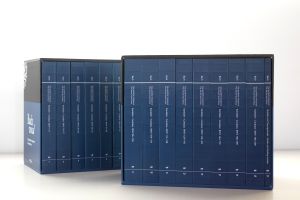
Depuis la création des éditions Carus, l’édition des œuvres de Jean-Sébastien Bach constitue pour nous une priorité particulière. À l’occasion de l’année commémorative de la Réforme, nous avons achevé le projet « Bach vocal ». La musique vocale sacrée de Bach est désormais disponible dans son intégralité sous forme d’éditions modernes « Urtext », accompagnées du matériel d’exécution. Une édition complète de toutes les partitions, présentée dans un coffret de grande qualité, est également disponible. Traduit avec DeepL.com (version gratuite)
Plus d'information sur la personne
-
Éditeur
Reinhold Kubik
| 1942-2024
-
Basse continue réalisée
Paul Horn
| 1922-2016Paul Horn war ein deutscher Kirchenmusiker, Organist, Komponist und Musikwissenschaftler. Er studierte Kirchenmusik und Orgel an der Evangelischen Kirchenmusikschule Esslingen am Neckar bei Hans-Arnold Metzger und Musikwissenschaft, Theologie und Geschichte an der Universität Tübingen. Seine berufliche Laufbahn begann als Kantor an der Evangelischen Michaelskirche in Stuttgart-Degerloch. 1954 wurde er Kantor an der Evangelischen Stadtkirche Ravensburg, eine Position, die er bis zu seiner Pensionierung innehatte. Als Musikwissenschaftler arbeitete Horn bis ins hohe Alter eng mit Carus zusammen. So stammen zahlreiche Carus-Klavierauszüge aus seiner Feder. Plus d'information sur la personne
-
Traducteur
Vernon Wicker
| 1934-2024
Les évaluations sur notre site web ne peuvent être effectuées que par des clients disposant d'un compte d'utilisateur enregistré. Il n'est pas vérifié si les produits évalués ont été effectivement achetés.
Aucune évaluation disponible pour ce produit.
Questions fréquentes sur l'œuvre
 Il n'y a pas encore de questions et réponses concernant cette œuvre ou vous n'avez pas trouvé la réponse à votre question sur l'œuvre ? Cliquez ici et envoyez votre question spécifique à notre service clients.