

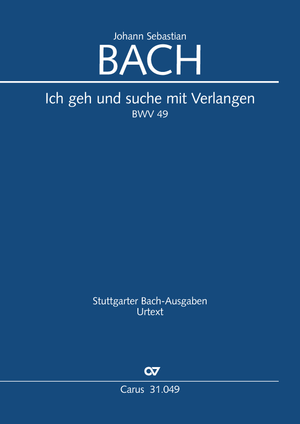
I go and search for thee with yearning
Cantata for the 20th Sunday after Trinity BWV 49, 1726
The beginning of Cantata no. 49 (I go and search for thee with yearning) may also be the most well-known part of this work: in the introductory sinfonia for organ and orchestra Bach refers back to the final movement of a lost concerto with concertante melody instrument which he later reworked into the Harpsichord Concerto in E major BWV 1053. The cantata, conceived as a composition in dialogue between the “faithful soul” (soprano) and Jesus (bass), is characterized by the expressiveness of the love poetry from the biblical Song of Songs, which finds its lyrical expression especially in the virtuosity and charm of its instrumentation – a “masterpiece in the Bachian art of characterization.” (Alfred Dürr)
Découvrir
 Consulter

 Compléments
- Acheter des compléments au format téléchargement.
-
 Texte numérique (sans notes), licence d'impression incluse, fichier html, paroles, traduction en anglaisfichier html, paroles, traduction en anglais (Extrait)1 Sinfonia 2 Aria (Basso)
I go and search for thee with yearning.
3 Recitativo e Duetto (Soprano, Basso)
Thou wayward spirit, come to me.
Say now, why art thou not returning,
that I may love and care for thee?My table is prepared
Duetto:
and ready set against thy coming,
and only thou, the welcome guest, art lacking.
My Saviour calls to me,
I come to thee with joyful heart.I go and search for thee with yearning
and now I find thee contrite soul!
My Saviour dear, at thy feet I am falling.
Ah, Master, I would share thy table;
I join thy feast of joy and gladness.
My Saviour dear, I hasten near,
Come, spirit, come;
...
-
Texte numérique (sans notes), licence d'impression incluse, fichier html, paroles, originalfichier html, paroles, original (Extrait)1 Sinfonia 2 Aria (Basso)
Ich geh und suche mit Verlangen,
3 Recitativo e Duetto (Soprano, Basso)
dich, meine Taube, schönste Braut.
Sag an, wo bist du hingegangen,
dass dich mein Auge nicht mehr schaut?Mein Mahl ist zubereit'
Duetto: Ich geh und suche mit Verlangen dich,
und meine Hochzeittafel fertig,
nur meine Braut ist noch nicht gegenwärtig.
Mein Jesus redt von mir;
o Stimme, welche mich erfreut!
meine Taube, schönste Braut.
Mein Bräutigam, ich falle dir zu Füßen.
Komm, Schönster, komm, und lass dich küssen,
lass mich dein fettes Mahl genießen.
mein Bräutigam, ich eile nun,
Komm, Schönste, komm, und lass dich küssen,
...
Acheter
Informations complémentaires sur l'œuvre
-
Compositeur
Johann Sebastian Bach
| 1685-1750Jean-Sébastien Bach compte parmi les compositeurs les plus importants de l'histoire de la musique occidentale. Il était issu d'une dynastie de musiciens très ramifiée, qui a donné naissance à de nombreux musiciens municipaux et organistes dans la région de Thuringe et de Saxe.
Bach vocal
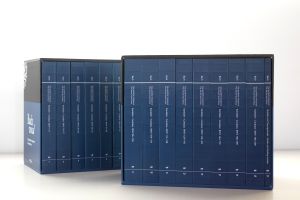
Depuis la création des éditions Carus, l’édition des œuvres de Jean-Sébastien Bach constitue pour nous une priorité particulière. À l’occasion de l’année commémorative de la Réforme, nous avons achevé le projet « Bach vocal ». La musique vocale sacrée de Bach est désormais disponible dans son intégralité sous forme d’éditions modernes « Urtext », accompagnées du matériel d’exécution. Une édition complète de toutes les partitions, présentée dans un coffret de grande qualité, est également disponible. Traduit avec DeepL.com (version gratuite)
Plus d'information sur la personne
-
Éditeur
Felix Loy
| 1963
-
Traducteur
Henry Drinker
Les évaluations sur notre site web ne peuvent être effectuées que par des clients disposant d'un compte d'utilisateur enregistré. Il n'est pas vérifié si les produits évalués ont été effectivement achetés.
Aucune évaluation disponible pour ce produit.
Questions fréquentes sur l'œuvre
 Il n'y a pas encore de questions et réponses concernant cette œuvre ou vous n'avez pas trouvé la réponse à votre question sur l'œuvre ? Cliquez ici et envoyez votre question spécifique à notre service clients.