

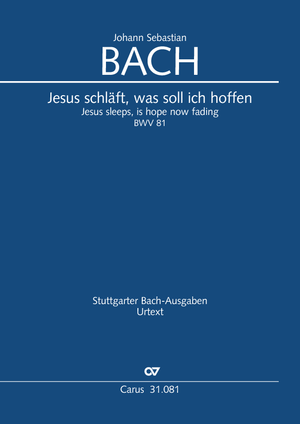
Jesus schläft, was soll ich hoffen
Cantate pour le 4ème dimanche après l'Epiphanie BWV 81, 1724
Bach composed the cantata "Jesus schläft, was soll ich hoffen" [Jesus sleeps, what hope have I] BWV 81 for the fourth Epiphany Sunday, 1724. The cantata is structured as a little drama: In the beginning, fear prevails. The seas rage and Jesus is asleep. The threateningly foaming waves are vividly depicted in the soughing string accompaniment of the tenor aria. Jesus’s words “Ihr Kleingläubigen, warum seid ihr so furchtsam?” [You of little faith, why are you so fearful?] are set as a bass arioso at the center of the cantata; they provide the turning point. In the subsequent bass aria, the “towering seas” are silenced. A recitative – “Wohl mir” [Well for me] – leads into the closing chorale with its certainty “Unter deinen Schirmen bin ich vor den Stürmen aller Feinde frei” [Under Your protection I am spared the tempests of my enemies].
Découvrir
 Consulter

 Compléments
- Acheter des compléments au format téléchargement.
-
 Texte numérique (sans notes), licence d'impression incluse, fichier html, paroles, traduction en anglaisfichier html, paroles, traduction en anglais (Extrait)1 Aria (Alto)
Jesus sleeps, is hope now fading?
2 Recitativo (Tenore)
Do I here see with trembling and with fear
death’s abyss so dark and gaping?Lord! Why do you stay so far from me?
3 Aria (Tenore)
Why do you hide at times of bitter need,
when ev’rything is fading in defeat?
O, will your eye not be then moved by all my anguish,
your eye that does not rest or languish?
You guided with a star the wisemen
to come from far away to find you,
and praising, they adored you.
Grant guidance, Lord, the light that your eyes shed
shows me the danger of this path ahead.Most turbulent billows from Belial’s waters
do multiply wrath.
A Christian should be strong as waves,
so that in trouble he is brave;...
-
Texte numérique (sans notes), licence d'impression incluse, fichier html, paroles, originalfichier html, paroles, original (Extrait)1 Aria (Alto)
Jesus schläft, was soll ich hoffen?
2 Recitativo (Tenore)
Seh ich nicht
mit erblasstem Angesicht
schon des Todes Abgrund offen?Herr! Warum trittest du so ferne?
3 Aria (Tenore)
Warum verbirgst du dich zur Zeit der Not,
da alles mir ein kläglich Ende droht?
Ach, wird dein Auge nicht durch meine Not beweget,
so sonsten nie zu schlummern pfleget?
Du wiesest ja mit einem Sterne
vordem die neu bekehrten Weisen,
den rechten Weg zu reisen.
Ach leite mich durch deiner Augen Licht,
weil dieser Weg nichts als Gefahr verspricht.Die schäumenden Wellen von Belials Bächen
verdoppeln die Wut.
Ein Christ soll zwar wie Wellen stehn,...
Acheter
Informations complémentaires sur l'œuvre
-
Compositeur
Johann Sebastian Bach
| 1685-1750Jean-Sébastien Bach compte parmi les compositeurs les plus importants de l'histoire de la musique occidentale. Il était issu d'une dynastie de musiciens très ramifiée, qui a donné naissance à de nombreux musiciens municipaux et organistes dans la région de Thuringe et de Saxe.
Bach vocal
Depuis la création des éditions Carus, l’édition des œuvres de Jean-Sébastien Bach constitue pour nous une priorité particulière. À l’occasion de l’année commémorative de la Réforme, nous avons achevé le projet « Bach vocal ». La musique vocale sacrée de Bach est désormais disponible dans son intégralité sous forme d’éditions modernes « Urtext », accompagnées du matériel d’exécution. Une édition complète de toutes les partitions, présentée dans un coffret de grande qualité, est également disponible. Traduit avec DeepL.com (version gratuite)
Plus d'information sur la personne
-
Éditeur
Reinhold Kubik
| 1942-2024
-
Basse continue réalisée
Paul Horn
| 1922-2016Paul Horn war ein deutscher Kirchenmusiker, Organist, Komponist und Musikwissenschaftler. Er studierte Kirchenmusik und Orgel an der Evangelischen Kirchenmusikschule Esslingen am Neckar bei Hans-Arnold Metzger und Musikwissenschaft, Theologie und Geschichte an der Universität Tübingen. Seine berufliche Laufbahn begann als Kantor an der Evangelischen Michaelskirche in Stuttgart-Degerloch. 1954 wurde er Kantor an der Evangelischen Stadtkirche Ravensburg, eine Position, die er bis zu seiner Pensionierung innehatte. Als Musikwissenschaftler arbeitete Horn bis ins hohe Alter eng mit Carus zusammen. So stammen zahlreiche Carus-Klavierauszüge aus seiner Feder. Plus d'information sur la personne
-
L'auteur de l'avant-propos
Karin Wollschläger
-
Traducteur
Vernon Wicker
| 1934-2024
Les évaluations sur notre site web ne peuvent être effectuées que par des clients disposant d'un compte d'utilisateur enregistré. Il n'est pas vérifié si les produits évalués ont été effectivement achetés.
Aucune évaluation disponible pour ce produit.
Questions fréquentes sur l'œuvre
 Il n'y a pas encore de questions et réponses concernant cette œuvre ou vous n'avez pas trouvé la réponse à votre question sur l'œuvre ? Cliquez ici et envoyez votre question spécifique à notre service clients.