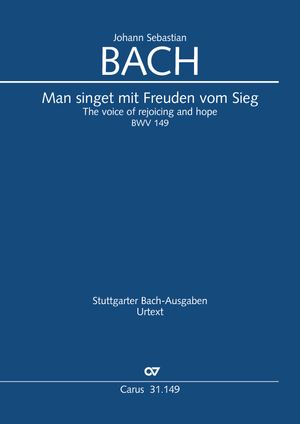
In composing the Cantata BWV 149 Bach reverted to parts of an earlier work: The opening chorus is a parody of the Jadgkantate BWV 208 (Hunting Cantata). In addition to smaller changes which were made necessary due to the text, Bach used trumpets instead of horns. For this purpose he transposed the movement from F major to C major. Musically, the form of the three arias and their instrumentation is rich in variety. The bass aria (2nd mvt.) is characterized by an active continuo accompaniment. After the secco recitative an extended dance like soprano aria with string accompaniment follows. The third aria (6th mvt.) is impressive due to the animated melody and the forming of a canon between the voices, and especially through the entry of the bassoon as the instrumental counterpart to a duet between the alto and tenor.
Découvrir
 Compléments
- Acheter des compléments au format téléchargement.
-
 Texte numérique (sans notes), licence d'impression incluse, fichier html, paroles, traduction en anglaisfichier html, paroles, traduction en anglais (Extrait)1 Coro
The voice of rejoicing and hope
2 Aria (Basso)
fills the temples of the righteous:
The right hand of God upholds his folk,
the right hand of God will exalt them.Might and power rise victorious,
3 Recitativo (Alto)
God, the Lamb again is glorious,
Satan’s horde has fled away,
who revile us night and day.
Through his death and degradation
righteous ones have gained salvation.I fear me not a hundred thousand foes,
the angels of the Lord are camped about on ev’ry side;
tho’ earth should break and all hope fail,
yet still may I be tranquil.
What cause is there for vain despairing?
With fiery steeds and trumpets blaring,
this host of angels will prevail....
-
Texte numérique (sans notes), licence d'impression incluse, fichier html, paroles, originalfichier html, paroles, original (Extrait)1 Coro
Man singet mit Freuden vom Sieg
2 Aria (Basso)
in den Hütten der Gerechten:
Die Rechte des Herrn behält den Sieg;
die Rechte des Herrn ist erhöhet.Kraft und Stärke sei gesungen
3 Recitativo (Alto)
Gott, dem Lamme, das bezwungen
und den Satanas verjagt,
der uns Tag und Nacht verklagt.
Ehr und Sieg ist auf die Frommen
durch des Lammes Blut gekommen.Ich fürchte mich
vor tausend Feinden nicht,
den Gottes Engel lagern sich
um meine Seiten her;
wenn alles fällt, wenn alles bricht,
so bin ich doch in Ruhe.
Wie wär es möglich zu verzagen?...
Acheter
Informations complémentaires sur l'œuvre
-
Compositeur
Johann Sebastian Bach
| 1685-1750Jean Sébastien Bach compte parmi les compositeurs essentiels de l'histoire de la musique occidentale. Il faisait partie d'une grande dynastie de musiciens, dont furent originaires nombre de musiciens municipaux et d'organistes dans les régions de Thuringe et de Saxe.
Bach vocal
Depuis la fondation des Éditions Carus en 1972, la publication des oeuvres de Johann Sebastian Bach revêt une importance particulière. En 2017, année du 500e anniversaire de la Réforme, nous avons clôturé le projet Bach vocal. L'intégralité de la musique vocale sacrée de Bach est désormais disponible en éditions modernes des textes originaux, matériel d'exécution compris. Une édition globale de toutes les partitions dans un coffret de grande qualité est aussi proposée. Plus d'information sur la personne
-
Parolier/Librettiste
Christian Friedrich Henrici (Picander)
| 1700-1764
Les évaluations sur notre site web ne peuvent être effectuées que par des clients disposant d'un compte d'utilisateur enregistré. Il n'est pas vérifié si les produits évalués ont été effectivement achetés.
Aucune évaluation disponible pour ce produit.
Questions fréquentes sur l'œuvre
 Il n'y a pas encore de questions et réponses concernant cette œuvre ou vous n'avez pas trouvé la réponse à votre question sur l'œuvre ? Cliquez ici et envoyez votre question spécifique à notre service clients.