Herr, wie du willt, so schicks mit mir
Cantate pour le 3ème dimanche après l'Epiphanie BWV 73, 1724
In 1724, Bach composed the cantata Herr, wie du willt, so schicks mit mir (Thy will, O Lord, be done for me) BWV 73 for the third Epiphany Sunday. Like in some other cantatas from the first annual cycle, the opening movement contains a part for corno which would in fact have been unplayable on an instrument of that era – probably also a reason why Bach allocated this part to the organ in a repeat performance (both variants can be performed using the Carus edition). The unusual choral movement, interrupted by recitatives, is based quite substantially on a short four-note motive which is introduced by the horn; at the end of the chorus, the choir sings it to the words “Herr, wie du willt” (Lord, as you will) – an avowal which also quite substantially characterizes other movements of the cantata.
Découvrir
 Consulter

 Compléments
- Acheter des compléments au format téléchargement.
-
 Texte numérique (sans notes), licence d'impression incluse, fichier html, paroles, traduction en anglaisfichier html, paroles, traduction en anglais (Extrait)1 Coro
Thy will, O Lord, be done for me
in living and in dying.Oh dearest Lord,
what grief thy will has brought upon me!
Ill fortune plagues me all my life,
for sorrow and distress
bring me unhappiness,
and hardly is my pain
in dying taken from me.All my desire is but for thee;
O cause not my undoing.Thou art my Helper, strength, and stay;
thou know’st tears of the afflicted,
lest all their confidence,
that weakened reed,
should break at once.
By thee I am elected;
speak one consoling word to me!Uphold me by thy grace alone,
...
-
Texte numérique (sans notes), licence d'impression incluse, fichier html, paroles, originalfichier html, paroles, original (Extrait)1 Coro
Herr, wie du willt, so schicks mit mir
im Leben und im Sterben!Ach! Aber ach! Wie viel
lässt mich dein Wille leiden!
Mein Leben ist Unglücks Ziel,
da Jammer und Verdruss
mich lebend foltern muss,
und kaum will meine Not im Sterben von mir scheiden.
Allein zu dir steht mein Begier,
Herr lass mich nicht verderben!
Du bist mein Helfer, Trost und Hort,
so der Betrübten Tränen zählet,
und ihre Zuversicht,
das schwache Rohr, nicht gar zerbricht;
und weil du mich erwählet,
so sprich ein Trost und Freudenwort.Erhalt mich nur in deiner Huld,
sonst, wie du willt, gib mir Geduld,
denn dein Will ist der beste....
Acheter
Informations complémentaires sur l'œuvre
-
Compositeur
Johann Sebastian Bach
| 1685-1750Jean-Sébastien Bach compte parmi les compositeurs les plus importants de l'histoire de la musique occidentale. Il était issu d'une dynastie de musiciens très ramifiée, qui a donné naissance à de nombreux musiciens municipaux et organistes dans la région de Thuringe et de Saxe.
Bach vocal
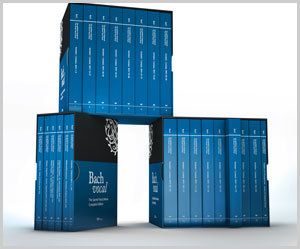
Depuis la création des éditions Carus, l’édition des œuvres de Jean-Sébastien Bach constitue pour nous une priorité particulière. À l’occasion de l’année commémorative de la Réforme, nous avons achevé le projet « Bach vocal ». La musique vocale sacrée de Bach est désormais disponible dans son intégralité sous forme d’éditions modernes « Urtext », accompagnées du matériel d’exécution. Une édition complète de toutes les partitions, présentée dans un coffret de grande qualité, est également disponible. Traduit avec DeepL.com (version gratuite)
Plus d'information sur la personne
-
Éditeur
Reinhold Kubik
| 1942-2024
-
Basse continue réalisée
Paul Horn
| 1922-2016Paul Horn war ein deutscher Kirchenmusiker, Organist, Komponist und Musikwissenschaftler. Er studierte Kirchenmusik und Orgel an der Evangelischen Kirchenmusikschule Esslingen am Neckar bei Hans-Arnold Metzger und Musikwissenschaft, Theologie und Geschichte an der Universität Tübingen. Seine berufliche Laufbahn begann als Kantor an der Evangelischen Michaelskirche in Stuttgart-Degerloch. 1954 wurde er Kantor an der Evangelischen Stadtkirche Ravensburg, eine Position, die er bis zu seiner Pensionierung innehatte. Als Musikwissenschaftler arbeitete Horn bis ins hohe Alter eng mit Carus zusammen. So stammen zahlreiche Carus-Klavierauszüge aus seiner Feder. Plus d'information sur la personne
-
L'auteur de l'avant-propos
Uwe Wolf
| 1961Uwe Wolf est un musicologue spécialisé dans les 17e et 18e siècles. Ses domaines de travail s'étendent de l'époque de Monteverdi et de Schütz au classicisme viennois en passant par Bach et la génération des fils et élèves de Bach. Depuis octobre 2011, il dirige le lectorat de la maison d'édition Carus. Auparavant, il a travaillé pendant plus de 20 ans dans la recherche sur Bach. Plus d'information sur la personne
-
Traducteur
Jean Lunn
Les évaluations sur notre site web ne peuvent être effectuées que par des clients disposant d'un compte d'utilisateur enregistré. Il n'est pas vérifié si les produits évalués ont été effectivement achetés.
Aucune évaluation disponible pour ce produit.
Questions fréquentes sur l'œuvre
 Il n'y a pas encore de questions et réponses concernant cette œuvre ou vous n'avez pas trouvé la réponse à votre question sur l'œuvre ? Cliquez ici et envoyez votre question spécifique à notre service clients.