

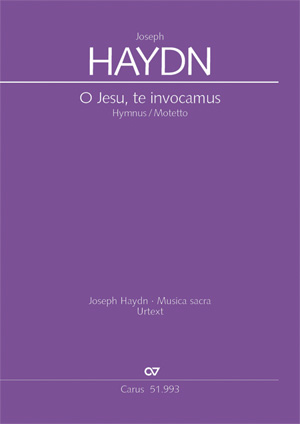
O Jesu, te invocamus
Hob. XXIVa:6/8b, 1768
The motet O Jesu, te invocamus arose through an adaptation of the text of the final chorus of Joseph Haydn’s Applausus, a festive cantata composed in 1768. For church music performances, the Latin text O Jesu, te invocamus was closely attached to the primary text and often only single words were replaced. The German alternative text Allmächtiger, Preis dir und Ehre, for which there was neither a biblical nor a liturgical basis, was added to the Latin text.
Découvrir


Acheter
Informations complémentaires sur l'œuvre
-
Compositeur
Joseph Haydn
| 1732-1809En tant que maître de chapelle du prince Esterházy, Haydn a créé, outre de nombreuses musiques instrumentales et divers opéras, d'importantes contributions à la musique sacrée, entre autres les quatorze messes en latin, dont seules douze sont authentiques ou achevées, des motets et des offertoires, deux importantes mises en musique du Te Deum, deux Salve Regina, un Stabat Mater ainsi que les différentes versions des Sept Paroles du Sauveur sur la croix. A l'exception des années 1783-1795, les messes ont été composées de manière continue entre 1749 et 1802 et constituent ainsi le genre auquel Haydn s'est consacré le plus longtemps. Les six messes (authentiques ou complètes) composées jusqu'en 1782 sont de styles très différents ; à côté de courtes Missae breves, on trouve également des messes étendues avec un riche effectif orchestral ; en revanche, les six messes dites tardives, composées à partir de 1796, forment un groupe relativement homogène d'œuvres à grand effectif et de grande envergure. Avec ses deux grands oratorios La Création (1798) et Les Saisons (1801), Haydn fonde la tradition de l'oratorio bourgeois allemand. Plus d'information sur la personne
-
Éditeur
Armin Kircher
| 1966-2015Armin Kircher studied church music at the Mozarteum in Salzburg. Until his death he was Director of the Church Music Department of the Archdiocese of Salzburg, and since 1992 he had been administrative director of the Österreichische Werkwoche für Kirchenmusik (Austrian Week for Church Music). He was also Director of Music at St Peter's Abbey, Salzburg and organist at the Cajetan Church in Salzburg. The collections he edited for the Catholic liturgy have become established standard works, in particular the choral collections Chorbuch Mozart • Haydn, the Chorbuch Kirchenjahr (Choirbook for the Church Year) and publications for organ and choir for the new Catholic hymnbook Gotteslob. Armin Kircher also made a name as an arranger of beautiful settings for choir and organ. Plus d'information sur la personne
-
Basse continue réalisée
Paul Horn
| 1922-2016Paul Horn war ein deutscher Kirchenmusiker, Organist, Komponist und Musikwissenschaftler. Er studierte Kirchenmusik und Orgel an der Evangelischen Kirchenmusikschule Esslingen am Neckar bei Hans-Arnold Metzger und Musikwissenschaft, Theologie und Geschichte an der Universität Tübingen. Seine berufliche Laufbahn begann als Kantor an der Evangelischen Michaelskirche in Stuttgart-Degerloch. 1954 wurde er Kantor an der Evangelischen Stadtkirche Ravensburg, eine Position, die er bis zu seiner Pensionierung innehatte. Als Musikwissenschaftler arbeitete Horn bis ins hohe Alter eng mit Carus zusammen. So stammen zahlreiche Carus-Klavierauszüge aus seiner Feder. Plus d'information sur la personne
Les évaluations sur notre site web ne peuvent être effectuées que par des clients disposant d'un compte d'utilisateur enregistré. Il n'est pas vérifié si les produits évalués ont été effectivement achetés.
Aucune évaluation disponible pour ce produit.
Questions fréquentes sur l'œuvre
 Il n'y a pas encore de questions et réponses concernant cette œuvre ou vous n'avez pas trouvé la réponse à votre question sur l'œuvre ? Cliquez ici et envoyez votre question spécifique à notre service clients.