

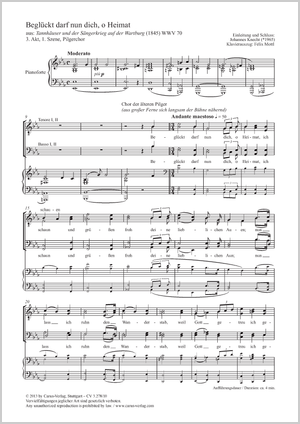
Beglückt darf nun dich, o Heimat
Pilgerchor, aus: Tannhäuser und der Sängerkrieg auf der Wartburg WWV 70, 1845
aus: Tannhäuser und der Sängerkrieg auf der Wartburg, 3. Akt, 1. Szene. Nach dem Eklat beim Sängerwettstreit auf der Wartburg sieht Tannhäuser nur noch einen Ausweg: Er pilgert nach Rom, um vor dem Papst Buße zu tun. In Rom wird er jedoch vom Papst harsch abgewiesen. Mit dem folgenden Chor kehren die Pilger aus Rom zurück.
Découvrir


Acheter
Informations complémentaires sur l'œuvre
-
Compositeur
Richard Wagner
| 1813-1883Born in 1813 in Leipzig, Richard Wagner grew up in a family very fond of theatre and he himself fell under its spell early. After failure in school and a mainly self-taught musical training (earliest compositions ~ 1830, Symphony in C 1832) 1833 initial employment as choir director in Wurzburg (completion of his first entire opera Die Feen). Start of years as a journeyman: Konigsberg, Riga, Paris, then as a court music director in Dresden, as a fugitive revolutionary in Zurich and finally as a protege of King Ludwig II. in Munich and Bayreuth, death in Venice in 1883. Plus d'information sur la personne
-
Parolier/Librettiste
Richard Wagner
| 1813-1883Born in 1813 in Leipzig, Richard Wagner grew up in a family very fond of theatre and he himself fell under its spell early. After failure in school and a mainly self-taught musical training (earliest compositions ~ 1830, Symphony in C 1832) 1833 initial employment as choir director in Wurzburg (completion of his first entire opera Die Feen). Start of years as a journeyman: Konigsberg, Riga, Paris, then as a court music director in Dresden, as a fugitive revolutionary in Zurich and finally as a protege of King Ludwig II. in Munich and Bayreuth, death in Venice in 1883. Plus d'information sur la personne
-
auteur de la réduction pour piano
Johannes Knecht
| 1965
-
auteur de la réduction pour piano
Felix Mottl
| 1856-1911
Les évaluations sur notre site web ne peuvent être effectuées que par des clients disposant d'un compte d'utilisateur enregistré. Il n'est pas vérifié si les produits évalués ont été effectivement achetés.
Aucune évaluation disponible pour ce produit.
Questions fréquentes sur l'œuvre
 Il n'y a pas encore de questions et réponses concernant cette œuvre ou vous n'avez pas trouvé la réponse à votre question sur l'œuvre ? Cliquez ici et envoyez votre question spécifique à notre service clients.