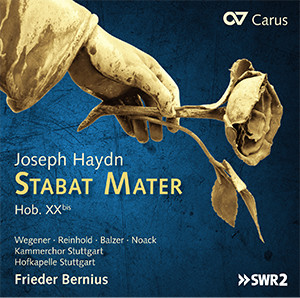
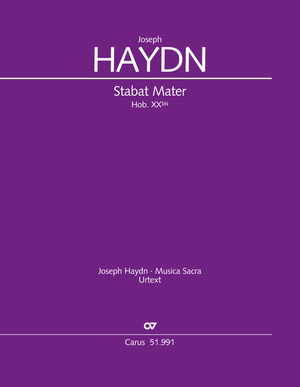
Joseph Haydn’s Stabat Mater, written in 1767, was the first church work the composer wrote after entering the service of Prince Esterházy in Eisenstadt. Unlike almost all his other sacred works, it soon circulated in numerous copies and established Haydn’s reputation as the leading vocal composer of his day. This persuasive recording by Frieder Bernius with first-rate soloists, the Kammerchor Stuttgart and the Hofkapelle Stuttgart uses the critical edition of the work published by Carus.
Awarded the Pizzicato Supersonic Award
Découvrir
 Ecouter
(14)
Ecouter
(14)
- Stabat Mater dolorosa
- O quam tristis et afflicta
- Quis est homo qui non fleret
- Quis non posset contristari
- Pro peccatis suae gentis
- Vidit suum dulcem natum
- Eja Mater, fons amoris
- Sancta Mater, istud agas
- Fac me vere, tecum flere
- Virgo virginum praeclara
- Flammis orci ne succendar
- Fac me cruce custodiri
- Quando corpus moriertur
- Paradisi Gloria
 Compléments
- Acheter des compléments au format téléchargement.
-
 Texte numérique (sans notes), licence d'impression incluse, fichier html, paroles, traduction en anglaisfichier html, paroles, traduction en anglais (Extrait)
1. Stabat Mater dolorosa (Tenore solo, Coro) A weeping mother was standing
full of sorrow beside the cross,
while her Son was hanging on it.Through her grieving heart,
anguished and lamenting,
a sword had passed.2. O quam tristis et afflicta (Alto solo) Oh, how sad and afflicted
was that blessed Mother
of an only begotten Son!She mourned and grieved
and trembled as she saw
the suffering of her glorious Son.3. Quis est homo qui non fleret (Coro) Who is the man who would
not weep, seeing the mother
of Christ in such torment?4. Quis non posset contristari (Soprano solo) Who would not feel compassion,
...
-
Texte numérique (sans notes), licence d'impression incluse, fichier html, paroles, traduction allemandefichier html, paroles, traduction allemande (Extrait)
1. Stabat Mater dolorosa (Tenore solo, Coro) Christi Mutter stand mit Schmerzen
bei dem Kreuz und weint’ von Herzen,
als ihr lieber Sohn da hing.Durch die Seele voller Trauer,
seufzend unter Todesschauer,
jetzt das Schwert des Leidens ging.2. O quam tristis et afflicta (Alto solo) Welch ein Schmerz der Auserkornen,
da sie sah den Eingebornen,
wie er mit dem Tode rang!Angst und Trauer, Qual und Bangen,
alles Leid hielt sie umfangen,
das nur je ein Herz durchdrang.3. Quis est homo qui non fleret (Coro) Wer könnt ohne Tränen sehen
Christi Mutter also stehen
in so tiefen Jammers Not?4. Quis non posset contristari (Soprano solo) Wer nicht mit der Mutter weinen,
...
-
Texte numérique (sans notes), licence d'impression incluse, fichier html, paroles, originalfichier html, paroles, original (Extrait)
1. Stabat Mater dolorosa (Tenore solo, Coro) Stabat Mater dolorosa
juxta crucem lacrimosa,
dum pendebat Filius.Cujus animam gementem,
contristatam et dolentem
pertransivit gladius.2. O quam tristis et afflicta (Alto solo) O quam tristis et afflicta
fuit illa benedicta
Mater Unigeniti!Quae maerebat et dolebat,
et tremebat, cum videbat
nati poenas inclyti.3. Quis est homo qui non fleret (Coro) Quis est homo qui non fleret,
Christi Matrem si videret
in tanto supplicio?4. Quis non posset contristari (Soprano solo) Quis non posset contristari,
...
-
Texte numérique (sans notes), licence d'impression incluse, fichier html, Texte introductif, en anglaisfichier html, Texte introductif, en anglais (Extrait)Text from the CD Carus 83.281
Clemens Harasim
Translation (abridged): David KosvinerWhen, from 1766 onwards, Joseph Haydn was finally able to take over from his predecessor Gregor Joseph Werner the sole responsibility for church music at the Esterházy court – in addition to the direction of chamber and theater music – he devoted more time to the composition of sacred music. The first larger-scale sacred work to be composed in this context was the Stabat Mater, completed in 1767.
The world premiere of this work seems to have taken place on Good Friday, 17 April 1767 in the Eisenstadt court chapel within the framework of the oratorial Good Friday performances which were held there every year. In all probability Haydn had been invited to perform his work again in the Church of St. John of God Brothers in Vienna a year later, which was organized by no less a personage than Johann Adolph Hasse who had been in the service of the emperor since 1764. The first documented public performance took place in Vienna on 29 March 1771, in the Piarist church Maria Treu in the Josephstadt borough of Vienna. Once again, it formed part of a Good Friday Vesper service. According to the church chronicles, an impressive number of 60 musicians
...
-
Texte numérique (sans notes), licence d'impression incluse, fichier html, Texte introductif, en allemandfichier html, Texte introductif, en allemand (Extrait)Booklet-Text der CD Carus 83.281
Clemens Harasim
Die Bedeutung Joseph Haydns als Komponist geistlicher Vokalmusik wird im heutigen Bewusstsein vor allem bestimmt durch die abendfüllenden Oratorien seines Spätwerks, Die Schöpfung und Die Jahreszeiten, sowie die ebenfalls als Oratorium bezeichnete nachträgliche Textierung seiner Karfreitagsmusik der Sieben letzten Worte unseres Erlösers am Kreuze. Im Bereich der liturgischen Kirchenmusik gelten vornehmlich seine großbesetzten Messen – ebenfalls der späteren Jahre – als Gipfelpunkt der Epoche und darüber hinaus. Angesichts dessen rückte Haydns erstes größeres Kirchenwerk, das bereits 1767 entstandene Stabat Mater, zu Unrecht in die „zweite Reihe“ seines Schaffens. Denn es war gerade dieses Werk, das Joseph Haydn nicht nur als „Kirchenkomponist“ bekannt machte, sondern das die wohl größte Verbreitung und die meisten Aufführungen im
...
Acheter
Informations complémentaires sur l'œuvre
Sommaire


-
Compositeur
Joseph Haydn
| 1732-1809En tant que maître de chapelle du prince Esterházy, Haydn a créé, outre de nombreuses musiques instrumentales et divers opéras, d'importantes contributions à la musique sacrée, entre autres les quatorze messes en latin, dont seules douze sont authentiques ou achevées, des motets et des offertoires, deux importantes mises en musique du Te Deum, deux Salve Regina, un Stabat Mater ainsi que les différentes versions des Sept Paroles du Sauveur sur la croix. A l'exception des années 1783-1795, les messes ont été composées de manière continue entre 1749 et 1802 et constituent ainsi le genre auquel Haydn s'est consacré le plus longtemps. Les six messes (authentiques ou complètes) composées jusqu'en 1782 sont de styles très différents ; à côté de courtes Missae breves, on trouve également des messes étendues avec un riche effectif orchestral ; en revanche, les six messes dites tardives, composées à partir de 1796, forment un groupe relativement homogène d'œuvres à grand effectif et de grande envergure. Avec ses deux grands oratorios La Création (1798) et Les Saisons (1801), Haydn fonde la tradition de l'oratorio bourgeois allemand. Plus d'information sur la personne
-
L'auteur de l'avant-propos
Clemens Harasim
| 1974
-
Chœur
Kammerchor Stuttgart
The Kammerchor Stuttgart is regarded as one of the best ensembles of its kind. Over its fifty-year existence, Frieder Bernius has developed the choir into an exceptional ensemble acclaimed by audiences and press alike. This has led to invitations for the choir to perform at all the important European festivals. In Germany the chamber choir performs at festivals and in concert halls in repertoire ranging from the 17th to the 21st century. Frieder Bernius and his ensemble have received numerous accolades for their contribution to new music. The Kammerchor Stuttgart has made over 80 CDs and LPs, numerous of which have been awarded international recording prizes (including the Edison award, Diapason d’or, Gramophone Choice, Classical Internet Award, International Classical Music Award, and German Record Critics’ Award prizes). The International Federation for Choral Music has invited the ensemble to sing at the 1st, 4th and 10th World Symposia on Choral Music in Vienna, Sydney and Seoul. Regular tours of North America and Asia since 1988 and a South America tour reflect the Kammerchor Stuttgart’s international reputation. Since 1984 the top ensemble has also been invited to Israel biennially. Plus d'information sur la personne
-
Orchestre
Hofkapelle Stuttgart
La Hofkapelle Stuttgart, créée en 2006 par Frieder Bernius pour compléter le Barockorchester Stuttgart, se consacre au répertoire du 19ème siècle sur des instruments historiques. Un centre de gravité est la redécouverte de trésors de l’histoire de la musique, notamment dans la région du sud-ouest de l’Allemagne (Kalliwoda, Knecht, Holzbauer). Hofkapelle et Barockorchester Stuttgart sont les hôtes réguliers de festivals internationaux (Rome, Salzbourg, Göttingen, Dresde). Leurs productions pour le CD se sont vues décerner des prix à plusieurs reprises : la Missa Dei Patris de Jan Dismas Zelenka a été nominée pour le Cannes Classical Award, la musique de scène du Songe d’une Nuit d’été de Félix Mendelssohn Bartholdy d’après Shakespeare a été distinguée par Rondo et a remporté l’Étoile du mois de la revue Fono Forum. Le Requiem de W.A. Mozart a obtenu le Diapason d’or de l’année 2003, l’opéra de Johann Gottlieb Naumann Aci e Galatea a été nommé enregistrement d’opéra de l’année dans la revue spécialisée Opernwelt, l’Oratorio de Pâques de Bach figure dans la liste des meilleurs enregistrements du prix de la Critique allemande du disque. L’enregistrement de la Messe en si mineur de Bach a été editors choice de la revue Gramophone. Plus d'information sur la personne
-
Chef d'orchestre
Frieder Bernius
| 1947Le travail de Frieder Bernius jouit d’une grande reconnaissance à l’échelle mondiale. Il est très sollicité à l’international, tant comme chef d’orchestre que comme professeur. Ses partenaires artistiques sont principalement le Chœur de chambre de Stuttgart, l’Orchestre baroque de Stuttgart, la Hofkapelle de Stuttgart et la Philharmonie classique de Stuttgart. C’est en 1968, avec la création du Chœur de chambre de Stuttgart, qu’il a posé les bases de sa carrière exceptionnelle, qu’il a rapidement fait de cet ensemble l’un des plus éminents de son genre. Qu’il s’agisse d’œuvres vocales de Monteverdi, Bach, Haendel, Mozart, Beethoven, Fauré et Ligeti, de musiques de théâtre de Mendelssohn ou de symphonies de Haydn, Burgmüller et Schubert, le travail de Frieder Bernius vise toujours un son à la fois fidèle à l’idéal sonore original et d’une personnalité incomparable. Il se consacre aussi bien à la redécouverte d’opéras du XVIIIe siècle qu’aux créations de compositions contemporaines. Il porte un intérêt particulier à l’histoire de la musique du sud-ouest de l’Allemagne. Le travail de Frieder Bernius est largement documenté sur disques et CD sous le label Carus. De nombreux enregistrements ont été récompensés par des prix internationaux. Dans le cadre du Festival choral allemand de Stuttgart, Frieder Bernius s’est vu décerner un CD d’or par les éditions Carus pour son intégrale de la musique vocale sacrée de Felix Mendelssohn Bartholdy. Plus d'information sur la personne
-
Solist - soprano
Sarah Wegener
-
Solist - alto
Marie Henriette Reinhold
-
Solist - ténor
Colin Balzer
Canadian born Colin Balzer studied singing with David Meek in Canada and Edith Wiens in Germany. He has participated in master classes given by Helmut Deutsch, Robert Tear, Elly Ameling, Brigitte Fassbaender and Christoph Prégardien. Colin Balzer has won a range of international prizes, and has embarked on a busy international concert schedule with a repertoire ranging from Monteverdi to Penderecki. He has been heard at Festivals in Baden-Baden, Aix-en-Provence and at the Early Music Festivals in Boston and Vancouver, and he regularly performs with various Canadian orchestras. He has also enjoyed considerable success as a lieder singer. He recorded his first CD, Hugo Wolf’s Italienisches Liederbuch, with Hartmut Höll. Plus d'information sur la personne
-
Solist - basse
Sebastian Noack
The baritone Sebastian Noack was born in Berlin and studied singing with Dietmar Hackel, Ingrid Figur and Dietrich Fischer-Dieskau. He became known after being awarded 1st prize at the Bundeswettbewerb Gesang; other prizes followed. Since then he has made a name for himself, particularly as a concert singer, performing under renowned conductors such as Frieder Bernius, Marcus Creed, Christoph Eschenbach, and Roy Goodman. His repertoire includes all of the significant oratorios from the Renaissance to the present time. On numerous tours he has travelled through all of Europe, the USA and Southeast Asia. He is a welcome guest at international festivals. Noack sings with the large broadcasting networks and well-known Baroque orchestras as well as with chamber music ensembles, e.g., the Sharoun Ensemble or Sabine Meyer’s Trio di Clarone. He has participated in CD productions under Philippe Herreweghe and Andreas Spering. Noack is particularly interested in lieder. Together with the pianist Manuel Lange, he founded the new concert series “Meisterlied im Musikinstrumenten-Museum”, for which – in addition to his own recitals – he has already been able to engage renowned guests. After having previ - ously performed concertante or semi-scenic operas, Noack made his stage debut in Donizetti’s Viva la Mamma at the Berlin State Opera in June 2009. He is a visit ing professor at the Hochschule für Musik Hanns Eisler in Berlin. Plus d'information sur la personne
Critiques

... Es ist davon auszugehen, dass sich diese Einspielung zum Standard- und Referenzwerk etablieren wird.
Musica Sacra, 04/2020
... In short, this is an almost perfect performance of what has to be considered a masterpiece.
Johan van Veen, musica Dei donum, 2019
... un disque d’un excellent niveau global , chaudement recommandé.
Florent Coudeyrat, ConcertoNet.com, 04/23/2019
... The soloists are attractive and dexterous enough to bring the composer’s melodic gifts to the fore.
American Record Guide, September/Oktober 2018
... Insgesamt mag diese Einspielung dank Frieder Bernius, dank seinem Stuttgarter Kammerchor und auch dank der beflissenen Musiker der Hofkapelle Stuttgart als Referenzaufnahme gelten.
Gerhard Persché, Fono Forum, Juli 2018
... Skvelý výkon podává také orchestr klasicistních nástroju Hofkapelle Stuttgart. Peclivé nastudování a celková koncepce jsou dokladem kvalitní práce a píedstavy o podobe kompozice ze strany dirigenta Friedera Berniuse. Haydnova Stabat Mater zde zaznívá jako skutecné mistrovské dílo.
Lukáš M. Vytlacil, Harmonie, 6/2018
... wird selbiger [der Hörer] von Text und Musik ergriffen, weil Bernius das große Kunststück gelingt, mit sparsamen, oft dezenten Mitteln zum Kern der Komposition vorzudringen.
Matthias Hengelbrock, Musik & Kirche, Mai/Juni 2018
... la précision, les sonorités capiteuses et l’élan des mouvements choraux émaillent l’écoute de superbes moments...
Jean Luc Macia, Diapason, Mai 2018
... This is a thoroughly musical and respectful performance of a deeply thoughtful and poignant work. As such it offers much solace and satisfaction.
Brian Robins, Early Music Review, March 23, 2018
... so sei diese Aufnahme nicht nur zum Kennenlernen oder zum Meditieren empfohlen, sondern auch als Anregung, selber zuzugreifen und dieses großartige Werk aufzuführen!
Gustav Danzinger, CHOR aktuell, 2/2018
... Die Aufnahme mit dem Stuttgarter Kammerchor ist auf ihre Art mustergültig... Die vier heutigen SolistInnen zeigen sich in Bestform.
Johannes Mundry, Chorzeit, April 2018
... Frieder Bernius hat es jetzt zusammen mit vier Solisten, Kammerchor und Hofkapelle Stuttgart mit großer Sorgfalt wieder ans Licht geholt und ... sehr abwechslungsreich eingespielt.
Lotte Thaler, swr.de, 20.04.2018
... Wer Beweise für die Exzellenz des Kammerchors Stuttgart suchte, der würde hier an allen Ecken und Enden fündig... Eine CD voller wundersamer Klang-Überraschungen...
Stuttgarter Zeitung, 17. April 2018
... Diese überzeugende Aufnahme von Frieder Bernius mit hochrangigen Solisten, dem Kammerchor Stuttgart und der Hofkapelle Stuttgart ... folgt der neuen kritischen Edition des Werkes von Carus.
ChorPfalz, März/April 2018
... Een meer dan sublieme uitvoering. Niet te missen!
Stretto. Magazine voor kunst, geschiedenes en muziek, 31.03.2018
... This is a thoroughly musical and respectful performance of a deeply thoughtful and poignant work.
Brian Robins, Early Music Review, 23.03.2018
… eine makellose Wiedergabe des … Werkes. … So macht Haydn richtig Spaß!
www.pizzicato.lu, Jan-Geert Wolff, 01.03.2018
... Der Kammerchor Stuttgart beweist bei dieser Aufnahme wieder einmal mehr, dass er zu Recht den Ruf als einer der führenden Chöre seiner Art besitzt!
Astrid Belschner, kulturradio vom rbb, 23.02.2018
... Dank des umsichtigen Dirigats, der exzellenten Solisten, dem hervorragenden Chor und Orchester ein echter Hörgenuss!
Jan Ritterstaedt, WDR TonArt, 23.02.2018
... Die neue Aufnahme von Frieder Bernius mit dem Kammerchor und der Hofkapelle Stuttgart sowie hervorragenden Solisten zeigt das 14 Nummern umfassende Werk in allen Schattierungen.
Austria Presse Agentur, 19.02.2018
... Den gripande framføringa til den kanadiske tenoren Colin Balzer bidreg til å gjera dette til den finaste Haydn-innspelinga på lenge.
Dag Og Tid, Sjur Haga Bringeland, 09.02.2018
... [Dirigent, Sänger und Ensemble] musizieren mit sensibler Leidenschaft, tiefer Innigkeit und großem Respekt vor dem Werk, das dem Pergolesis in Nichts nachsteht.
Martin Bail, CLASS: aktuell, Nr. 1 2018
Les évaluations sur notre site web ne peuvent être effectuées que par des clients disposant d'un compte d'utilisateur enregistré. Il n'est pas vérifié si les produits évalués ont été effectivement achetés.
Aucune évaluation disponible pour ce produit.
Questions fréquentes sur l'œuvre
 Il n'y a pas encore de questions et réponses concernant cette œuvre ou vous n'avez pas trouvé la réponse à votre question sur l'œuvre ? Cliquez ici et envoyez votre question spécifique à notre service clients.