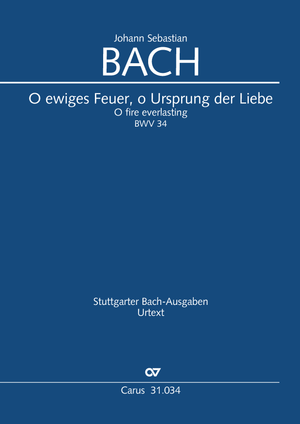
O ewiges Feuer, o Ursprung der Liebe
Cantate pour la Pentecôte (dimanche de Pentecôte) BWV 34 (BWV3 34.2), 1745
The Whitsuntide cantata BWV 34 is closely related to the wedding cantata BWV 34a, with which it has three movements in common. Although the history surrounding the gestation of the two works is not exactly known, it is assumed that BWV 34 is a parody of BWV 34a because of the parallel texts. First performed in 1727, the work – in the form that it has been handed down – dates from 1745. Bach probably made it available to his son, Wilhelm Friedemann, for his newly appointed office as church music director in Halle in a 1746 Whitsuntide performance. The most important part is the magnificent opening chorus, which, with three trumpets, timpani, and oboes, is juxtaposed against the contemplative alto aria in the third movement "Wohl euch" ("It is well for you"), which is contrasting also in the scoring with flutes and muted violins.
New revised edition.
Découvrir
 Consulter

 Compléments
- Acheter des compléments au format téléchargement.
-
 Texte numérique (sans notes), licence d'impression incluse, fichier html, paroles, traduction en anglaisfichier html, paroles, traduction en anglais (Extrait)1 Coro
O fire everlasting, o wellspring of rapture,
2 Recitativo (Tenore)
enkindle our hearts with devotion to thee.
With holy light glowing,
with love over flowing,
would that our hearts, Father thy temple may be.
Ah, grant that our faith in thy sight may be pleasing.Lord! Truth and right thy word imparts
3 Aria (Alto)
upholding all our hearts.
To mortals now thy favor show,
and by thy grace divine,
Lord, make our hearts thy shrine.
A sanctuary, honored so,
with glory bright must glow.Blessed ye hearts whom God has chosen,
to be his favored dwelling place.
How could there greater joy attend us?
How could a father more befriend us,...
-
Texte numérique (sans notes), licence d'impression incluse, fichier html, paroles, originalfichier html, paroles, original (Extrait)1 Chor
O ewiges Feuer, o Ursprung der Liebe,
2 Recitativo (Tenore)
entzünde die Herzen und weihe sie ein.
Lass himmlische Flammen durchdringen und wallen,
wir wünschen, o Höchster, dein Tempel zu sein;
ach, lass dir die Seelen im Glauben gefallen.Herr, unsre Herzen halten dir
3 Aria (Alto)
dein Wort der Wahrheit für:
Du willst bei Menschen gerne sein,
Drum sei das Herze dein;
Herr, ziehe gnädig ein.
Ein solch erwähltes Heiligtum
Hat selbst den größten Ruhm.Wohl euch, ihr auserwählten Seelen,
die Gott zur Wohnung ausersehn.
Wer kann ein größer Heil erwählen?
Wer kann des Segens Menge zählen?
Und dieses ist vom Herrn geschehn....
Acheter
Informations complémentaires sur l'œuvre
-
Compositeur
Johann Sebastian Bach
| 1685-1750Jean-Sébastien Bach compte parmi les compositeurs les plus importants de l'histoire de la musique occidentale. Il était issu d'une dynastie de musiciens très ramifiée, qui a donné naissance à de nombreux musiciens municipaux et organistes dans la région de Thuringe et de Saxe.
Bach vocal
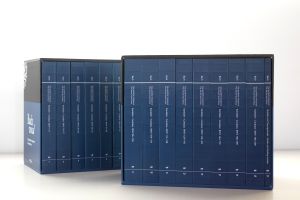
Depuis la création des éditions Carus, l’édition des œuvres de Jean-Sébastien Bach constitue pour nous une priorité particulière. À l’occasion de l’année commémorative de la Réforme, nous avons achevé le projet « Bach vocal ». La musique vocale sacrée de Bach est désormais disponible dans son intégralité sous forme d’éditions modernes « Urtext », accompagnées du matériel d’exécution. Une édition complète de toutes les partitions, présentée dans un coffret de grande qualité, est également disponible. Traduit avec DeepL.com (version gratuite)
Plus d'information sur la personne
-
Éditeur
Paul Horn
| 1922-2016Paul Horn war ein deutscher Kirchenmusiker, Organist, Komponist und Musikwissenschaftler. Er studierte Kirchenmusik und Orgel an der Evangelischen Kirchenmusikschule Esslingen am Neckar bei Hans-Arnold Metzger und Musikwissenschaft, Theologie und Geschichte an der Universität Tübingen. Seine berufliche Laufbahn begann als Kantor an der Evangelischen Michaelskirche in Stuttgart-Degerloch. 1954 wurde er Kantor an der Evangelischen Stadtkirche Ravensburg, eine Position, die er bis zu seiner Pensionierung innehatte. Als Musikwissenschaftler arbeitete Horn bis ins hohe Alter eng mit Carus zusammen. So stammen zahlreiche Carus-Klavierauszüge aus seiner Feder. Plus d'information sur la personne
-
Éditeur
Felix Loy
| 1963
Les évaluations sur notre site web ne peuvent être effectuées que par des clients disposant d'un compte d'utilisateur enregistré. Il n'est pas vérifié si les produits évalués ont été effectivement achetés.
Aucune évaluation disponible pour ce produit.
Questions fréquentes sur l'œuvre
 Il n'y a pas encore de questions et réponses concernant cette œuvre ou vous n'avez pas trouvé la réponse à votre question sur l'œuvre ? Cliquez ici et envoyez votre question spécifique à notre service clients.