

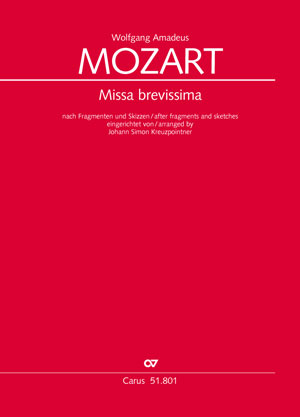
Missa brevissima
after fragments and sketches arranged by Johann Simon Kreuzpointner
When Wolfgang Amadeus Mozart returned to Salzburg in January 1779 from his journey to Paris, his luggage contained a single church music work – an unfinished Kyrie in E flat major (KV 296a) together with sketches for the Sanctus and Benedictus (KV 296c). In 2015, at the suggestion of the late Armin Kircher, Johann Simon Kreuzpointner set about compiling a five-movement setting of the mass from this material, also drawing on an unfinished cantata in E flat major (KV 429). For the orchestration and text underlay, Kreuzpointner took his cue from Mozart’s church music works. With this edition Kreuzpointner, an experienced church musician and composer, created a convincing and stylistically assured work, which he tried out in several performances.
The result is a concise setting of the mass, good to sing, which does not present any great difficulties for soloists, chorus, or orchestra.
The title "Missa brevissima" does not come from Mozart, but was chosen because of the brevity of the mass setting with its missing Credo. It also underlines the special status of this setting of the mass.



Acheter
Informations complémentaires sur l'œuvre
-
Compositeur
Wolfgang Amadeus Mozart
| 1756-1791Fils du vice-maître de chapelle du prince-archevêque de Salzbourg, Mozart a été constamment entouré de musique sacrée dès sa jeunesse. Au cours de ses voyages, Mozart découvrit la musique sacrée italienne, et plus tard, à Vienne, il étudia les œuvres de Bach et de Haendel. Après son installation à Vienne, il se lance de nouveaux défis avec l'opéra et le concerto pour piano. Il est significatif que la « Messe en ut mineur » KV 427, la plus grande œuvre de musique sacrée des premières années viennoises, reste inachevée. La dernière période de sa vie montre à nouveau une orientation vers la musique sacrée : Mozart postule avec succès pour succéder à Leopold Hoffmann, malade à l'article de la mort, en tant que maître de chapelle à la cathédrale Saint-Étienne, mais il ne peut pas prendre le poste, car il meurt avant Hoffmann. Un joyau comme l'« Ave verum » KV 618 et le Requiem KV 626, resté inachevé, laissent entrevoir ce que Mozart aurait encore pu accomplir en tant que compositeur d'église s'il était parvenu à ce poste à responsabilité. Plus d'information sur la personne
-
Arrangeur
Johann Simon Kreuzpointner
| 1968
Les évaluations sur notre site web ne peuvent être effectuées que par des clients disposant d'un compte d'utilisateur enregistré. Il n'est pas vérifié si les produits évalués ont été effectivement achetés.
Aucune évaluation disponible pour ce produit.
Questions fréquentes sur l'œuvre
 Il n'y a pas encore de questions et réponses concernant cette œuvre ou vous n'avez pas trouvé la réponse à votre question sur l'œuvre ? Cliquez ici et envoyez votre question spécifique à notre service clients.