

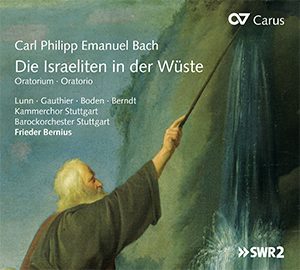
A High Point in the CPE Bach Anniversary Year: Frieder Bernius and the Kammerchor Stuttgart are marking the composer’s 300th anniversary with a recording of the oratorio “Die Israeliten in der Wüste” (The Israelites in the Wilderness). In 1768, right at the beginning of his long period as musical director of the Hamburg principal churches, Carl Philipp Emanuel Bach composed this masterpiece. The new, sensitive musical language he used delighted contemporaries and colleagues alike. This recording contributes a fitting concluding note to the anniversary year.
Découvrir
 Ecouter
(29)
Ecouter
(29)
- Erster Teil. Chor der Israeliten: Die Zunge klebt am dürren Gaum
- Rezitativ Erste Israelitin: Ist dieses Abrams Gott?
- Arie Erste Israelitin: Will er, dass sein Volk verderbe?
- Accompagnement Aaron: Verehrt des Ew'gen Willen
- Arie Aaron: Bis hieher hat er euch gebracht
- Rezitativ Zweite Israelitin: Warum verließen wir Ägyptens blühend Land
- Arie Zweite Israelitin: O, bringet uns zu jenen Mauren
- Rezitativ Aaron: Für euch fleht Moses stets um neue Huld
- Symphonie
- Rezitativ Moses: Welch ein Geschrei tönt in mein Ohr?
- Chor der Israeliten: Du bist der Ursprung unsrer Not
- Rezitativ Moses: Undankbar Volk, hast du die Werke
- Duett Erste & Zweite Israelitin: Umsonst sind unsre Zähren
- Accompagnement Moses/Chor der Israeliten: Gott, meiner Väter Gott
- Arie Moses: Gott, sieh dein Volk im Staube liegen!
- Chor der Israeliten: O Wunder! Gott hat uns erhört!
- Zweiter Teil. Rezitativ Moses: Verdienet habt ihr ihn
- Arie Moses/Erste Israelitin: Gott Israels, empfange im jauchzenden Gesange
- Tutti Chor/Zweite Israelitin: Gott Israels, empfange der Herzen heißen Dank!
- Rezitativ Erste Israelitin: Wie nah war uns der Tod!
- Arie Erste Israelitin: Vor des Mittags heißen Strahlen
- Accompagnement Moses: O Freunde, Kinder, mein Gebet
- Rezitativ Zweite Israelitin: Beneidenswert, die ihren Sohn ihn nennt!
- Arie Zweite Israelitin: O selig, wem der Herr gewähret
- Rezitativ Moses: Hofft auf den Ew’gen
- Chor: Verheißner Gottes
- Choral: Was der alten Väter Schar
- Accompagnement Tenor: O Heil der Welt
- Chor: Lass dein Wort, das uns erschallt
 Compléments
- Acheter des compléments au format téléchargement.
-
 Texte numérique (sans notes), licence d'impression incluse, fichier html, paroles, originalfichier html, paroles, original (Extrait)
Erster Teil
1. Chor der Israeliten Die Zunge klebt am dürren Gaum,
wir atmen kaum.
Rings um uns her ist Grab.
Gott, du erhörst des Jammers Klage nicht,
Gott, du kehrst dein Antlitz von uns ab.2. Rezitativ Erste Israelitin Ist dieses Abrams Gott?
Der Gott, der bei sich selbst geschworen,
das Volk, das er sich auserkoren,
nie zu vergessen, zu verlassen?
Wir schmachten, wir erblassen.
Wir haben keinen Trank
als diese Tränen, die wir weinen.
Der Herr hat Lust an unserm Untergang,
und er gedenkt nicht mehr der Seinen.3. Arie Erste Israelitin Will er, dass sein Volk verderbe?
Sind wir länger nicht sein Erbe?
...
-
Texte numérique (sans notes), licence d'impression incluse, fichier html, Texte introductif, en anglaisfichier html, Texte introductif, en anglais (Extrait)Text from the CD Carus 83.292
Wolfram Enßlin
Translation: David KosvinerWith the oratorio Die Israeliten in der Wüste, which was premiered on 1 November 1769, Carl Philipp Emanuel Bach presented a sacred vocal work accompanied by orchestra that was completely his own to the Hamburg audience for the first time. The work was commissioned for the consecration of the newly-built Lazarett-Kirche (hospital church) that belonged to the “Pesthof” area which had been established outside the Hamburg city walls in 1606.
One and a half years earlier, on Easter Sunday 1768, Bach had been ceremoniously inaugurated as the successor of his godfather Georg Philipp Telemann, who had died the previous year, as the Kantor of the Johanneum school and music director of Hamburg’s five principal churches. The Hamburg music director’s duties included the organization
...
-
Texte numérique (sans notes), licence d'impression incluse, fichier html, Texte introductif, en allemandfichier html, Texte introductif, en allemand (Extrait)Booklet-Text der CD Carus 83.292
Wolfram Enßlin
Mit dem am 1. November 1769 uraufgeführten Oratorium Die Israeliten in der Wüste präsentierte Carl Philipp Emanuel Bach erstmals dem Hamburger Publikum ein vollständig eigenes orchesterbegleitetes geistliches Vokalwerk. Es war eine Auftragskomposition zur Einweihung der neu errichteten Lazarett-Kirche, die zu dem 1606 gegründeten, außerhalb der Hamburger Stadtmauern gelegenen Pesthof gehörte.
Eineinhalb Jahre zuvor, am Ostersonntag 1768, war C. P. E. Bach feierlich als Nachfolger seines im Jahr zuvor verstorbenen Patenonkels Georg Philipp Telemann in das Amt des Kantor des Johanneum und Musikdirektor der fünf Hamburger Hauptkirchen eingeführt worden. Zu den Aufgaben eines Hamburger Musikdirektors gehörten die Organisation und Durchführung der regulären Kirchenmusik in den fünf Hauptkirchen
...
Acheter
Informations complémentaires sur l'œuvre
Sommaire

-
Compositeur
Carl Philipp Emanuel Bach
| 1714-1788L'immense oeuvre de Carl Philipp Emanuel Bach (1714–1788) jouissait, de son vivant déjà, de la faveur générale et d'une diffusion hors du commun. Ses oeuvres de jeunesse sont encore influencées par l'école de Berlin. Dans ses compositions plus tardives, il développa un style de plus en plus individuel, indépendant des courant de mode de l'époque, style que l'on trouve surtout dans les oeuvres vocales sacrées composées pendant son activité de directeur de la musique à Hambourg (1768–1788). Plus d'information sur la personne
-
Parolier/Librettiste
Daniel Schiebeler
| 1741-1771
-
L'auteur de l'avant-propos
Wolfram Enßlin
-
Chœur
Kammerchor Stuttgart
The Kammerchor Stuttgart is regarded as one of the best ensembles of its kind. Over its fifty-year existence, Frieder Bernius has developed the choir into an exceptional ensemble acclaimed by audiences and press alike. This has led to invitations for the choir to perform at all the important European festivals. In Germany the chamber choir performs at festivals and in concert halls in repertoire ranging from the 17th to the 21st century. Frieder Bernius and his ensemble have received numerous accolades for their contribution to new music. The Kammerchor Stuttgart has made over 80 CDs and LPs, numerous of which have been awarded international recording prizes (including the Edison award, Diapason d’or, Gramophone Choice, Classical Internet Award, International Classical Music Award, and German Record Critics’ Award prizes). The International Federation for Choral Music has invited the ensemble to sing at the 1st, 4th and 10th World Symposia on Choral Music in Vienna, Sydney and Seoul. Regular tours of North America and Asia since 1988 and a South America tour reflect the Kammerchor Stuttgart’s international reputation. Since 1984 the top ensemble has also been invited to Israel biennially. Plus d'information sur la personne
-
Orchestre
Barockorchester Stuttgart
The Barockorchester Stuttgart, which was founded by Bernius in 1985, specializes in 18th century music. The musicians are among the leading representatives of historical performance practice and perform exclusively on original instruments. The ensemble dedicates itself to a large extent to the revival of 18th century operas. It has performed at numerous international festivals, among others in Rome, Dresden and Göttingen. Plus d'information sur la personne
-
Chef d'orchestre
Frieder Bernius
| 1947Le travail de Frieder Bernius jouit d’une grande reconnaissance à l’échelle mondiale. Il est très sollicité à l’international, tant comme chef d’orchestre que comme professeur. Ses partenaires artistiques sont principalement le Chœur de chambre de Stuttgart, l’Orchestre baroque de Stuttgart, la Hofkapelle de Stuttgart et la Philharmonie classique de Stuttgart. C’est en 1968, avec la création du Chœur de chambre de Stuttgart, qu’il a posé les bases de sa carrière exceptionnelle, qu’il a rapidement fait de cet ensemble l’un des plus éminents de son genre. Qu’il s’agisse d’œuvres vocales de Monteverdi, Bach, Haendel, Mozart, Beethoven, Fauré et Ligeti, de musiques de théâtre de Mendelssohn ou de symphonies de Haydn, Burgmüller et Schubert, le travail de Frieder Bernius vise toujours un son à la fois fidèle à l’idéal sonore original et d’une personnalité incomparable. Il se consacre aussi bien à la redécouverte d’opéras du XVIIIe siècle qu’aux créations de compositions contemporaines. Il porte un intérêt particulier à l’histoire de la musique du sud-ouest de l’Allemagne. Le travail de Frieder Bernius est largement documenté sur disques et CD sous le label Carus. De nombreux enregistrements ont été récompensés par des prix internationaux. Dans le cadre du Festival choral allemand de Stuttgart, Frieder Bernius s’est vu décerner un CD d’or par les éditions Carus pour son intégrale de la musique vocale sacrée de Felix Mendelssohn Bartholdy. Plus d'information sur la personne
-
Solist - soprano
Joanne Lunn
Joanne Lunn, soprano, studied at the Royal College of Music in London, where she won the renowned Tagore Gold Medal. She regularly concertizes as a soloist with all the renowned early music ensembles. She gave her opera debut at the English National Opera in Monteverdi’s L’incoronazione di Poppea and sang the role of Helena in Britten’s A Midsummer Night’s Dream in Venice, as well as singing in Monteverdi’s L’Orfeo in Paris and Beijing. In the field of oratorio, Joanne Lunn has worked together with conductors such as Bernius, Minkowski, Norrington and Suzuki. Plus d'information sur la personne
-
Solist - soprano
Judith Gauthier
The mezzosoprano Judith Gauthier studied at the Conservatoire National Supérieur de Musique in Paris. She has sung as a soloist in, among others, Bach’s "St. John’s Passion", Brahm’s "Ein deutsches Requiem", as well as in Händel’s "La Resurrezione". She is not only an internationally renowned interpreter of early music, but also a seasoned performer of music of the 20th and 21st centuries. As an opera singer she has performed the roles of Oberto in Händel’s "Alcina" (Santiago de Chile), Bellezza in "Il trionfo del Tempo e del Disinganno" (Stuttgart) and Cendrillon in Massenet’s opera of the same name (Paris und Vienna.) She has been awarded numerous prizes. Plus d'information sur la personne
-
Solist - ténor
Samuel Boden
The tenor Samuel Boden studied at Trinity College of Music in London with John Wakefield and graduated with distinction in 2006. His repertoire is very broad and includes operas and oratorios ranging from the Baroque to the modern period. His concert repertoire includes, among others, works by Bach, Mozart, Britten and Charpentier. CD recordings of Monteverdi's "Vespers 1610" with the Orchestra of the Age of Enlightenment, cantatas by Pachelbel und Bach, as well as Bach's "B Minor Mass" document his predilection for Baroque music. Plus d'information sur la personne
-
Solist - basse
Tobias Berndt
Tobias Berndt began his musical education in the Dresden Kreuzchor. He studied with Christian Polster in Leipzig and continued his training with Rudolf Piernay in Mannheim. He also studied with Dietrich Fischer-Dieskau and Thomas Quasthoff. He was a laureate in numerous renowned singing competitions, winning – among others – the International Das Lied Competition in Berlin, the International Brahms Competition and the Cantilena Singing Competition. Tobias Berndt has also established himself abroad as an opera and concert singer. He has collaborated with conductors such as Philippe Herreweghe, Helmuth Rilling, Frieder Bernius, Teodor Currentzis, Marcus Creed, Hans-Christoph Rademann, Andrea Marcon, Marek Janowski and Sir Roger Norrington and has performed at the Berliner Philharmonie, the Tonhalle in Zurich, the Concertgebouw Amsterdam, the Leipzig Gewandhaus, the Tchaikovsky Concert Hall in Moscow, the Teatro Colon in Buenos Aires and at Lincoln Center in New York. He has also performed at important festivals such as the Prague Spring, the Rheingau Musik Festival, the Händel Festivals in Göttingen und Halle, the Bachfest Leipzig, the Oregon Bach Festival and the International Music Festival in Peking. An extensive discography attests to his versatile artistic activities. Plus d'information sur la personne
Critiques
Frieder Bernius leads this classy, well-balanced, and earnest performance, which shows the performers and the piece to excellent advantage.
Joanne Sydney Lessner, operanews.com, Juni 2015
Frieder Bernius est sans doute un des chefs les mieux aptes aujourd’hui à transcender ces élans choraux, d’une beauté chatoyante grâce à sa formation stuttgartoise...
Jean-Luc Macia, Diapason, März 2015
Kammerchor und Barockorchester Stuttgart unter der Leitung von Frieder Bernius bringen das Oratorium mit hoher Antizipation und luzider Transparenz zur Geltung. Auf hohem Niveau auch die Gesangssolisten.
Mannheimer Morgen, 26. Februar 2015
Die vielfältig abgestuften Gefühlsregungen spüren Frieder Bernius und seine Stuttgarter feinfühlig auf.
concerti, Februar 2015
A superb recording, perfectly balanced, and well suited for the discovery of this neglected music.
pizzicato.lu Die Israeliten in der Wüste, 19. Januar 2015
Deux excellents CD, deux chaleureuses recommandations [...].
(Zwei exzellente CDs, zwei warme Empfehlungen...)
Christophe Huss, ledevoir.com, 9. Januar 2015
[…] fãlicitons les artistes du Kammerchor Stuttgart pour leur fin travail de nuance, la probante gravitã qui domine l’exãcution […]
(Wir gratulieren den Künstlers des Kammerchors Stuttgart zur scharfsinnigen Schattierung und zur Überzeugenden Ernsthaftigkeit, die diese Einspielung prägen.)
www.anaclase.com, Januar 2014
[…] diese CD gehört zum Besten, was einem anlässlich von Bachs 300. Geburtstag zu Ohren kommen kann.
Andreas Waczkat, Concerto, Januar/Februar 2015
Die Gesamtleistung Überzeugt durch stilistisches Feingefühl für den differenzierten musikalischen Ausdruck C. P. E. Bachs, aufmerksame Begleitung des Orchesters, insbesondere in den Arien, und durch ein homogenes Klangbild des Chors, der zusammen mit der ausdrucksstarken Interpretation der vier Solisten für einen hohen klanglichen Wiedererkennungswert der Einspielung sorgt.
Marion Beyer, klassik.com, 21. Januar 2015
[…] sehr empfehlenswert[.]
Jan Ritterstaedt, WDR3 TonArt, 25. November 2014
Les évaluations sur notre site web ne peuvent être effectuées que par des clients disposant d'un compte d'utilisateur enregistré. Il n'est pas vérifié si les produits évalués ont été effectivement achetés.
Aucune évaluation disponible pour ce produit.
Questions fréquentes sur l'œuvre
 Il n'y a pas encore de questions et réponses concernant cette œuvre ou vous n'avez pas trouvé la réponse à votre question sur l'œuvre ? Cliquez ici et envoyez votre question spécifique à notre service clients.