

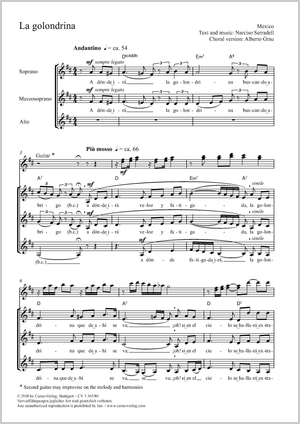
It was composed in 1862 as a song of exile or farewell by a young Mexican soldier who was captured by the French army and taken prisoner. It became an iconic popular anthem for all Mexican exiles. The author’s intention was to contrast the image of the Eagle as a symbol of might with that of a simple and docile bird, such as the swallow. This song, in the style of a serenade, has been interpreted in many versions by great popular and opera singers.
Découvrir


 Ecouter
(1)
Ecouter
(1)
- The Swallow
Acheter
Informations complémentaires sur l'œuvre
-
Compositeur de melodie
Narciso Serradell
| 1843-1910Serradell was a doctor and composer, who was exiled in France during the Second French Intervention in Mexico. While in France he taught music and spanish and composed his most emblematic song La Golondrina which became a hymn of mexican exiles. Plus d'information sur la personne
-
Parolier/Librettiste
Narciso Serradell
| 1843-1910Serradell was a doctor and composer, who was exiled in France during the Second French Intervention in Mexico. While in France he taught music and spanish and composed his most emblematic song La Golondrina which became a hymn of mexican exiles. Plus d'information sur la personne
-
Arrangeur
Alberto Grau
| 1937Cet éminent compositeur et chef d'orchestre catalan-vénézuélien s'est taillé une place d'honneur parmi les plus grands musiciens vénézuéliens contemporains. Connu pour sa carrière de chef de chœur, il est devenu l'une des principales figures de la composition chorale en Amérique latine, et nombre de ses œuvres ont été publiées. Ses livres sur la direction et la composition chorales, The making of a conductor et The making of the composer, sont des références pour les jeunes chefs d'orchestre et les musiciens. En 1967, il a fondé la Schola Cantorum de Caracas et a remporté le premier prix du concours international Guido D'Arezzo en 1974 en Italie. Depuis lors, il a été invité à de nombreuses conférences et festivals importants avec ses ensembles et en tant que chef d'orchestre invité. Plus de trente enregistrements témoignent de sa grande musicalité et de sa connaissance approfondie du répertoire choral international et latino-américain. Il est également le directeur fondateur de l'Orfeón Universitario Simón Bolívar et du Coral Ave Fenix, et il est membre du conseil d'administration d'El Sistema (Fondation pour les orchestres et les chœurs d'enfants et de jeunes du Venezuela). Il est conseiller et compositeur résident du programme Pequeños Cantores de la fondation Schola Cantorum de Venezuela et du programme d'action sociale pour la musique de la CAF/Banque latino-américaine de développement. Plus d'information sur la personne
Les évaluations sur notre site web ne peuvent être effectuées que par des clients disposant d'un compte d'utilisateur enregistré. Il n'est pas vérifié si les produits évalués ont été effectivement achetés.
Aucune évaluation disponible pour ce produit.
Questions fréquentes sur l'œuvre
 Il n'y a pas encore de questions et réponses concernant cette œuvre ou vous n'avez pas trouvé la réponse à votre question sur l'œuvre ? Cliquez ici et envoyez votre question spécifique à notre service clients.