

Une œuvre chorale magnifique! bien sûr, elle comporte aussi des mouvements solistes, mais le chœur se taille la part du lion et n'a pas seulement beaucoup à chanter, mais surtout des mouvements très variés dans cette impressionnante mise en musique du texte du Gloria. C'est pourquoi cela vaut toujours le coup d'arriver préparé en répétition...
Il suffit de s'exercer. Partout. A tout moment.
Que ce soit à la maison sur votre tablette ou votre PC ou en déplacement sur votre smartphone : avec carus music, the Choir Coach, vous avez toujours vos œuvres chorales avec vous pour vous entraîner ! Avec l'application chorale de carus music, vous pouvez écouter votre partition ainsi qu'un enregistrement de première qualité sur n'importe quel appareil et vous entraîner facilement à votre propre partie de chœur avec un coach. Avec carus music, la préparation de vos concerts est facile, efficace et amusante à maîtriser !
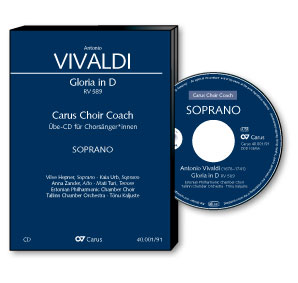
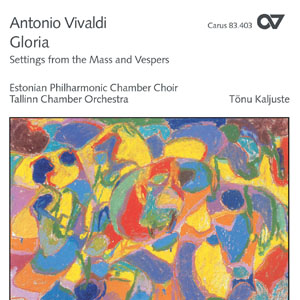
Interprètes: Vilve Hepner, Kaia Urb (soprano), Anna Zander (alto), Mati Turi (tenor) – Estonian Philharmonic Chamber Choir, Tallinn Chamber Orchestra – Tõnu Kaljuste
Découvrir


 Ecouter
(12)
Ecouter
(12)
- Gloria in excelsis Deo
- Et in terra pax
- Laudamus te
- Gratias agimus
- Propter magnam
- Domine Deus
- Domine Fili unigenite
- Domine Deus, Agnus Dei
- Qui tollis peccata mundi
- Qui sedes ad dexteram Patris
- Quoniam tu solus sanctus
- Cum Sancto Spiritu
 S`exercer
-
 carus music, the Choir Coach
Üben mit carus music
carus music, the Choir Coach
Üben mit carus music
-
Aides à l'apprentissage
-
Aides à l'apprentissage voix soprano
- Gloria in excelsis Deo (Choir Coach)
- Gloria in excelsis Deo (Choir Coach, Slow mode)
- Et in terra pax (Choir Coach)
- Et in terra pax (Choir Coach, Slow mode)
- Gratias agimus (Choir Coach)
- Gratias agimus (Choir Coach, Slow mode)
- Propter magnam (Choir Coach)
- Propter magnam (Choir Coach, Slow mode)
- Domine Fili unigenite (Choir Coach)
- Domine Fili unigenite (Choir Coach, Slow mode)
- Domine Deus, Agnus Dei (Choir Coach)
- Domine Deus, Agnus Dei (Choir Coach, Slow mode)
- Qui tollis peccata mundi (Choir Coach)
- Qui tollis peccata mundi (Choir Coach, Slow mode)
- Quoniam tu solus sanctus (Choir Coach)
- Quoniam tu solus sanctus (Choir Coach, Slow mode)
- Cum Sancto Spiritu (Choir Coach)
- Cum Sancto Spiritu (Choir Coach, Slow mode)
-
Aides à l'apprentissage voix alto
- Gloria in excelsis Deo (Choir Coach)
- Gloria in excelsis Deo (Choir Coach, Slow mode)
- Et in terra pax (Choir Coach)
- Et in terra pax (Choir Coach, Slow mode)
- Gratias agimus (Choir Coach)
- Gratias agimus (Choir Coach, Slow mode)
- Propter magnam (Choir Coach)
- Propter magnam (Choir Coach, Slow mode)
- Domine Fili unigenite (Choir Coach)
- Domine Fili unigenite (Choir Coach, Slow mode)
- Domine Deus, Agnus Dei (Choir Coach)
- Domine Deus, Agnus Dei (Choir Coach, Slow mode)
- Qui tollis peccata mundi (Choir Coach)
- Qui tollis peccata mundi (Choir Coach, Slow mode)
- Quoniam tu solus sanctus (Choir Coach)
- Quoniam tu solus sanctus (Choir Coach, Slow mode)
- Cum Sancto Spiritu (Choir Coach)
- Cum Sancto Spiritu (Choir Coach, Slow mode)
-
Aides à l'apprentissage voix tenore
- Gloria in excelsis Deo (Choir Coach)
- Gloria in excelsis Deo (Choir Coach, Slow mode)
- Et in terra pax (Choir Coach)
- Et in terra pax (Choir Coach, Slow mode)
- Gratias agimus (Choir Coach)
- Gratias agimus (Choir Coach, Slow mode)
- Propter magnam (Choir Coach)
- Propter magnam (Choir Coach, Slow mode)
- Domine Fili unigenite (Choir Coach)
- Domine Fili unigenite (Choir Coach, Slow mode)
- Domine Deus, Agnus Dei (Choir Coach)
- Domine Deus, Agnus Dei (Choir Coach, Slow mode)
- Qui tollis peccata mundi (Choir Coach)
- Qui tollis peccata mundi (Choir Coach, Slow mode)
- Quoniam tu solus sanctus (Choir Coach)
- Quoniam tu solus sanctus (Choir Coach, Slow mode)
- Cum Sancto Spiritu (Choir Coach)
- Cum Sancto Spiritu (Choir Coach, Slow mode)
-
Aides à l'apprentissage voix basse
- Gloria in excelsis Deo (Choir Coach)
- Gloria in excelsis Deo (Choir Coach, Slow mode)
- Et in terra pax (Choir Coach)
- Et in terra pax (Choir Coach, Slow mode)
- Gratias agimus (Choir Coach)
- Gratias agimus (Choir Coach, Slow mode)
- Propter magnam (Choir Coach)
- Propter magnam (Choir Coach, Slow mode)
- Domine Fili unigenite (Choir Coach)
- Domine Fili unigenite (Choir Coach, Slow mode)
- Domine Deus, Agnus Dei (Choir Coach)
- Domine Deus, Agnus Dei (Choir Coach, Slow mode)
- Qui tollis peccata mundi (Choir Coach)
- Qui tollis peccata mundi (Choir Coach, Slow mode)
- Quoniam tu solus sanctus (Choir Coach)
- Quoniam tu solus sanctus (Choir Coach, Slow mode)
- Cum Sancto Spiritu (Choir Coach)
- Cum Sancto Spiritu (Choir Coach, Slow mode)
-
 Compléments
- Acheter des compléments au format téléchargement.
-
 Texte numérique (sans notes), licence d'impression incluse, fichier html, paroles, traduction en anglaisfichier html, paroles, traduction en anglais (Extrait)1. Gloria in excelsis (Coro
Glory be to God on high
2. Et in terra pax (Coro)and on earth peace to men of good will.
3. Laudamus te (Duetto Soprano I.II)We praise Thee;
4. Gratias agimus tibi (Coro)
we bless Thee;
we adore Thee;
we glorify Thee.We give Thee thanks
5. Propter magnam gloriam tuam (Coro)for Thy great glory.
6. Domine Deus (Aria Soprano)Lord God, heavenly King, God the almighty Father.
7. Domine Fili unigenite (Coro)O Lord, the only-begotten Son,
...
-
Texte numérique (sans notes), licence d'impression incluse, fichier html, paroles, traduction allemandefichier html, paroles, traduction allemande (Extrait)1. Gloria in excelsis (Coro)
Ehre sei Gott in der Höhe
2. Et in terra pax (Coro)und Friede auf Erden den Menschen, die guten Willens sind.
3. Laudamus te (Duetto Soprano I.II)Wir loben Dich,
4. Gratias agimus tibi (Coro)
wir preisen Dich,
wir beten Dich an,
wir rühmen Dich.Wir danken Dir,
5. Propter magnam gloriam tuam (Coro)denn groß ist Deine Herrlichkeit.
6. Domine Deus (Aria Soprano)Herr und Gott, König des Himmels, Gott, allmächtiger Vater.
7. Domine Fili unigenite (Coro)Herr Jesus Christus,
...
-
Texte numérique (sans notes), licence d'impression incluse, fichier html, paroles, originalfichier html, paroles, original (Extrait)1. Gloria in excelsis Deo (Coro)
Gloria in excelsis Deo.
2. Et in terra pax (Coro)Et in terra pax hominibus bonae voluntatis.
3. Laudamus te (Duetto Soprano I.II)Laudamus te, benedicimus te, adoramus te, glorificamus te.
4. Gratias agimus tibi (Coro)Gratias agimus tibi
5. Propter magnam gloriam tuam (Coro)propter magnam gloriam tuam.
6. Domine Deus (Aria, Soprano)Domine Deus, Rex coelestis,
7. Domine Fili unigenite (Coro)
Deus Pater omnipotens.Domine Fili unigenite, Jesu Christe.
8. Domine Deus, Agnus Dei (Alto e Coro)...
-
Texte numérique (sans notes), licence d'impression incluse, fichier html, Texte introductif, en anglaisfichier html, Texte introductif, en anglais (Extrait)Text from the CD Carus 83.325
Karl Heller
Translation (abridged): John CoombsThe Gloria in D major has, more than any other work, established Vivaldi’s reputation as a composer of church music. In the compositional design of this work Vivaldi followed the same basic conception which is known from Bach’s B minor Mass: it is arranged in a large number of individual movements, some of which are for chorus, while others are solo arias or duets. This is the basis of the socalled “cantata” or “number” Mass, which enabled the composer to focus on central thoughts of the text. Thus the twelve movements profit from a great diversity of character, while at the same spanning a considerable stylistic range.
The heart of the composition is the chorus “Et in terra pax.” Among the unusual features of this masterly piece is the fact that the musical events proceed on two levels which motivically are distinct from each other: the orchestra plays wide intervals,
...
-
Texte numérique (sans notes), licence d'impression incluse, fichier html, Texte introductif, en allemandfichier html, Texte introductif, en allemand (Extrait)Booklet-Text der CD Carus 83.325
Karl Heller
Die Wiederbelebung der Musik Antonio Vivaldis im 20. Jahrhundert ging einher mit der Neuentdeckung bisher völlig unbekannter Schaffensbereiche des Komponisten. Für die stärksten Überraschungen sorgte dabei ein großer Bestand an geistlicher Vokalmusik, dessen Repertoire von der groß angelegten Mess- und Vesperkomposition bis zum biblischen Oratorium und zur Solomotette reicht. Die ersten Wiederaufführungen solcher Werke, darunter das Gloria RV 589 und das Credo RV 591, während einer Vivaldi-Woche in Siena 1939 wurden geradezu als Sensation empfunden. Sie ließen deutlich werden, dass der Komponist gerade auf diesem Sektor Werke höchsten künstlerischen Ranges geschaffen hat.
Wie kaum ein zweites Werk hat das Gloria D-Dur RV 589 dazu beigetragen, den Ruf Vivaldis als Kirchenkomponist zu begründen. Seit es 1941 als erstes der kirchenmusikalischen Werke des Komponisten durch Druck veröffentlicht wurde, erfreut es sich der besonderen Gunst der Musizierenden und der Hörer. Die Gründe dafür mögen vielfältiger Natur sein, liegen aber gewiss primär bei der Kraft und dem Reichtum der musikalischen Erfindung und Ausdrucksgebung.
Vivaldi folgt in der kompositorischen
...
Acheter
Informations complémentaires sur l'œuvre
Sommaire


-
Compositeur
Antonio Vivaldi
| 1678-1741Antonio (Lucio) Vivaldi était un compositeur et violoniste italien de la période baroque.
On suppose que son père, lui-même musicien, fut responsable de l'éducation musicale de Vivaldi. Cependant, il commença sa carrière professionnelle comme prêtre, ce qui lui valut le surnom de Il prete rosso (le prêtre roux).
À partir de 1703, Vivaldi travailla par intermittence comme professeur de violon et compositeur à l'Ospedale della Pietà, un orphelinat pour filles à Venise, jusqu'à peu avant sa mort. Au départ, il y travailla également comme prêtre, mais abandonna cette fonction après trois ans. Il composa de nombreuses œuvres de musique de chambre et des concertos pour ses élèves de la Pietà. Les célèbres Quatre Saisons sont particulièrement connues et souvent jouées aujourd'hui. Vivaldi a également composé de la musique vocale sacrée et profane et était compositeur et directeur d'opéra.
Sur les plus de 800 œuvres connues aujourd'hui, seules 135 ont été publiées du vivant de Vivaldi. Après sa mort, les compositions de Vivaldi ont d'abord été largement oubliées. Beaucoup de ses œuvres ont été redécouvertes et publiées, en particulier au XXe siècle. Parmi elles figure le Gloria en ré majeur RV 589, la toute première édition musicale publiée par Carus-Verlag.
Plus d'information sur la personne
-
auteur de la réduction pour piano
Paul Horn
| 1922-2016Paul Horn war ein deutscher Kirchenmusiker, Organist, Komponist und Musikwissenschaftler. Er studierte Kirchenmusik und Orgel an der Evangelischen Kirchenmusikschule Esslingen am Neckar bei Hans-Arnold Metzger und Musikwissenschaft, Theologie und Geschichte an der Universität Tübingen. Seine berufliche Laufbahn begann als Kantor an der Evangelischen Michaelskirche in Stuttgart-Degerloch. 1954 wurde er Kantor an der Evangelischen Stadtkirche Ravensburg, eine Position, die er bis zu seiner Pensionierung innehatte. Als Musikwissenschaftler arbeitete Horn bis ins hohe Alter eng mit Carus zusammen. So stammen zahlreiche Carus-Klavierauszüge aus seiner Feder. Plus d'information sur la personne
-
Basse continue réalisée
Paul Horn
| 1922-2016Paul Horn war ein deutscher Kirchenmusiker, Organist, Komponist und Musikwissenschaftler. Er studierte Kirchenmusik und Orgel an der Evangelischen Kirchenmusikschule Esslingen am Neckar bei Hans-Arnold Metzger und Musikwissenschaft, Theologie und Geschichte an der Universität Tübingen. Seine berufliche Laufbahn begann als Kantor an der Evangelischen Michaelskirche in Stuttgart-Degerloch. 1954 wurde er Kantor an der Evangelischen Stadtkirche Ravensburg, eine Position, die er bis zu seiner Pensionierung innehatte. Als Musikwissenschaftler arbeitete Horn bis ins hohe Alter eng mit Carus zusammen. So stammen zahlreiche Carus-Klavierauszüge aus seiner Feder. Plus d'information sur la personne
-
Ensemble
Estonian Philharmonic Chamber Choir
-
Ensemble
Tallinn Chamber Orchestra
-
Chef d'orchestre
Tonu Kaljuste
For twenty years Tõnu Kaljuste (conductor) was artistic director and principal conductor of the Estonian Philharmonic Chamber Choir, which he founded in 1981, and the Tallinn Chamber Orchestra. Kaljuste has also been chief conductor of the Swedish Radio Choir and the Netherlands Chamber Choir. He has directed international choral seminars and workshops for several years and has worked as a guest conductor with leading orchestras and choirs throughout Europe, Australia and America. As well as immersing himself in the music of the great northern and eastern European moderns, such as Schnittke, Kurtag, Penderecki, Rautavaara and Kancheli, he has a deep affinity with the composers of his native Estonia, including Pärt, Tüür, Tormis and Eller. He has established an international reputation with his wide-ranging repertoire from opera, via the traditional symphonic repertoire to contemporary music. His numerous recordings have won many awards and have been nominated for Grammy awards. In 1999 he received the Cannes Classical Award in the category “Best 20th Century Choral Music” for his recording of Alfred Schnittke’s Psalms of Repentance. In 2004 he was awarded first prize by the Estonian State Foundation “Kultuurkapital.” The same year he became artistic director of the Nargen Festival, an annual, three-month long musical event on the coast of Estonia. He is a member of the Royal Swedish Academy of Music. Plus d'information sur la personne
-
Solist - soprano
Kaia Urb
-
Solist - soprano
Vilve Hepner
-
Solist - alto
Anna Zander
-
Solist - ténor
Mati Turi
Les évaluations sur notre site web ne peuvent être effectuées que par des clients disposant d'un compte d'utilisateur enregistré. Il n'est pas vérifié si les produits évalués ont été effectivement achetés.
Aucune évaluation disponible pour ce produit.
Questions fréquentes sur l'œuvre
 Il n'y a pas encore de questions et réponses concernant cette œuvre ou vous n'avez pas trouvé la réponse à votre question sur l'œuvre ? Cliquez ici et envoyez votre question spécifique à notre service clients.