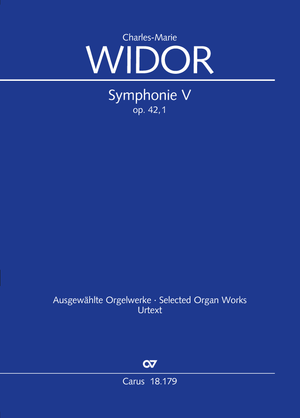
Symphonie No. V pour Orgue
op. 42,1
It is no coincidence that the Toccata from Widor’s Vth Organ Symphony is his best-known composition. Who can resist its thrilling verve? Not only this, but also the other movements of this unique work of the organ repertoire win you over immediately – the first with its march-like, majestic, much-varied theme; the second with its wonderfully elegiac oboe melody, flowing along over staccato sixteenth notes; and the two slow movements, of which the melancholy, almost static Adagio forms the greatest contrast imaginable to the following triumphal Toccata.
The Carus Urtext edition is based on the Paris edition of 1928/29, the last one to be published during Widor’s lifetime. The corrections which the composer made after the publication of this edition have also been taken into consideration. As well as this, earlier editions have been consulted for comparison to clarify individual variant readings. Editorial suggestions on the performance of individual passages complete the new edition.
Great organ works:
Series A:
- Symphony II op. 13 no. 2
- Symphony IV op. 13 no. 4
- Symphony V op. 42 no. 1
- Symphony VI op. 42 no. 2
- Symphony Romane op. 73
Subscription offer for Series A: 20% discount off the retail price
 Consulter

-
Compositeur
Charles-Marie Widor
| 1844-1937
-
Éditeur
Georg Koch
| 1961
Critiques
... Als Spieler gefällt mir das klare und großzügige Notenbild, welches das Lesen sehr erleichtert, ....
Markus Frank Hollingshaus, Ars Organi, September 2019
... So verfügt der Spieler über eine zuverlässige, mit einem informativen Vorwort versehene Quelle, die ein klares Bild der Entstehungsgeschichte des Werks schafft und, genauso wie ihr amerikanisches Pendant, sehr zu empfehlen ist.
Schweizer Musikzeitung, Nr. 4/2019
... Die editorische Sorgfalt Georg Kochs lässt viel von der Leidenschaft aufblitzen, die diesen Herausgeber antreibt. Das Notenbild ist sehr übersichtlich und gut lesbar. Ein instruktives Vorwort mit Widors originalem „Avant-propos“ führt in die geistige Welt der Symphonien ein. (jg)
Kirchenmusikalische Mitteilungen der Erzdiözese Freiburg, Mai 2019
... Ein großzügiges Notenbild, bei dem versucht wird, möglichst häu?g Wendestellen zum Selberblättern anzubieten, verlocken einen, sich Zeit zum Üben zu nehmen und sich eine passende Orgel zu suchen, wenn man keine hat.
Württembergische Blätter für Kirchenmusik 4/2019
... So verfügt der Spieler über eine zuverlässige, mit einem informativen Vorwort versehene Quelle, die ein klares Bild der Entstehungsgeschichte des Werks schafft und, genauso wie ihr amerikanisches Pendant, sehr
zu empfehlen ist.
Tobias Willi, Schweizer Musikzeitung, 04/2019
Les évaluations sur notre site web ne peuvent être effectuées que par des clients disposant d'un compte d'utilisateur enregistré. Il n'est pas vérifié si les produits évalués ont été effectivement achetés.
Questions fréquentes sur l'œuvre
 Il n'y a pas encore de questions et réponses concernant cette œuvre ou vous n'avez pas trouvé la réponse à votre question sur l'œuvre ? Cliquez ici et envoyez votre question spécifique à notre service clients.