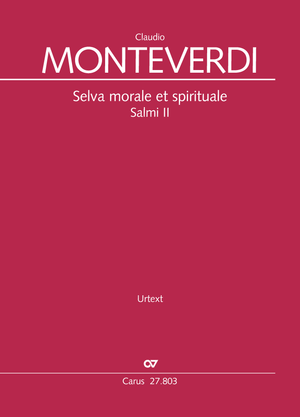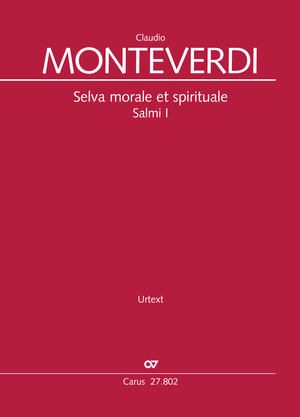
Selva morale et spirituale. Salmi I
Today Monteverdi's Selva morale et spirituale (1641) stands entirely in the shadow of his famous Vespers 1610. The editions from 1610 and 1641 both include music for the Mass and Vespers, but each of these collections was composed under much different circumstances during Monteverdi's lifetime. If the works of 1610 are a bold combination of traditional compositional techniques and avant garde music, which were intended by this weary Court Composer at Mantua as an application portfolio for a new job, the 1641 collection is the only church music by the mature Monteverdi which was published after almost thirty years in his position as Music Director of St. Mark's Cathedral: the latter, a kind of "best of" collection from his many years of experience as a church musician. In Venice the composer had not only a fabulous, but a large ensemble at his disposal (finally, about 35 singers, alone)! The big effect in this music is the combination of soloistic and weighty tutti sections, it makes the music, with its clearly defined sections and, for the most part homophonic choral passages more easily performable than the Vespers for today's choirs.The new edition, comprised initially of three volumes, also includes those works from the Selva Morale (a Mass and two Magnificats) which have already been published by Carus, as well as all further liturgical compositions for use in the church. The present volume, Salmi I, contains each of the first of the multiple settings of the psalms, as well as the "Credidi."
The edition is based on the methods employed in the much acclaimed Carus edition of the Vespers:
- It contains a detailed foreword with suggestions for notation, scoring and for the liturgical use of individual compositions.
- For the present edition four of the five surviving printed copies, as well as contemporary manuscript were consulted. Facsimiles illustrate special characteristics of the edition of 1641. A Critical Report makes clear all of the editorial decisions made in the edition.
- All of the pieces are printed untransposed and using the original note values.
- All of the pieces are available in single editions with complete performance material.
- Vocal scores of all works with obbligato instruments facilitate rehearsal.
- Instrumental parts for collaparte accompaniment of tutti-sections (including text underlay).



Sommaire

-
Compositeur
Claudio Monteverdi
| 1567-1643Durant sa jeunesse à Crémone, Monteverdi reçut sa première formation musicale auprès de Marc'Antonio Ingegneri, le maître de chapelle de la cathédrale. Après s'être fait connaître par ses premières publications, dont son premier livre de madrigaux, il se rendit en 1590 à Mantoue, à la cour des Gonzague : il resta 22 ans au service de la famille, d'abord comme chanteur et violoniste, puis comme maître de chapelle. C'est là qu'il écrivit d'autres livres de madrigaux et, avec L'Orfeo en 1607, l'un des premiers opéras de l'histoire de la musique. C'est également à Mantoue que furent composées les Vêpres de la Vierge en 1610. En 1613, Monteverdi devient maître de chapelle à Saint-Marc à Venise. A ce poste, il passa 30 années fructueuses sur le plan musical : il composa des œuvres sacrées, mais resta également attaché à la musique profane et publia avec les livres de madrigaux 6 à 8 ses plus vastes collections profanes. Après l'ouverture de l'Opéra de Venise en 1637, le tout premier lieu de représentation public, il réapparut également comme compositeur d'opéra : ses deux opéras tardifs Il ritorno d'Ulisse in Patria et L'incoronazione di Poppea y furent créés. Plus d'information sur la personne
-
Éditeur
Uwe Wolf
| 1961Uwe Wolf est un musicologue spécialisé dans les 17e et 18e siècles. Ses domaines de travail s'étendent de l'époque de Monteverdi et de Schütz au classicisme viennois en passant par Bach et la génération des fils et élèves de Bach. Depuis octobre 2011, il dirige le lectorat de la maison d'édition Carus. Auparavant, il a travaillé pendant plus de 20 ans dans la recherche sur Bach. Plus d'information sur la personne
-
Éditeur
Barbara Neumeier
| 1980
Critiques
... Ein Best-of aus langjähriger kirchenmusikalischer Praxis ...
Musik & Liturgie, 3/2017
Ein detaillierter Kritischer Bericht komplettiert diese feine Neuausgabe.
Singende Kirche, 3/2016
Les évaluations sur notre site web ne peuvent être effectuées que par des clients disposant d'un compte d'utilisateur enregistré. Il n'est pas vérifié si les produits évalués ont été effectivement achetés.
Questions fréquentes sur l'œuvre
 Il n'y a pas encore de questions et réponses concernant cette œuvre ou vous n'avez pas trouvé la réponse à votre question sur l'œuvre ? Cliquez ici et envoyez votre question spécifique à notre service clients.