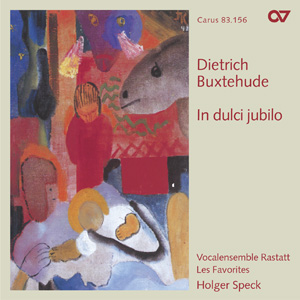
In dulci jubilo (Speck)
 Ecouter
(15)
Ecouter
(15)
- Kommst du, Licht der Heiden
- Magnificat
- How then shall I receive thee
- Sinfonia
- Choral: Ihr lieben Christen
- Chor: Siehe, der Herr kommt
- Sinfonia
- Arioso: Siehe, ich komme bald
- Terzett: So komm doch
- Duett: Amen
- Chor: Ei lieber Herr
- Cantate Domino
- A newborn Infant meek and mild
- In dulci jubilo
- Alleluja
Sommaire


-
Compositeur
Dieterich Buxtehude
| 1637-1707There are few documents concerning Buxtehude’s life. From a contemporary article in Nova literaria Maris Balthici, published soon after his death, we know that he regarded “Denmark as his homeland, from where he came to our region.”Dieterich Buxtehude, to use the spelling of his forename which he used when signing letters, was born about 1637 in Helsingborg, so he was a subject of the King of Denmark. His father, Johannes Buxtehude, was an organist, and taught his son sufficiently for him to become, in 1657 or 1658, an organist in Helsingborg and later in Helsingør. On the 11 April 1668 he was chosen to succeed Franz Tunder as organist at St. Marien in Lübeck, and until his death on 9 May 1707 Buxtehude remained in that position, one of the most important in northern Germany. After his death in 1707 musical experts praised Dieterich Buxtehude particularly for his keyboard music. For example, Johann Mattheson referred to him as a “highly regarded, former Lübeck organist.” That appreciation was based not on printed works, but on manuscript copies of his keyboard compositions, and on his reputation as a virtuoso which he enjoyed throughout Germany. Thus in 1703 Georg Friedrich Händel and Johann Mattheson were in Lübeck, and during the winter of 1705–06 Johann Sebastian Bach also went to Lübeck to study under Buxtehude so as to perfect his technique in composition and organ playing. Together with vocal music and music for keyboard instruments, two publications of his trio sonatas are extant. We know of the “Abendmusiken” in Lübeck from libretti printed for those occasions, but unfortunately the music is lost. That tradition of events similar to concerts was taken over by Buxtehude from his predecessor Franz Tunder. Plus d'information sur la personne
-
L'auteur de l'avant-propos
Thomas Schlage
-
Chœur
Vocalensemble Rastatt
Alongside its dedication to a core repertoire of composers such as Monteverdi, Schütz, Bach, Mozart, Haydn, Schumann, and Brahms, the Vocalensemble Rastatt & Les Favorites frequently explore new terrain with premiere performances. On the heels of its successes in national and international choir competitions, the ensemble has taken part in numerous internationally acclaimed CD recordings as well as radio, and television productions for SWR, Radio France, Deutschlandradio Kultur, and Deutschlandfunk. The Vocalensemble Rastatt & Les Favorites have performed in the Festspielhaus Baden-Baden, the Musikfest Bremen, the Kölner Philharmonie, the SWR RheinVokal Festival, the Europäisches Musikfest Stuttgart, the Schwetzinger Festspiele, the Deutschlandradio Kultur Wartburgkonzerte, the Internationale Musiktage im Dom zu Speyer, the Philharmonie in Mulhouse, and the Centre de Musique “Les Dominicains” in Guebwiller, France, among other venues. The flexible choir does not shy away from excursions into the world of opera, having performed Donizetti’s Lucia di Lammermoor and Bellini’s Norma with Edita Gruberova, and Mozart’s Don Giovanni and Così fan tutte with Rolando Villazón. Together with Klaus Maria Brandauer and the Chamber Orchestra of Europe, the choir also performed Mendelssohn’s Sommernachtstraum at the Musikfest Bremen. The ensemble is sponsored by the German state of Baden-Württemberg in co-operation with its “Kunst 2020” program, as well as by its home city of Rastatt. Plus d'information sur la personne
-
Ensemble
Les Favorites
Alongside its dedication to a core repertoire of composers such as Monteverdi, Schütz, Bach, Mozart, Haydn, Schumann, and Brahms, the Vocalensemble Rastatt & Les Favorites frequently explore new terrain with premiere performances. On the heels of its successes in national and international choir competitions, the ensemble has taken part in numerous internationally acclaimed CD recordings as well as radio, and television productions for SWR, Radio France, Deutschlandradio Kultur, and Deutschlandfunk. The Vocalensemble Rastatt & Les Favorites have performed in the Festspielhaus Baden-Baden, the Musikfest Bremen, the Kölner Philharmonie, the SWR RheinVokal Festival, the Europäisches Musikfest Stuttgart, the Schwetzinger Festspiele, the Deutschlandradio Kultur Wartburgkonzerte, the Internationale Musiktage im Dom zu Speyer, the Philharmonie in Mulhouse, and the Centre de Musique “Les Dominicains” in Guebwiller, France, among other venues. The flexible choir does not shy away from excursions into the world of opera, having performed Donizetti’s Lucia di Lammermoor and Bellini’s Norma with Edita Gruberova, and Mozart’s Don Giovanni and Così fan tutte with Rolando Villazón. Together with Klaus Maria Brandauer and the Chamber Orchestra of Europe, the choir also performed Mendelssohn’s Sommernachtstraum at the Musikfest Bremen. The ensemble is sponsored by the German state of Baden-Württemberg in co-operation with its “Kunst 2020” program, as well as by its home city of Rastatt. Plus d'information sur la personne
-
Chef d'orchestre
Holger Speck
Holger Speck enjoys an international reputation as a charismatic conductor who succeeds both in realizing stylistic characteristics in an innovative manner and in conveying emotional content. Fanfare magazine from the USA attests to his “undeniable authority.” With his distinctive sense of sound and compelling, lively and authentic interpretations, he shapes the image of his own ensembles as well as the choirs and orchestras with which he works as a guest conductor. The president of the German Bundestag Dr. Wolfgang Schäuble engaged him and his Vocalensemble Rastatt for a concert during the G20 summit. Speck established the Grammy-nominated Vocalensemble Rastatt and the Baroque orchestra Les Favorites internationally with exciting concert programs and outstanding CD recordings on the Carus label containing music by Buxtehude, Telemann, Handel and Brahms, among others. For Deutsche Grammophon productions, he was responsible for the choral sections of the Mozart operas “Die Entführung aus dem Serail,” “Le nozze di Figaro,” “Così fan tutte,” and “Don Giovanni.” Holger Speck teaches at the University of Music in Karlsruhe; in addition to being the artistic director of Vocalensemble Rastatt & Les Favorites, he works as a guest conductor with the NDR Vokalensemble, the Freiburg Baroque Orchestra, the Akademie für Alte Musik Berlin, and the choir and orchestra of the Slovenian Philharmonic Orchestra in Ljubljana, among others. The ballet director John Neumeier engaged Speck to conduct his last major creation “Dona nobis pacem” with Bach’s Mass in B minor at the Hamburg State Opera and the Festspielhaus Baden-Baden. . Plus d'information sur la personne
-
Solist - soprano
Antonia Bourvé
Antonia Bourvé studied opera and lieder singing with Stephan Kohlenberg and Felicitas Strack at the Hochschule für Musik in Karlsruhe. Her studies continued with master classes with Brigitte Fassbaender and Anna Reynolds, and lieder classes with Mitsuko Shirai and Hartmut Höll. She was awarded a scholarship by the Richard Wagner Association and won first prize in the Kulturfonds Baden opera competition. A much sought-after soprano, Antonia Bourvé’s guest appearances include the title role in Mozart’s Zaide at the Staatstheater Nuremberg. She has also sung on CD recordings of Mozart’s Schauspieldirektor and Beethoven’s Scottish Songs. A further recording, which has been praised as a benchmark recording by the press, is Saint-Saëns’ Oratorio de Noël, conducted by Holger Speck on the Carus label (Carus 83.352) Plus d'information sur la personne
-
Solist - soprano
Angelika Lenter
Angelika Lenter studied at the Musikhochschule Karlsruhe. She is much in demand as a soloist and has given guest performances at the Festival of European Church Music in Schwäbisch Gmünd, the Rheingau Musik Festival, and the Ludwigsburg Festival. She sings freelance in the SWR Stuttgart Vocal Ensemble, and is a guest member of Ensemble Officium Tübingen, the Vokalensemble Rastatt and Capella Angelica Berlin. On the operatic stage Angelika Lenter has sung Countess Almaviva in Le nozze di Figaro, in Judith at the Salzburg Festival and in the Staatstheater Stuttgart. Plus d'information sur la personne
-
Solist - soprano
Laila Finvik Pettersen
-
Solist - alto
Jürgen Banholzer
-
Solist - alto
Edzard Burchards
-
Solist - ténor
Michael Berner
-
Solist - basse
Konstantin Wolff
Konstantin Wolff studied with Donald Litaker at the Hochschule für Musik in Karlsruhe. He won the Felix Mendelssohn Bartholdy Prize from the Stiftung Preußischer Kulturbesitz, was awarded a scholarship by the German National Academic Foundation and made his opera debut in 2005 at the Opera National de Lyon under William Christie in Monteverdi’s L’incoronazione di Poppea. His concert repertoire ranges from the early baroque to the 20th century. He has performed with conductors including Gerd Albrecht, Alun Francis, Riccardo Chailly, Ton Koopman, René Jacobs, Claudio Abbado, Sir Simon Rattle and Nicholas McGegan. His first solo CD, a recording of Lieder to texts by Victor Hugo, has been enthusiastically received. Plus d'information sur la personne
-
Solist - basse
Frank Laffin
-
Solist - basse
Jens Hamann
Jens Hamann a été enfant de chœur du « Stuttgarter Hymnus-Chorknaben », a fait partie du Kammerchor Suttgart et de la Maîtrise de Gächingen. Après ses études de chant auprès de Rudolf Piernay à Mannheim, le baryton a remporté en 2006 le « prix spécial de musique ancienne » de la Radio de la Sarre. Le premier enregistrement mondial du Requiem de Michael Haydn (Carus 83.353) auquel il a participé s’est vu décerner le MIDEM Classical Award 2007. Dans le domaine de l’oratorio, il travaille avec Helmuth Rilling, Georg Grün et Ralf Otto et a répondu à des invitations du Festival de musique européen de Stuttgart et du Festival d’opéra du château de Hallwyl. Plus d'information sur la personne
Critiques
Buxtehude: In dulci jubilo
Wenn lange Wege sich lohnen
[...] Umso glücklicher für den Hörer, wenn die Interpreten diese Musik in ihrer Besonderheit ernst nehmen, ihre Reize erfassen und zum Klingen bringen. Das gelingt dem Vocalensemble Rastatt auf eindrucksvolle Weise: Unter der kundigen und sensiblen Leitung Holger Specks sammelt es sich zu einem außerordentlich transparenten, beinahe eleganten Klang, der sich nobel und diskret verströmt, ohne an Klarheit einzubüßen. Glücklich fügen sich die auf ausgewogen hohem Niveau gebotenen chorsolistischen Leistungen in das Klangbild ein. Dass sich zurückhaltende Delikatesse und eine lebhafte, musikantische Ausstrahlung nicht widersprechen, mag einerseits an der souveränen Ausstrahlung des Ensembles, seiner ‚jugendlichen Reife’ liegen, ist wohl aber auch sehr klar der künstlerischen Konzeption Specks zu verdanken: Er überfordert die häufig wenig komplexen Kompositionen nicht mit interpretatorischem Übereifer sondern packt sie bei ihren Stärken, indem er ganz auf die musikalische Frische und Lebendigkeit der Vokalmusik Buxtehudes setzt. Und so können auch dreistimmige Chorsätze auf der Basis strophischer Textgrundlagen unvermittelt zu kunstvollen Höhepunkten werden. Wichtigen Anteil an dieser - in der Wahl der Tempi ebenso wie der Gestaltung des dynamischen Tableaus überaus kontrastreichen – Einspielung der meist kürzeren Kantaten hat zweifellos auch das Instrumentalensemble ‚Les Favorites’, das hier sein Debüt für die Platte gibt: Es präsentiert sich als stilkundiges Ensemble, dessen klangklare Disposition der begleitenden Haltung ebenso zu Gute kommt wie es die rein instrumentalen Sätze und Passagen bereichert. Es agiert selbstbewusst und spielfreudig, kostet die Dissonanzen mancher Sinfonia beinahe lustvoll aus. [...]
Matthias Lange
Quelle: klassik.com, 12.11.2004
Adventskantaten von Dietrich Buxtehude
Mit den Werken von Dietrich Buxtehude sollten sich als allererste die norddeutschen Musiker befassen, könnte man meinen. Schließlich ist Buxtehude ja vor allem als Organist an der Lübecker Marienkirche und als Gründer der berühmten Lübecker Abendmusiken in die Geschichte eingegangen. Aber der süddeutsche Carus-Verlag, spezialisiert auf geistliche Vokalmusik aller Epochen, wandte sich für die Ersteinspielung diverser Advents- und Weihnachtsmusiken von Buxtehude ausgerechnet an das Rastatter Vokalensemble und dessen Leiter Holger Speck. Und rannte bei ihnen offene Türen ein. ...
Die Lübecker Bürger des 17. Jahrhunderts hatten regelmäßig zwischen dem 2. und 4. Adventssonntag Gelegenheit, bei den Abendmusiken neue Werke von Buxtehude kennenzulernen. Für das Publikum des 21. Jahrhunderts dürfte es jetzt eine Premiere geben, denn etliche dieser Advents- und Weihnachtsmusiken sind erstmalig auf CD zu hören. Aber sie haben seit der Entstehung nichts von ihrer Aktualität verloren [...]
Uneitel aber engagiert - diese Haltung merkt man der Einspielung an. Homogener Klang, saubere Intonation, abwechslungsreiche Dynamik, gute Balance und große Gestaltungskraft, das sind die Markenzeichen des Rastatter Vokalensembles, und mit dieser CD macht es seinem Ruhm wieder alle Ehre. Wer im süßlichen Christmas-Gedudel der Ladenpassagen und Weihnachtsmärkte vergeblich nach dem Wunder der heiligen Nacht sucht, der wird es hier vielleicht wiederfinden.
Christiane Irrgang
Quelle: NDR2, Klassisch unterwegs, 26.11.2004
Dietrich Buxtehude: In dulci jubilo
Möchten Sie sich und Ihren Lieben dieses Jahr eine ganz besondere Weihnachtsfreude bescheren? Diese Aufnahme von Advents- und Weihnachtskantaten Dietrich Buxtehudes mit dem Vokalensemble Rastatt und dem Ensemble Les Favorites unter Holger Speck kann zu diesem Behufe nur allerwärmstens empfohlen werden!
Schon die acht auf der Platte vereinten Werke (BuxWV 66, Anh.1, 109, 51, 12, 13, 52, 43) in ihrer glanz- und bläserreichen weihnachtlichen Konzeption allein lassen dem Hörer imaginäre Kerzen leuchten, doch die Interpretation durch das Vokalensemble Rastatt setzt noch den Tannenbaum drunter – und dürfte zum Besten gehören, was von Buxtehude bisher auf Plastik gebannt wurde.
Das jedoch hat Holger Speck nicht durch die Entwicklung eines gänzlich neuen und originellen Interpretationsansatzes erreicht, sondern schlicht dadurch, dass er das, was er macht nämlich eine möglichst authentische Aufführung absolut konsequent und kompetent macht. Das heißt hervorragend ausgewählte Stimm- Klangfarben im Chor (der auch die Solisten stellt): schlank, klar und strahlend, wunderbar gerade und technisch makellos – ohne jegliche Kompromisse. Dazu kommt mit Les Favorites ein durchsichtig, stilsicher und präsent musizierendes Ensemble, das ohne jeden Alte Instrumente Bonus auskommt da quiekt keine Trompete, knarzt keine Darmsaite.
Was die Aufnahme noch hörenswerter macht, ist der natürliche Umgang mit den musikalischen Formeln, die sich bei Buxtehude zuhauf finden und hier nicht als historische Notwendigkeit verstanden werden, sondern als lebendiger, emotional erfüllter Teil der Musik: eine rhythmische Floskel ist hier nicht einfach Floskel, sondern integraler Bestandteil eines optimal abgezirkelten Spannungsbogens, der aber stets mit schneeflockiger, filigraner Leichtigkeit daherkommt; selten hört man derart perfekt ausgespielte Hemiolen, schöne Linien, hervorragende Phrasierungen ...
Kurz: locker, flockig, prächtig, glanzvoll, spannend, zum Mitschwingen einladend ... – weihnachtlich!
Andrea Braun
Quelle: Cantate Sept./Okt. 2004
Kluge Weihnacht
Das Repertoire dieser Buxtehude-CD reicht vom bläsersatten Glanz der Kantate „Ihr lieben Christen freut euch nun” bis zur lyrischen Inngkeit des „Cantata domino” - und gibt so einen schönen Einblick in die stilistische Vielseitigkeit des norddeutsch-skandinavischen Barockmeisters. Für den positiven, mitunter begeisternden Gesamteindruck sorgt auch die sehr schlanke, vibratoarme und ungemein sorgfältig artikulierte Darbietung der beiden handverlesenen Ensembles - herausragend: Countertenor Jürgen Banholzer - unter der inspirierenden Leitung von Holger Speck.
Quelle: Fono Forum, 12/2004
Buxtehude: Cantatas
The musical antecedents of Bach-both professional and familial-generally don’t receive the artistic due of which they are worthy. To paraphrase comedian Rodney Dangerfield, „They don’t get no respect!” We tend to relegate them to a ranking below that of the Leipzig Thomaskantor, even though some of them were more widely known and held in higher esteem in their time than Bach was in his. Chief among these is the Danish-born organist and composer, Dietrich (Diderik) Buxtehude (1637-1707). The story of Bach’s 200-mile journey to Lübeck to hear the Great Dane perform and conduct his own music in his famous Abendmusiken is well known, and Buxtehude’s influence, specifically the stylus phantasticus, can be found in several of the keyboard works written in Bach’s early years. The availability of Buxtehude’s organ music in printed editions is nothing new, but it is generally trotted out when someone wants to show his influence on Bach. It is seldom offered for its own numerous and varied merits. Until recently, the oratorios, cantatas, strophic arias, and other sacred vocal works of Buxtehude were largely ignored, but in the last generation, leaders in the early music movement have begun to look anew at these compositions, prepare critical editions, and walk them into the recording studio.. Still, the progress is slow, with just over 100 of these works available in print and the accuracy of some of the earlier editions has been called into question. This Carus release gives us a fresh look at some of Buxtehude’s Advent and Nativity repertoire, some of which isn’t available elsewhere on disc. .....
Holger Speck and his musicians are ideal for this repertoire as they display an enviable ease of execution that is tied to insightful understanding of the era, the idiom, and the music. The experienced and accomplished soloists, who step from the choir as required, produce an equal tone throughout their range. Further, they are confident in their technique, committed in their emotional response to the three-century old texts, and vocalists and instrumentalists alike perform with undeniable authority. While the challenges that one finds in the sacred music of Bach are not present here, there is much to enjoy. This release belongs on the shelf of not only every choral music lover, but also every Bach aficionado, for in recordings such as this and others like cpo’s recent release of cantatas by Johann Pachelbel, we find the seeds of Bach’s greatness.
Micheal Carter
Quelle: Fanfare Magazine Vol. 28:3 Jan/Feb 2005
[...] Unter der kundigen und sensiblen Leitung Holger Specks sammelt es sich zu einem außerordentlich transparenten, beinahe eleganten Klang, der sich nobel und diskret verströmt, ohne an Klarheit einzubüßen. Glücklich fügen sich die auf ausgewogen hohem Niveau gebotenen chorsolistischen Leistungen in das Klangbild ein. [...]
Dr. Matthias Lange
klassik.com, 12.11.2004
Les évaluations sur notre site web ne peuvent être effectuées que par des clients disposant d'un compte d'utilisateur enregistré. Il n'est pas vérifié si les produits évalués ont été effectivement achetés.
Questions fréquentes sur l'œuvre
 Il n'y a pas encore de questions et réponses concernant cette œuvre ou vous n'avez pas trouvé la réponse à votre question sur l'œuvre ? Cliquez ici et envoyez votre question spécifique à notre service clients.