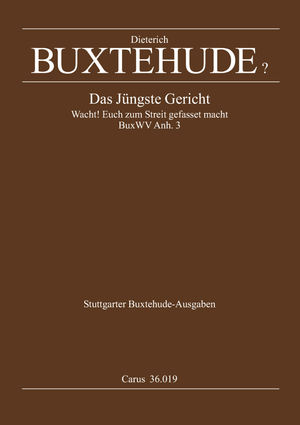
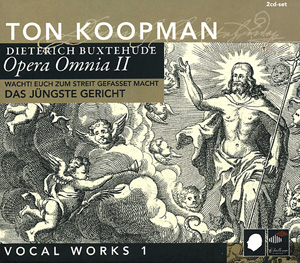
Beaucoup laisse à penser que l’oratorium "Wacht! Euch zum Streit", connu sous le nom "Das Jüngste Gericht", constitue la seule sérénade de Buxtehude conservée. L’oeuvre fut composée pour la Marienkirche de Lübeck et créée probablement en 1683. La présente édition permet à nouveau l’exécution authentique de l’oeuvre., pleine de contrastes de styles et d’actions. Cependant, des parties manquantes dans les sources ont été reconstituées par Ton Koopman, auteur de cette édition.
Découvrir
 Consulter

Acheter
Informations complémentaires sur l'œuvre
-
Compositeur
Dieterich Buxtehude
| 1637-1707There are few documents concerning Buxtehude’s life. From a contemporary article in Nova literaria Maris Balthici, published soon after his death, we know that he regarded “Denmark as his homeland, from where he came to our region.”Dieterich Buxtehude, to use the spelling of his forename which he used when signing letters, was born about 1637 in Helsingborg, so he was a subject of the King of Denmark. His father, Johannes Buxtehude, was an organist, and taught his son sufficiently for him to become, in 1657 or 1658, an organist in Helsingborg and later in Helsingør. On the 11 April 1668 he was chosen to succeed Franz Tunder as organist at St. Marien in Lübeck, and until his death on 9 May 1707 Buxtehude remained in that position, one of the most important in northern Germany. After his death in 1707 musical experts praised Dieterich Buxtehude particularly for his keyboard music. For example, Johann Mattheson referred to him as a “highly regarded, former Lübeck organist.” That appreciation was based not on printed works, but on manuscript copies of his keyboard compositions, and on his reputation as a virtuoso which he enjoyed throughout Germany. Thus in 1703 Georg Friedrich Händel and Johann Mattheson were in Lübeck, and during the winter of 1705–06 Johann Sebastian Bach also went to Lübeck to study under Buxtehude so as to perfect his technique in composition and organ playing. Together with vocal music and music for keyboard instruments, two publications of his trio sonatas are extant. We know of the “Abendmusiken” in Lübeck from libretti printed for those occasions, but unfortunately the music is lost. That tradition of events similar to concerts was taken over by Buxtehude from his predecessor Franz Tunder. Plus d'information sur la personne
-
Éditeur
Ton Koopman
| 1944Ton Koopman was born in October 1944 in Zwolle in the Netherlands. He received his musical training in Amsterdam and studied organ, harpsichord, and musicology. With both instruments and an extensive repertoire ranging from the Renaissance to the classical period he won the Prix d’Excellence, and has given concerts throughout Europe and the USA.
Koopman has been involved in Baroque performance practice and the historical instruments required for this since he was a student. In 1979 he founded the Amsterdam Baroque Orchestra and 13 years later the Amsterdam Baroque Choir. He has enjoyed international success with both ensembles.
Koopman’s publications for Carus-Verlag include new editions of Handel’s Messiah and Buxtehude’s Das Jüngste Gericht.
Plus d'information sur la personne
Critiques
Vieles spricht dafür, dass es sich bei dem anonym überlieferten Oratorium "Wacht! Euch zum Streit gefasset macht", bekannt auch unter dem Namen "Das Jüngste Gericht", um die einzige erhaltene Abendmusik Dieterich Buxtehudes handelt, die dieser für die Lübecker Marienkirche komponierte und vermutlich um 1683 aufführte. Die vorliegende Edition macht das abendfüllende, in Stil und Handlung kontrastreiche Werk erstmals in seiner originalen Gestalt wieder aufführbar, wobei in der Quelle fehlende Stimmen vom Herausgeber Ton Koopman rekonstruiert wurden. Der Text ist eine Kompilation aus freier Dichtung, Bibelzitaten und Chorälen. Alle Gattungen der Zeit werden in diesem Werk aufgegriffen: die moderne Aria, eine reiche Ausgestaltung der Choräle sowie eine freie Umsetzung des Bibeltextes. Den Instrumentalstimmen sind vielfältige Aufgaben zugedacht. Einleitungsstücke wie "Sonaten" und markante Begleitformulierungen belegen den Erfindungsreichtum des anonymen Komponisten. Wenn Wacht! Euch zum Streit gefasset macht von Buxtehude komponiert worden ist, dann steht das Werk im Kontext der Lübecker Abendmusiken. Von einigen der für diesen Anlass von Buxtehude komponierten Oratorien sind die Textbücher erhalten, die Musik allerdings ist verschollen. Es könnte sich bei dem vorliegenden Werk um das einzige erhaltene Oratorium handeln, das die Vielfalt des Komponisten auch in opernhaftem Genre zeigt. Die Partitur schließt ein äußerst informatives Vorwort von Ton Koopman mit ein, der auf programmatische Fakten der Abendmusiken Buxtehudes sowie auf Fragen zur Aufführungspraxis, insbesondere die Verwendung des hohen Chortones und dokumentierte Besetzungsgrößen hinweist. Der Notentext ist übersichtlich gestaltet, bei Carus befasst man sich offensichtlich eingehend mit der optischen Wirkung von Notenmaterial auf den Sänger/Musiker beim Musizieren. Ein umfangreicher kritischer Bericht dokumentiert die präzise Arbeit der Herausgeber.
Quelle: Singende Kirche 2007/2
Les évaluations sur notre site web ne peuvent être effectuées que par des clients disposant d'un compte d'utilisateur enregistré. Il n'est pas vérifié si les produits évalués ont été effectivement achetés.
Aucune évaluation disponible pour ce produit.
Questions fréquentes sur l'œuvre
 Il n'y a pas encore de questions et réponses concernant cette œuvre ou vous n'avez pas trouvé la réponse à votre question sur l'œuvre ? Cliquez ici et envoyez votre question spécifique à notre service clients.