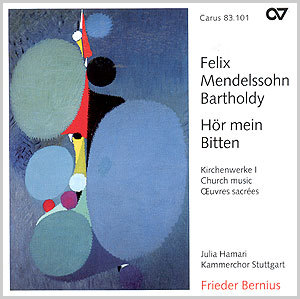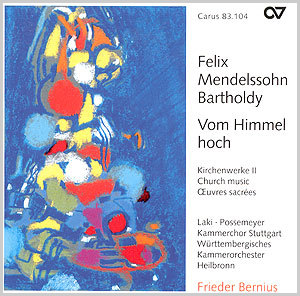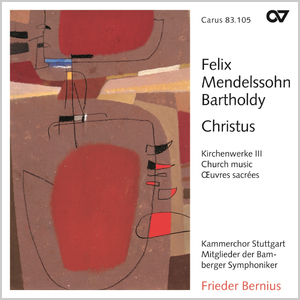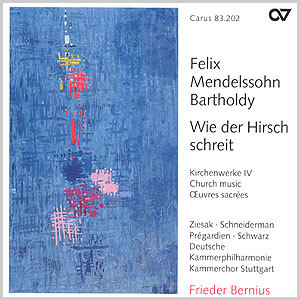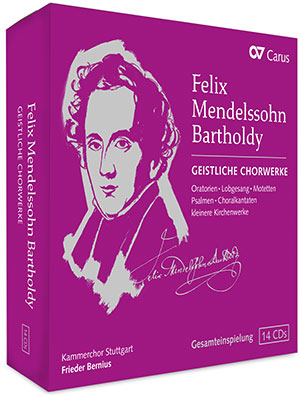
Musique vocale sacrée. L'enregistrement intégral
Les oratorios de Mendelssohn, tous les motets, psaumes, cantates chorales, toutes les œuvres sacrées de moindre importance et la symphonie-cantate Lobgesang : ce coffret contient tous les enregistrements réalisés dans le cadre de l’intégrale de la musique vocale sacrée de Felix Mendelssohn Bartholdy avec le Kammerchor Stuttgart sous la direction de Frieder Bernius.
Cet enregistrement, qui a nécessité plus de deux décennies, a été salué par la presse et a obtenu de nombreuses distinctions. Les interprétations magistrales de Bernius qui révèlent l’affinité de Mendelssohn pour les mélodies cantabiles et les harmonies subtiles, avec une grande exigence de qualité sonore et une diction colorée et transparente, sont maintenant disponibles dans un coffret intégral.
 Ecouter
(222)
Ecouter
(222)
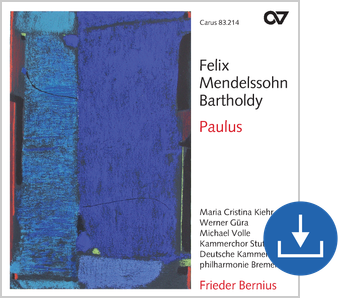
- Ouverture
- Coro "Herr, der du bist der Gott
- Choral "Allein Gott in der Höh sei Ehr"
- Coro "Dieser Mensch hört nicht auf"
- Aria "Jerusalem, die du tötest die Propheten"
- Coro "Siehe, wir preisen selig, die erduldet haben"
- Coro "Mache dich auf, werde licht"
- Choral "Wachet auf, ruft uns die Stimme"
- Aria "Gott, sei mir gnädig nach deiner Güte"
- Aria "Ich danke dir, Herr, mein Gott" con Coro "Der Herr wird die Tränen"
- Coro "O welch eine Tiefe des Reichtums"
- Coro "Der Erdkreis ist nun des Herrn"
- Duetto "So sind wir nun Botschafter an Christi Statt"
- Coro "Wie lieblich sind die Boten"
- Coro "Ist das nicht, der zu Jerusalem verstörte alle" e Choral "O Jesu Christe, wahres Licht"
- Duetto "Denn also hat uns der Herr geboten"
- Coro "Die Götter sind den Menschen gleich geworden"
- Coro "Seid uns gnädig, hohe Götter"
- Coro "Hier ist des Herren Tempel"
- Cavatina "Sei getreu bis in den Tod"
- Coro "Schone doch deiner selbst" e Recitativo "Was machet ihr"
- Coro "Sehet, welch eine Liebe hat uns der Vater erzeiget"
- Coro "Nicht aber ihm allein, sondern allen"
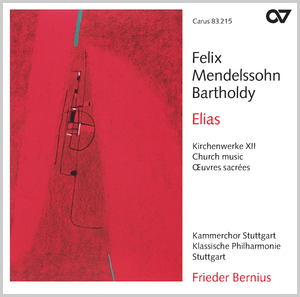
- Einleitung (Elias): So wahr der Herr, der Gott Israels, lebet
- Ouvertüre
- Chor (Das Volk): Hilf Herr! Willst Du uns denn gar vertilgen?
- Duett (Zwei Frauen) mit chor: Herr, höre unser Gebet
- Rezitativ (Obadjah): Zerreißet eure Herzen
- Arie (Obadjah): So ihr mich von ganzem Herzen suchet
- Chor (Das Volk): Aber der Herr sieht es nicht
- Rezitativ (Ein Engel): Elias, gehe weg von hinnen
- Doppelquartett (Die Engel): Denn er hat seinen Engeln befohlen
- Rezitativ, Arie und Duett (Die Witwe, Elias): Was hast Du an mir getan
- Chor: Wohl dem, der den Herrn fürchtet
- Rezitativ (Elias, Ahab) mit Chor (Das Volk): So wahr der Herr Zebaoth lebet
- Chor (Propheten Baals): Baal, erhöre uns
- Rezitativ (Elias) und chor (Propheten Baals): Rufet lauter! Denn er ist ja Gott!
- Rezitativ (Elias) und Chor (Propheten Baals): Rufet lauter! Er hört euch nicht
- Arie (Elias): Herr Gott Abrahams, Isaaks und Israels
- Quartett (SATB): Wirf dein Anliegen auf den Herrn
- Rezitativ (Elias) und Chor (Das Volk): Der du deine Diener machst zu Geistern
- Arie (Elias): Ist nicht des Herrn Wort wie ein Feuer
- Arioso (Alt): Weh ihnen, dass sie von mir weichen!
- Rezitativ (Obadjah, Elias, Knabe) und Chor (Das Volk): Hilf deinem Volk, du Mann Gottes!
- Chor (Das Volk): Dank sei dir Gott, due tränkest das durst'ge Land
- Arie (Sopran): Höre, Israel, höre des Herrn Stimme!
- Chor: Fürchte dich nicht, spricht unser Gott
- Rezitativ (Elias, Die Königin) mir Chor (Das Volk): Der Herr hat dich erhoben
- Chor (Das Volk): Wehe ihm, er muss sterben!
- Rezitativ (Obadjah, Elias): Du Mann Gottes, lass meine Rede
- Arie (Elias): Es ist genug, so nimm nun, Herr, meine Seele
- Rezitativ (Tenor): Siehe, er schläft unter dem Wachholder
- Terzett (Drei Engel): Hebe deine Augen auf zu den Bergen
- Chor: Siehe, der Hüter Israels
- Rezitativ (Ein Engel, Elias): Stehe auf , Elias, denn du hast einen langen Weg
- Arie (Ein Engel): Sei stille dem Herrn und warte auf ihn
- Chor: Wer bis an das Ende beharrt
- Rezitativ (Elias, Der Engel): Herr, es wird Nacht um mich
- Chor: Der Herr ging vorüber
- Rezitativ (Alt): Seraphim standen über ihm, Quartett (Seraphim) mit Chor: Heilig, heilig ist Gott der Herr
- Chor-Rezitativ: Gehe wiederum hinab!
- Arioso (Elias): Ja, es sollen wohl Berge weichen
- Und der Prophet Elias brach hervor
- Arie (Tenor): Dann werden die Gerechten leuchten
- Rezitativ (Sopran): Darum ward gesendet der Prophet Elias
- Chor: Aber einer erwacht von Mitternacht
- Quartett (SATB): Wohlan, alle, die ihr durstig seid
- Schlusschor: Alsdann wird euer Licht hervorbrechen
- Kyrie en ré mineur
- Christus: Geburt Christi
- Christus: Leiden Christi
- Grant us, Father
- Why are the heathen so angry (Psalm 2)
- Psaume 43
- Mein Gott, warum hast du mich verlassen (Psaume 22)
- Jesus, meine Zuversicht
- 1. Sinfonia – Maestoso con moto
- 1. Sinfonia - Allegretto un poco agitato
- 1. Sinfonia - Adagio religioso
- 2. Alles, was Odem hat (Coro e Soprano solo)
- 3. Recitativo: Saget es, die ihr erlöst seid, Arie: Er zählet unsre Tränen (Tenore solo)
- 4. Sagt es, die ihr erlöst seid (Coro)
- 5. Ich harrete des Herrn (Soprano I e II solo e Coro)
- 6. Stricke des Todes (Tenore solo)
- 7. Die Nacht ist vergangen (Coro)
- 8. Choral: Nun danket alle Gott
- 9. Drum sing‘ ich mit meinem Liede (Soprano e Tenore solo)
- 10. Ihr Völker, bringet her (Coro)
- Hear my prayer
- Kyrie en ut mineur
- Laß, o Herr mich Hilfe finden
- Hora est
- Magnificat allemand
- Salve Regina
- Lord, now lettest thou thy servant depart
- Coro: Vom Himmel hoch
- Aria: Es ist der Herr Christ
- Choral: Er bringt euch alle Seligkeit
- Aria: Sei willekomm'
- Arioso: Das also hat gefallen dir
- Schlusschor: Lob, Ehr sei Gott
- Ave maris stella
- Te Deum laudamus
- Te aeternum Patrem
- Tibi omnes Angeli
- Tibi Cherubim
- Te gloriosus Apostolorum
- Patrem immensae majestatis
- Tu rex gloriae
- Te ergo quaesumus
- Salvum fac populum
- Per singulos dies
- Dignare, Domine
- Fiat misericordia tua
- Psaume 114
- Coro: Wie der Hirsch schreit
- Recitativo, Aria: Meine Tränen
- Aria: Meine Seele dürstet
- Coro: Was betrübst du dich
- Recitativo: Mein Gott, betrübt ist meine Seele
- Quintetto: Der Herr hat des Tages
- Schlußchor: Was betrübst du dich, meine Seele
- Coro: Lauda Sion Salvatorem
- Coro: Laudis thema specialis
- Soprano Solo e coro: Sit laus plena, sit sonora
- Quartetto: In hac mensa novi Regis
- Coro: Docti sacris institutis
- Coro: Sub diversis speciebus
- Soprano Solo: Caro cibus, sanguis potus
- Soli e Coro: Sumit unus, sumunt mille
- Kyrie en la majeur
- Glory to god in the highest
- Holy is God, the Lord Sabaoth!
- From depth of grief I call to Thee
- Even in the midst of life
- Ave Maria
- Adspice Domine
- Let ua all be joyful
- Weihnachten
- O Lord, thou art our strong refuge
- Lord, take no remembrance of our misdoings
- Because of our transgressions
- Exalted, O Lord, over all our praise
- Jauchzet dem Herrn (Psaume 100)
- Denn er hat seinen Engeln befohlen
- Coro: Nicht unserm Namen, Herr
- Duetto: Israel hofft auf dich
- Arioso: Er segne euch je mehr
- Coro: Die Toten werden dich nicht loben
- Coro: O Haupt voll Blut und Wunden
- Aria: Du, dessen Todeswunden
- Choral: Ich will hier bei dir stehen
- Christe, du Lamm Gottes
- Choral: Mein Gott, du weißt am allerbesten
- Choral: Wer nur den lieben Gott lässt walten
- Aria: Er kennt die rechten Freudenstunden
- Choral: Sing, bet und geh auf Gottes Wegen
- Verleih uns Frieden gnädiglich
- Lord, have mercy
- Have you seen him hov'ring near
- Beati mortui in Domino morientes
- Periti autem
- O most blessed, most praised and holy
- Te Deum à 4
- Come, O Lord our God
- from: Three motets
- The shepherd blest is risen
- Now the Lord, he guides ev'ry sinner a right
- Thou who dost cause all men to perish
- Jauchzet dem Herrn (Psaume 100)
- Lift thine eyes to the mountains
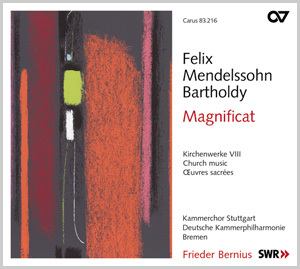
- Magnificat
- Quia respexit
- Et misericordia
- Fecit potentiam, Aria
- Deposuit potentes
- Gloria Patri
- Sicut erat, Fuga
- Jesu, meine Freude
- Tu es Petrus
- Wir glauben all an einen Gott
- Wir glauben auch an Jesum Christ
- Wir glauben an den Heilgen Geist
- Gloria
- Laudamus te
- Gratias agimus tibi
- Domine Deus
- Qui tollis
- Quoniam
- Kommt, lasst uns anbeten
- Kommet herzu
- Denn in seiner Hand
- Denn sein ist das Meer
- Heute, so ihr Stimme höret
- Ach Gott, vom Himmel
- Recitativo (Bass): Barmherzig und gnädig
- Aria: Das Silber durchs Feur (Solo Basso)
- Choral: Das wollst du, Gott
- Psaume 5
- Defend me, Lord from shame
- Cantique pour l’Eglise Wallonne de Francfort
- Laß, o Herr, mich Hilfe finden
- Chorale: Deines Kindes Gebet erhöre (version orgue)
- Herr, wir trau’n auf deine Güte
- Lasst sein heilig Lob uns singen
- Psaume 2
- Psaume 24
- Psaume 31
- Psaume 91
- Singet dem Herrn ein neues Lied
- Der Herr lässt sein Heil verkündigen
- Jauchzet dem Herrn alle Welt
- Er wird den Erdkreis richten
- Hark! The herald angels sing
- Psaume 93
- Psaume 98
- Psaume 100
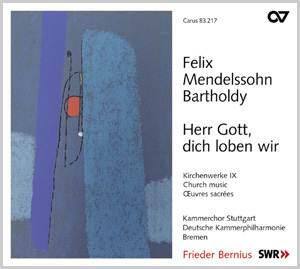
- Lord God, thy praise we sing
- Dein göttlich Macht und Herrlichkeit
- Du König der Ehren Jesu Christ!
- Lass uns im Himmel haben Teil
- Täglich, Herr Gott, dich loben wir
-
Compositeur
Felix Mendelssohn Bartholdy
| 1809-1847Felix Mendelssohn Bartholdy (1809-1847) compte parmi les compositeurs les plus importants du romantisme musical. Son œuvre allie la clarté formelle du classicisme viennois à la puissance expressive propre au XIXe siècle. Son étude de la musique de Jean-Sébastien Bach a eu une influence particulièrement marquante ; il a d’ailleurs largement contribué à la redécouverte de cette œuvre en organisant l’exécution de la Passion selon saint Matthieu en 1829.
Parmi ses compositions vocales les plus célèbres figurent ses deux oratorios, Paul et Élie, ainsi que sa cantate chorale « Verleih uns Frieden gnädiglich ». Par ailleurs, Mendelssohn a exercé les fonctions de chef d’orchestre, de pianiste et de pédagogue musical, et a contribué de manière significative à la professionnalisation du monde des concerts ainsi qu’au développement du Conservatoire de Leipzig. Son œuvre occupe une place centrale dans l’histoire de la musique du XIXe siècle et allie le respect de la tradition à l’esthétique sonore romantique.
Plus d'information sur la personne
-
Chœur
Kammerchor Stuttgart
The Kammerchor Stuttgart is regarded as one of the best ensembles of its kind. Over its fifty-year existence, Frieder Bernius has developed the choir into an exceptional ensemble acclaimed by audiences and press alike. This has led to invitations for the choir to perform at all the important European festivals. In Germany the chamber choir performs at festivals and in concert halls in repertoire ranging from the 17th to the 21st century. Frieder Bernius and his ensemble have received numerous accolades for their contribution to new music. The Kammerchor Stuttgart has made over 80 CDs and LPs, numerous of which have been awarded international recording prizes (including the Edison award, Diapason d’or, Gramophone Choice, Classical Internet Award, International Classical Music Award, and German Record Critics’ Award prizes). The International Federation for Choral Music has invited the ensemble to sing at the 1st, 4th and 10th World Symposia on Choral Music in Vienna, Sydney and Seoul. Regular tours of North America and Asia since 1988 and a South America tour reflect the Kammerchor Stuttgart’s international reputation. Since 1984 the top ensemble has also been invited to Israel biennially. Plus d'information sur la personne
-
Ensemble
Württembergisches Kammerorchester Heilbronn
-
Ensemble
Bamberger Symphoniker
Mitglieder der Bamberger Symphoniker Plus d'information sur la personne
-
Ensemble
Ensemble '76 Stuttgart
The Ensemble Stuttgart (Ensemble '76) was founded by Wolfgang Rösch in 1976 and is made up of solo players, musicians from Stuttgart orchestras and music students. Its repertoire comprises pieces for chamber orchestra, including the Bach Brandenburg Concertos as well as symphonies by Haydn, Mozart and Schubert, and chamber music, including the sextets of Brahms and Tchaikovsky and the Mendelssohn Octet. In addition it plays contemporary pieces, some of which were written for this ensemble. The Ensemble Stuttgart gives concerts in Germany, France, Italy and Belgium, and has been involved in many CD and radio productions. Plus d'information sur la personne
-
Ensemble
Stuttgarter Kammerorchester
Founded in 1945, the Stuttgarter Kammerorchester is the oldest and most renowned ensemble of its kind and for over 65 years it has occupied an outstanding position in international orchestra culture. Michael Hofstetter has been the conductor of this ensemble since September 2006. The orchestra had already earned its excellent reputation under its founder and long-time director, Karl Münchinger. Through a completely new and exemplary style of interpretation of the works of Johann Sebastian Bach the Stuttgarter Kammerorchester became a pathfinder in the field of historical performance practice. Dennis Russell Davies, its principal conductor, from 1995 to 2006, expanded the repertoire of the orchestral, especially with works from 20th century. In 2008 the orchestra was awarded the European Chamber Music Award by the European Foundation for Culture. Plus d'information sur la personne
-
Ensemble
Die Deutsche Kammerphilharmonie Bremen
The Deutsche Kammerphilharmonie Bremen is one of the world's leading orchestras, captivating audiences everywhere with its unique style of music-making. The Estonian conductor Paavo Järvi has been the orchestra's Artistic Director since 2004.
One of the many highlights of the collaboration with Paavo Järvi has been their Beethoven Project, on which conductor and orchestra concentrated for six years. Their Beethoven interpretations have been acclaimed worldwide by audiences and critics alike as benchmark performances. Following the Beethoven Project The Deutsche Kammerphilharmonie Bremen and Paavo Järvi focused on Robert Schumann's symphonic works with equal success.
The latest project of the orchestra and its conductor is the German composer Johannes Brahms. The first CD (Sony/RCA) of the project – Symphony No. 2, Tragic Ouverture and the Academic Festi-val Ouverture – was released in autumn 2017 and received the Opus Klassik in October 2018. The second CD, including Symphony No. 1 and the Haydn-Variations, followed in autumn 2018. With the third and fourth Symphony, released in March 2019, the symphony cycle has come to completion.
Highlight of the project was the internationally acclaimed performance of ›A German Requiem‹ on the 10th of April 2018 at Bremen Cathedral, 150 years after the first performance. The recording has now been released on DVD and Blu-ray by C-Major. In October 2019, ›The Brahms Code‹ – an excit-ing TV/DVD documentary about the Brahms Project produced by Deutsche Welle/Unitel – was re-leased and is the current German Record Critics' Award winner in the category music film (listed 1/20).
The Deutsche Kammerphilharmonie Bremen has been honoured with countless prizes such as Echo, Opus and Diapason d'Or for its recordings and the unique education project with the Gesamtschule Bremen-Ost in Osterholz-Tenever, the Zukunftslabor. For years, the orchestra has cultivated close musical friendships with international soloists such as Christian Tetzlaff, Maria João Pires, Janine Jansen, Igor Levit, Hilary Hahn and Martin Grubinger.
The Deutsche Kammerphilharmonie Bremen is permanent guest orchestra at the Elbphilharmonie Hamburg and Festival Orchestra of Kissinger Sommer. Plus d'information sur la personne
-
Ensemble
Klassische Philharmonie Stuttgart
La Klassische Philharmonie Stuttgart se compose de musiciens d’orchestres symphoniques et d’ensembles chambristes allemands de première classe qui travaillent depuis longtemps avec Frieder Bernius. L’orchestre joue sur des instruments modernes mais chef d’orchestre et musiciens accordent une importance particulière à la différenciation stylistique. Dans la représentation d’œuvres symphoniques chorales à grande distribution, la Klassische Philharmonie Stuttgart est le pendant orchestral au Kammerchor Stuttgart. La Klassische Philharmonie Stuttgart a participé à différents festivals comme le Festival musical du Rheingau, le Festival musical européen de Stuttgart, le Festival international de Bade-Wurtemberg, le festival « Wratislavia Cantans » de Wroc³aw (Pologne), les Journées musicales de Kassel, la Société philharmonique de Bruxelles et les Herbstliche Musiktage de Bad Urach. L’idée de créer un partenaire instrumental de niveau équivalent au Kammerchor Stuttgart a été dernièrement consacrée par le Requiem allemand de Johannes Brahms enregistré ensemble. La revue française Répertoire a certifié à Frieder Bernius que sa vision de l’œuvre est une « pulvérisation discographique ». Plus d'information sur la personne
-
Chef d'orchestre
Frieder Bernius
| 1947Le travail de Frieder Bernius jouit d’une grande reconnaissance à l’échelle mondiale. Il est très sollicité à l’international, tant comme chef d’orchestre que comme professeur. Ses partenaires artistiques sont principalement le Chœur de chambre de Stuttgart, l’Orchestre baroque de Stuttgart, la Hofkapelle de Stuttgart et la Philharmonie classique de Stuttgart. C’est en 1968, avec la création du Chœur de chambre de Stuttgart, qu’il a posé les bases de sa carrière exceptionnelle, qu’il a rapidement fait de cet ensemble l’un des plus éminents de son genre. Qu’il s’agisse d’œuvres vocales de Monteverdi, Bach, Haendel, Mozart, Beethoven, Fauré et Ligeti, de musiques de théâtre de Mendelssohn ou de symphonies de Haydn, Burgmüller et Schubert, le travail de Frieder Bernius vise toujours un son à la fois fidèle à l’idéal sonore original et d’une personnalité incomparable. Il se consacre aussi bien à la redécouverte d’opéras du XVIIIe siècle qu’aux créations de compositions contemporaines. Il porte un intérêt particulier à l’histoire de la musique du sud-ouest de l’Allemagne. Le travail de Frieder Bernius est largement documenté sur disques et CD sous le label Carus. De nombreux enregistrements ont été récompensés par des prix internationaux. Dans le cadre du Festival choral allemand de Stuttgart, Frieder Bernius s’est vu décerner un CD d’or par les éditions Carus pour son intégrale de la musique vocale sacrée de Felix Mendelssohn Bartholdy. Plus d'information sur la personne
Les évaluations sur notre site web ne peuvent être effectuées que par des clients disposant d'un compte d'utilisateur enregistré. Il n'est pas vérifié si les produits évalués ont été effectivement achetés.
Questions fréquentes sur l'œuvre
 Il n'y a pas encore de questions et réponses concernant cette œuvre ou vous n'avez pas trouvé la réponse à votre question sur l'œuvre ? Cliquez ici et envoyez votre question spécifique à notre service clients.