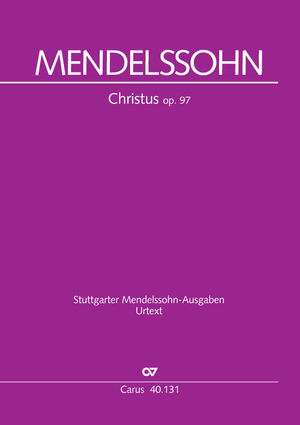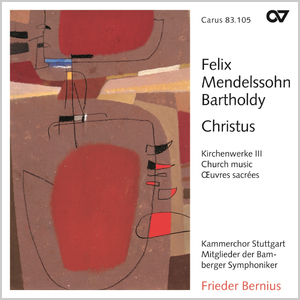
Christus. Kirchenwerke III
 Ecouter
(8)
Ecouter
(8)
- Kyrie en ré mineur
- Christus: Geburt Christi
- Christus: Leiden Christi
- Grant us, Father
- Why are the heathen so angry (Psalm 2)
- Psaume 43
- Mein Gott, warum hast du mich verlassen (Psaume 22)
- Jesus, meine Zuversicht
 Compléments
- Acheter des compléments au format téléchargement.
-
 Texte numérique (sans notes), licence d'impression incluse, fichier html, paroles, traduction en anglaisfichier html, paroles, traduction en anglais (Extrait)Warum toben die Heiden (Psalm 2) Why rage fiercely the heathen, and the people mediate a vain thing?
The kings of the earth they set themselves up,
and the rulers counsel take together against the Lord, and against his anointed.
“Now let us break their bands asunder, and cast away their cords from us!”
He that sitteth in the heav’ns shall laugh them to scorn,
and the Lord shall deride them.
In wrath he shall speak to them, and shall vex them in his sore displeasure.
“Yet have I set my King on Zion’s holy hill, yea, on my holy hill of Zion.”
I will declare the law where-of the Lord hath said, as the Lord hath said unto me:
“Thou art my Son, thee this day have I begotten.
Ask thou of me, and I shall give the heathen for thine inheritance,
utmost parts for thy possession.
Thou shalt break them in pieces with sceptres of iron,
like a potter’s vessel thou shalt dash them.”
O therefore be ye wise, o kings, ye judges of the earth be instructed.
Serve ye the Lord with fear, rejoice to him with trembling.
Kiss ye the Son, lest he be angry,
and ye perish from the right way.
Kiss ye the Son, for his wrath shall soon rekindle;
...
-
Texte numérique (sans notes), licence d'impression incluse, fichier html, paroles, originalfichier html, paroles, original (Extrait)Warum toben die Heiden (Psalm 2) Warum toben die Heiden, und die Leute reden so vergeblich?
Die Könige im Lande lehnen sich auf,
und die Herrn ratschlagen miteinander wider den Herrn und seinen Gesalbten:
„Lasst uns zerreißen ihre Bande, und von uns werfen ihre Seile!“
Aber der im Himmel wohnet, lachet ihrer, und der Herr spottet ihrer.
Er wird einst mit ihnen reden in seinem Zorn, und mit seinem Grimm wird er sie schrecken:
„Aber ich habe meinen König eingesetzt auf meinem heiligen Berge Zion.
Ich will von einer solchen Weise predigen, dass der Herr zu mir gesagt hat:
„Du bist mein Sohn, heute hab’ ich dich gezeuget;
heische von mir, so will ich dir die Heiden zum Erbe geben, und der Welt Ende zum Eigentum.
Du sollst sie mit eisernem Szepter zerschlagen, wie Töpfe sollst du sie zerbrechen.“
So lasset euch nun weisen, ihr Könige, und lasset euch züchtigen, ihr Richter auf Erden.
Dienet dem Herrn mit Furcht und freuet euch mit Zittern!
Küsset den Sohn, dass er nicht zürne und ihr umkommet auf dem Wege.
Küsset den Sohn; denn sein Zorn wird bald anbrennen.
Aber wohl allen, die auf ihn trauen.
Ehre sei dem Vater und dem Sohne und
...
-
Texte numérique (sans notes), licence d'impression incluse, fichier html, paroles, traduction en anglaisfichier html, paroles, traduction en anglais (Extrait)The birth of Christ 1. Recitative (Soprano)
When Jesus our Lord was born in Bethlehem, in the land of Judea, behold, from the east to the city of Jerusalem there came wise men, and said:
2. Trio (Tenor, Basso I/II)Say, where is he born the king of Judea? For we have seen his star, and are come to adore him.
3. ChorusThere shall a star from Jacob come forth,
and a sceptre from Israel rise up,
and dash in pieces princes and nations.
As bright the star of morning gleams,
so Jesus sheddeth glorious beams
of light and consolation!
Thy Word, O Lord, radiance darting,
truth imparting, gives salvation.
Thine be praise and adoration!...
-
Texte numérique (sans notes), licence d'impression incluse, fichier html, paroles, originalfichier html, paroles, original (Extrait)Die Geburt Christi 1. Rezitativ (Sopran)
Da Jesus geboren ward zu Bethlehem im jüdischen Lande, da kamen die Weisen vom Morgenlande gen Jerusalem und beteten ihn an.
2. Terzett (Tenor, Bass I/II)Wo ist der neugeborne König der Juden? Wir haben seinen Stern gesehn und sind gekommen, ihn anzubeten.
3. ChorEs wird ein Stern aus Jakob aufgehn
und ein Szepter aus Israel kommen
und wird zerschmettern Fürsten und Städte.
Wie schön leuchtet der Morgenstern!
O welch ein Glanz geht auf vom Herrn,
uns Licht und Trost zu geben!
Dein Wort, Jesu, ist die Klarheit,
führt zur Wahrheit und zum Leben.
Wer kann dich genug erheben?...
-
Texte numérique (sans notes), licence d'impression incluse, fichier html, Texte introductif, en anglaisfichier html, Texte introductif, en anglais (Extrait)Foreword of the Edition Carus 40.131
R. Larry Todd
The oratorio Christus has remained among Mendelssohn’s most enigmatic works, raising innumerable questions since his death in November 1847 that have so far eluded answers in the scholar ly literature. Left unfinished, the project appeared in print in 1852 as Mendelssohn’s Op. 97, the twenty-sixth in a series of posthumous works. It included a trio for male soloists, several recitatives and choruses, and a setting of the chorale “Er nimmt auf seinen Rücken.” Understandably enough, the editors of the first edition divided these numbers into two parts: “The Birth of Christ” (Trio of the Wise Men and Chorus “Es wird ein Stern aus Jakob aufgeh’n”) and “The Passion of Christ” (alternating recitatives and choruses for the audience with Pilate and the procession to Golgatha, concluding with the chorus “Ihr Töchter Zions, weint über euch selbst,” and the chorale). But the ultimate position of the fragments in the oratorio remains unclear; indeed, Mendelssohn himself seems not to have specified a bipartite division (versus, say, a tripartite ordering, with a third section for the Resurrection), and, furthermore, does not appear to have used the title Christus for what
...
-
Texte numérique (sans notes), licence d'impression incluse, fichier html, Texte introductif, en allemandfichier html, Texte introductif, en allemand (Extrait)Vorwort der Ausgabe Carus 40.131
R. Larry Todd
Übersetzung: Helga BesteDas Oratorium Christus ist und bleibt eines der rätselhaftesten Werke Mendelssohns, das seit dem Tod des Komponisten im November 1847 unzählige Fragen aufwirft, die die Forschungsliteratur bis heute nicht beantworten kann.
Das unvollendete Werk erschien 1852 als Mendelssohns op. 97 erstmals im Druck. Es war die 26. Veröffentlichung in einer Reihe mit postumen Werken. Mendelssohn hinterließ unter anderem ein Terzett für drei Männerstimmen, mehrere Rezitative und Chöre und eine Vertonung des Chorals „Er nimmt auf seinen Rücken“. Die Herausgeber der ersten Ausgabe unterteilten diese Nummern verständlicherweise in zwei Teile: „Die Geburt Christi“ (Terzett der Weisen aus dem Morgenland) und Chor „Es wird ein Stern aus Jakob aufgehn“ und „Die Passion Christi“, bestehend aus Rezitativen und Chören im Wechsel für die Anhörung bei Pilatus und den Gang nach Golgatha, der mit dem Chor „Ihr Töchter Zions, weint über euch selbst“ schließt, sowie dem Choral. Doch die eigentliche Positionierung der Fragmente im Oratorium bleibt ungeklärt, Mendelssohn selbst scheint sich auch nicht auf eine Zweiteiligkeit festgelegt zu haben (im Gegensatz,
...
-
Texte numérique (sans notes), licence d'impression incluse, fichier html, paroles, traduction en anglaisfichier html, paroles, traduction en anglais (Extrait)
Kyrie eleison! – Lord, have mercy on us!
...
-
Texte numérique (sans notes), licence d'impression incluse, fichier html, paroles, originalfichier html, paroles, original (Extrait)
Kyrie eleison! – Herr, erbarme dich!
...
Sommaire


-
Compositeur
Felix Mendelssohn Bartholdy
| 1809-1847Felix Mendelssohn Bartholdy (1809-1847) compte parmi les compositeurs les plus importants du romantisme musical. Son œuvre allie la clarté formelle du classicisme viennois à la puissance expressive propre au XIXe siècle. Son étude de la musique de Jean-Sébastien Bach a eu une influence particulièrement marquante ; il a d’ailleurs largement contribué à la redécouverte de cette œuvre en organisant l’exécution de la Passion selon saint Matthieu en 1829.
Parmi ses compositions vocales les plus célèbres figurent ses deux oratorios, Paul et Élie, ainsi que sa cantate chorale « Verleih uns Frieden gnädiglich ». Par ailleurs, Mendelssohn a exercé les fonctions de chef d’orchestre, de pianiste et de pédagogue musical, et a contribué de manière significative à la professionnalisation du monde des concerts ainsi qu’au développement du Conservatoire de Leipzig. Son œuvre occupe une place centrale dans l’histoire de la musique du XIXe siècle et allie le respect de la tradition à l’esthétique sonore romantique.
Plus d'information sur la personne
-
L'auteur de l'avant-propos
Gerhard Schuhmacher
-
Chœur
Kammerchor Stuttgart
The Kammerchor Stuttgart is regarded as one of the best ensembles of its kind. Over its fifty-year existence, Frieder Bernius has developed the choir into an exceptional ensemble acclaimed by audiences and press alike. This has led to invitations for the choir to perform at all the important European festivals. In Germany the chamber choir performs at festivals and in concert halls in repertoire ranging from the 17th to the 21st century. Frieder Bernius and his ensemble have received numerous accolades for their contribution to new music. The Kammerchor Stuttgart has made over 80 CDs and LPs, numerous of which have been awarded international recording prizes (including the Edison award, Diapason d’or, Gramophone Choice, Classical Internet Award, International Classical Music Award, and German Record Critics’ Award prizes). The International Federation for Choral Music has invited the ensemble to sing at the 1st, 4th and 10th World Symposia on Choral Music in Vienna, Sydney and Seoul. Regular tours of North America and Asia since 1988 and a South America tour reflect the Kammerchor Stuttgart’s international reputation. Since 1984 the top ensemble has also been invited to Israel biennially. Plus d'information sur la personne
-
Ensemble
Bamberger Symphoniker
Mitglieder der Bamberger Symphoniker Plus d'information sur la personne
-
Chef d'orchestre
Frieder Bernius
| 1947Le travail de Frieder Bernius jouit d’une grande reconnaissance à l’échelle mondiale. Il est très sollicité à l’international, tant comme chef d’orchestre que comme professeur. Ses partenaires artistiques sont principalement le Chœur de chambre de Stuttgart, l’Orchestre baroque de Stuttgart, la Hofkapelle de Stuttgart et la Philharmonie classique de Stuttgart. C’est en 1968, avec la création du Chœur de chambre de Stuttgart, qu’il a posé les bases de sa carrière exceptionnelle, qu’il a rapidement fait de cet ensemble l’un des plus éminents de son genre. Qu’il s’agisse d’œuvres vocales de Monteverdi, Bach, Haendel, Mozart, Beethoven, Fauré et Ligeti, de musiques de théâtre de Mendelssohn ou de symphonies de Haydn, Burgmüller et Schubert, le travail de Frieder Bernius vise toujours un son à la fois fidèle à l’idéal sonore original et d’une personnalité incomparable. Il se consacre aussi bien à la redécouverte d’opéras du XVIIIe siècle qu’aux créations de compositions contemporaines. Il porte un intérêt particulier à l’histoire de la musique du sud-ouest de l’Allemagne. Le travail de Frieder Bernius est largement documenté sur disques et CD sous le label Carus. De nombreux enregistrements ont été récompensés par des prix internationaux. Dans le cadre du Festival choral allemand de Stuttgart, Frieder Bernius s’est vu décerner un CD d’or par les éditions Carus pour son intégrale de la musique vocale sacrée de Felix Mendelssohn Bartholdy. Plus d'information sur la personne
-
Solist - soprano
Monika Meier-Schmid
-
Solist - soprano
Dorothea Rieger
-
Solist - alto
Isolde Assenheimer
-
Solist - alto
Mechthild Seitz
-
Solist - ténor
Christoph Prégardien
Christoph Prégardien a commencé sa carrière musicale comme enfant de chœur de cathédrale. Il est considéré aujourd’hui comme l’un des plus grands ténors lyriques de notre époque et travaille avec des chefs tels que Barenboim, Gardiner, Harnoncourt, Herreweghe, Nagano et Thielemann. A son répertoire, les grands oratorios et passions des époques baroque, classique et romantique, mais aussi des œuvres des 17ème au 20ème siècles. En dehors de son activité dans le domaine de l’opéra – en 2005, il a chanté par exemple le rôle-titre dans La Clemenza di Tito de Mozart à l’Opéra National de Paris – Prégardien est un interprète de lied reconnu. Parmi ses plus de 120 enregistrements maintes fois récompensés, mentionnons ses derniers CDs avec des lieder de Schumann, Wolf et Mahler, accompagné au piano par Michael Gees. De 2000 à 2005, Prégardien a dirigé une classe au Conservatoire de musique et de théâtre de Zurich, depuis 2004, il est professeur au Conservatoire de musique de Cologne. Dans une combinaison DVD-livre, il présente pour la première fois des questions de technique vocale et d’interprétation en paroles, images et son avec ses meilleurs élèves. Plus d'information sur la personne
-
Solist - ténor
Stefan Dörr
-
Solist - ténor
Bernhard Scheffel
-
solist - baryton
Johannes Happel
-
Solist - basse
Cornelius Hauptmann
| 1951
-
Solist - basse
Adolph Seidel
Adolph Seidel a étudié le chant avec Peter Wetzler et Paul Lohmann. La musique du baroque ancien et moyen est l’un des points principaux de son travail. A côté des parties de basse de son activité de concertiste, il se consacre avec grand enthousiasme au chant choral. Ainsi, il est membre du Kammerchor Stuttgart depuis 1977, des Sechzehn Solisten du Kammerchor Stuttgart sous la direction de Frieder Bernius et du KammerChor Saarbrücken, et il a travaillé pendant plusieurs années comme basse attitrée de l’ensemble Orlando di Lasso. En plus de son activité de chanteur, il se consacre, en tant que directeur de l’ensemble vocal VocArt, à la musique vocale baroque, du petit effectif soliste aux oratorios. Plus d'information sur la personne
-
Solist - orgue
Sonntraud Engels-Benz
Critiques
Felix Mendelssohn Bartholdy: Christus, unvollendetes Oratorium, Kyrie d-Moll, Drei Psalmen op
... Die vielfältige Literaturkenntnis von Frieder Bernius und seinem Stuttgarter Kammerchor garantiert dabei eine stilistische Treffsicherheit sondergleichen, ohne auch nur den Hauch von Historismus spüren zu lassen. Zusammen mit den Musikern der Bamberger eine Chormusikplatte par excellence. Detailqualitäten von Chor und Solisten sind hinreichend bekannt. Wem nicht, der soll diese CD anhören.
Musica Sacra 3/1988
... Frieder Bernius and his Stuttgarters are known for their complete set of Schubert masses. They are as good here. Members of the Bamberg Symphony play beautifully in the Christus, and an organ turns up (finally!) in the motet. If you like Elijah, you’ll want this.
American record guide, 3/1989
Les évaluations sur notre site web ne peuvent être effectuées que par des clients disposant d'un compte d'utilisateur enregistré. Il n'est pas vérifié si les produits évalués ont été effectivement achetés.
Questions fréquentes sur l'œuvre
 Il n'y a pas encore de questions et réponses concernant cette œuvre ou vous n'avez pas trouvé la réponse à votre question sur l'œuvre ? Cliquez ici et envoyez votre question spécifique à notre service clients.