

Alexander's Feast
Ode. Version of the first performance and version of 1751 HWV 75, 1736/1751
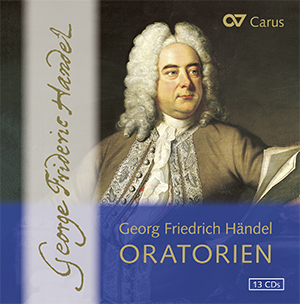
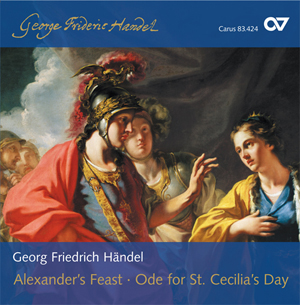
Avec l’oratorio Alexander’s Feast, Händel ouvre la saison des oratorios avec faste en 1736. Dans la première partie, le texte représente le pouvoir de la musique à partir de la célébration de la victoire d’Alexandre le Grand. La musique est donc polyphonique, avec de larges coloratures et des tempi rapides. Cette interprétation musicale et raffinée du texte donne justement ce charme sonore si particulier, mais il s’agit aussi des passages difficiles qui sont de véritables défis pour les choristes.
Remarque : cet enregistrement correspond à la version de la création de 1739 (version a dans la partition pour piano). La version b et le n° 30a « Your voices tune » ne sont pas inclus.
L’enregistrement original a été réalisé avec un accordage d’époque. Il sonne environ un demi-ton plus grave que l’accordage moderne de notre piano.Il suffit de s’exercer. Partout. A tout moment.
Que ce soit à la maison sur votre tablette ou votre PC ou en déplacement sur votre smartphone : avec carus music, the Choir Coach, vous avez toujours vos œuvres chorales avec vous pour vous entraîner ! Avec l’application chorale de carus music, vous pouvez écouter votre partition ainsi qu’un enregistrement de première qualité sur n’importe quel appareil et vous entraîner facilement à votre propre partie de chœur avec un coach. Avec carus music, la préparation de vos concerts est facile, efficace et amusante à maîtriser !
Interprètes: Simone Kermes (soprano), Virgil Hartinger (tenore), Konstantin Wolff (basso) – Collegium Cartusanium, Kölner Kammerchor – Peter Neumann
Découvrir
 Ecouter
(28)
Ecouter
(28)
- Recitative (Tenore): The praise of Bacchus
- Arioso (Soprano): Softly sweet, in Lydian measures
- Chorus: The many rend the skies
- Ouverture
- Recitative (Tenore): ‘Twas at the royal feast
- Air (Tenore) and Chorus: Happy, happy, happy pair!
- Recitative (Tenore): Timotheus plac’d on high
- Accompagnato (Soprano): The song began from Jove
- Chorus: The list’ning crowd admire the lofty sound
- Air (Soprano): With ravish’d ears
- Air (Basso): Bacchus, ever fair – Chorus: Bacchus’ blessings are a treasure
- Recitative (Tenore): Sooth’d with the sound
- Accompagnato (Soprano): He chose a mournful muse
- Air (Soprano): He sung Darius great and good
- Accompagnato (Soprano): With downcast looks the joyless victor sate
- Chorus: Behold Darius, great and good
- Recitative (Tenore): The mighty master smil’d to see
- Air (Soprano): War, he sung, is toil and trouble
- Chorus: The many rend the skies
- Air (Soprano): The Prince, unable to conceal his pain
- Accompagnato (Tenore): Now strike the golden lyre; Chorus: Break his bands of sleep; Accompagnato (Tenore): Hark! hark! – the horrid sound
- Air (Basso): Revenge, Timotheus cries
- Accompagnato (Tenore): Give the vengeance due
- Air (Tenore): The princes applaud with a furious joy
- Air (Soprano): Thais led the way; Chorus: The princes applaud with a furious joy
- Accompagnato (Tenore): Thus long ago; Chorus: At last divine Cecilia came
- Recitative (Tenore, Basso): Let old Timotheus yield the prize
- Chorus: Let old Timotheus yield the prize
 Compléments
- Acheter des compléments au format téléchargement.
-
 Texte numérique (sans notes), licence d'impression incluse, fichier html, paroles, traduction allemandefichier html, paroles, traduction allemande (Extrait)
Erster Teil
1. Ouvertüre
2. Rezitativ (Tenore) Es war beim Königsfest, als Persien gewonnen war
durch Philipps kriegerischen Sohn.
In erhabener Pracht
saß der göttergleiche Held
auf seinem Herrscherthron,
umringt von seiner tapfern Feldherrn Schar,
die Ros’ und Myrten froh bekränzt,
wie sie durch ihren Sieg verdient.
Zur Seite ihm die liebliche Thais saß
geschmückt wie eine Braut des Morgenlandes,
in jugendlichem Glanz und stolzer Freude.3. Arie (Tenore) und Chor Glücklich, glücklich, glücklich Paar!
Allein der Tapfere verdient die Schöne.4. Rezitativ (Tenore) Timotheus, der erhöht
unter den Sängern sitzt
...
-
Texte numérique (sans notes), licence d'impression incluse, fichier html, paroles, originalfichier html, paroles, original (Extrait)
First Part
1. Ouverture
2. Recitative (Tenore) ’Twas at the royal feast, for Persia won
by Philip’s warlike son.
Aloft in awful state
the god-like hero sate
on his imperial throne;
his valiant peers were plac’d around,
their brows with roses and with myrtles bound.
So should desert in arms be crown’d.
The lovely Thais by his side
sate like a blooming Eastern bride,
in flow’r of youth, and beauty’s pride.3. Air (Tenore) and Chorus Happy, happy, happy pair!
None but the brave deserves the fair.4. Recitative (Tenore) Timotheus plac’d on high,
amid the tuneful quire,
...
Acheter
Informations complémentaires sur l'œuvre
Sommaire

-
Compositeur
Georg Friedrich Händel
| 1685-1759Georg Friedrich Händel a démontré très tôt ses capacités de composition universelle exceptionnelles. Après s'être installé à Londres en 1712, il y créa - nommé Composer of Musick for His Majesty's Chapel Royal en 1723 - de nombreux chefs-d'œuvre pour la cour royale ainsi que ses grandes séries d'opéras : pendant des années, il connut des succès triomphants avec des opéras chantés par des interprètes d'exception ou avec des sérénades, plus tard aussi avec des oratorios comme "Saul" ou "Israel in Egypt". Au fil des années, la renommée de Haendel s'est étendue bien au-delà de son lieu de travail ; certaines de ses œuvres chorales, notamment le "Messiah", disposent d'une tradition d'exécution qui ne s'est jamais démentie et sont chantées par des chœurs du monde entier. Plus d'information sur la personne
-
Ensemble
Kölner Kammerchor
-
Ensemble
Collegium Cartusianum
The period instrument ensemble Collegium Cartusianum, founded in 1988 as successor to the Barockorchester Koln, has a repertoire ranging from Monteverdi to Brahms. The ensemble’s participation in the complete recording of Wolfgang Amadeus Mozart’s masses conducted by Peter Neumann earned it an outstanding reputation, subsequently confirmed by many concerts, radio broadcasts and CD recordings. As well as collaborating with the Kolner Kammerchor, the Collegium Cartusianum has also received international acclaim for its performances of J. S. Bach’s Orchestral Suites as well as Mozart and Beethoven symphonies. With Mozart’s Il Re Pastore, Mendelssohn’s St. Paul and Elijah, and Dvo?ak’s Requiem the orchestra has extended its repertoire to include opera and romantic works. It has appeared at many leading festivals in Europe and Japan, recently at the Leipzig Bach Festival with a Handel-Bach program, with Handel’s Serenata Aci, Galatea e Polifemo in Krakow and Essen at the second “Fest fur Alte Musik” in Cologne in February 2012. Plus d'information sur la personne
-
Chef d'orchestre
Peter Neumann
| 1940-2025In recent years Peter Neumann, born in Karlsruhe, has made a name for himself particularly as a conductor of Handel’s music. This is demonstrated both by the concert series “250 Years Handel Oratorios” which he initiated – performing nine music dramas in accordance with Handel’s concert schedule of 1749–1752 – and by his numerous CD recordings. He has performed masterworks from vocal and orchestral music in the European musical capitals and at many renowned festivals, ranging from Monteverdi’s L’Orfeo and Vespers for the Blessed Virgin (Palais Garnier, Paris) through J. S. Bach’s passions (last in Moscow, Oslo and Versailles) and Mass in B minor (BBC Proms) to Debussy’s Le Martyre de Saint Sébastien at the MusikTriennale in Cologne. 2010, Peter Neumann and his ensembles Kolner Kammerchor and Collegium Cartusianum were guests at the Rheingau Music Festival with Schumann’s Das Paradies und die Peri and at the Schumann Festival in Dusseldorf as well as the Leipzig Bach Festival in 2011. In June 2012 he made his highly acclaimed debut at the Cologne Opera with Handel’s Alcina. As a guest conductor, Neumann has collaborated with, among others, ChorWerkRuhr, the Netherlands Chamber Choir, the SWR Vokalensemble Stuttgart, the NDR Choir, the Schola Cantorum Tokyo, the Concertgebouw Orchestra Amsterdam, the Jerusalem Symphony Orchestra, the Junge Deutsche Philharmonie and Concerto Koln. Highlights of his extensive discography include the complete recording of Mozart’s masses (Gramophone “Crown of Crowns”), Schutz’s Musical Vesper, Schumann’s Missa sacra (Diapason d’Or) and recordings of Bach’s St. John Passion and Handel’s Alexander’s Feast and Brockes Passion (Carus). Plus d'information sur la personne
-
Solist - soprano
Simone Kermes
Internationally Simone Kermes is one of the most sought after sopranos for dramatic roles. Her unusually large vocal range predestined her for the virtuoso works of the baroque masters, but also for soprano roles and arias of Mozart, Haydn and Beethoven. Artistic engagements have taken her to the largest, most famous concert halls in the world. She has given solo concerts in such venues as Carnegie Hall, Tchaikovsky Hall in Moscow, and the Palau de la music in Barcelona. In addition to many radio and television productions she has recorded many CDs. She has received numerous awards for her solo albms, including the annual prize of the German Record Critics, the Diapason d’Or, BBC music choice, Gramophone Disc of the month and the ECHO Classic award. Plus d'information sur la personne
-
Solist - ténor
Virgil Hartinger
Virgil Hartinger studied at the Mozarteum in Salzburg, the Eastman School of Music and the Oberlin Conservatory in the USA, and has taken part in master classes with Thomas Hampson, Ernst Haefliger and Richard Miller. He has worked with conductors including Jamie Laredo, Ton Koopman, Peter Neumann, Paul O’Dette, Reinhard Goebel, Christophe Coin and Sigiswald Kuijken. His repertoire ranges from the renaissance to contemporary works in concert and operatic repertoire. While still studying, he began a busy concert schedule which has taken him to the Salzburg Festival, the Folle Journée in Nantes and Lisbon, the Concertgebouw (Amsterdam), Theâtre des Champs Élysées (Paris), Prinzregententheater (Munich) and Carnegie Hall. Plus d'information sur la personne
-
Solist - basse
Konstantin Wolff
Konstantin Wolff studied with Donald Litaker at the Hochschule für Musik in Karlsruhe. He won the Felix Mendelssohn Bartholdy Prize from the Stiftung Preußischer Kulturbesitz, was awarded a scholarship by the German National Academic Foundation and made his opera debut in 2005 at the Opera National de Lyon under William Christie in Monteverdi’s L’incoronazione di Poppea. His concert repertoire ranges from the early baroque to the 20th century. He has performed with conductors including Gerd Albrecht, Alun Francis, Riccardo Chailly, Ton Koopman, René Jacobs, Claudio Abbado, Sir Simon Rattle and Nicholas McGegan. His first solo CD, a recording of Lieder to texts by Victor Hugo, has been enthusiastically received. Plus d'information sur la personne
Les évaluations sur notre site web ne peuvent être effectuées que par des clients disposant d'un compte d'utilisateur enregistré. Il n'est pas vérifié si les produits évalués ont été effectivement achetés.
Aucune évaluation disponible pour ce produit.
Questions fréquentes sur l'œuvre
 Il n'y a pas encore de questions et réponses concernant cette œuvre ou vous n'avez pas trouvé la réponse à votre question sur l'œuvre ? Cliquez ici et envoyez votre question spécifique à notre service clients.