

Alexander's Feast
Ode. Version of the first performance and version of 1751 HWV 75, 1736/1751
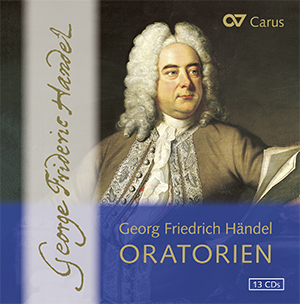
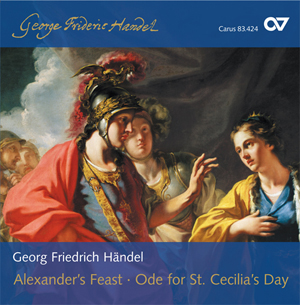
Handel opened the 1736 oratorio season in splendid fashion with Alexander’s Feast. The libretto depicts the power of music in the first part, in the form of a victory celebration for Alexander the Great. Accordingly the setting is contrapuntal, with extended coloratura passages and fast tempi. It is precisely this sophisticated musical interpretation of the text which constitutes the particular charm of the work, but at the same time there are ambitious, challenging passages for the choral singers here.
Please note: The recording corresponds to the version of the premiere in 1739 (version a in the vocal score). Version b and No. 30a Your voices tune are not included.
The underlying recording was made using a historical tuning. It sounds approximately a semitone lower than our modern piano tuning.
Simply practice. Anytime. Everywhere.
Whether at home on your tablet or PC or on the road on your smartphone: with carus music, the Choir Coach, you always have your choral works with you to practice! With the carus music choir app, you can listen to your score together with a first-class recording on any device and easily practice your own choir part with a coach. With carus music, your concert preparation is easy, efficient and fun to master!
Performers: Simone Kermes (soprano), Virgil Hartinger (tenore), Konstantin Wolff (basso) – Collegium Cartusanium, Kölner Kammerchor – Peter Neumann
Explore
 Listen
(28)
Listen
(28)
- Recitative (Tenore): The praise of Bacchus
- Arioso (Soprano): Softly sweet, in Lydian measures
- Chorus: The many rend the skies
- Ouverture
- Recitative (Tenore): ‘Twas at the royal feast
- Air (Tenore) and Chorus: Happy, happy, happy pair!
- Recitative (Tenore): Timotheus plac’d on high
- Accompagnato (Soprano): The song began from Jove
- Chorus: The list’ning crowd admire the lofty sound
- Air (Soprano): With ravish’d ears
- Air (Basso): Bacchus, ever fair – Chorus: Bacchus’ blessings are a treasure
- Recitative (Tenore): Sooth’d with the sound
- Accompagnato (Soprano): He chose a mournful muse
- Air (Soprano): He sung Darius great and good
- Accompagnato (Soprano): With downcast looks the joyless victor sate
- Chorus: Behold Darius, great and good
- Recitative (Tenore): The mighty master smil’d to see
- Air (Soprano): War, he sung, is toil and trouble
- Chorus: The many rend the skies
- Air (Soprano): The Prince, unable to conceal his pain
- Accompagnato (Tenore): Now strike the golden lyre; Chorus: Break his bands of sleep; Accompagnato (Tenore): Hark! hark! – the horrid sound
- Air (Basso): Revenge, Timotheus cries
- Accompagnato (Tenore): Give the vengeance due
- Air (Tenore): The princes applaud with a furious joy
- Air (Soprano): Thais led the way; Chorus: The princes applaud with a furious joy
- Accompagnato (Tenore): Thus long ago; Chorus: At last divine Cecilia came
- Recitative (Tenore, Basso): Let old Timotheus yield the prize
- Chorus: Let old Timotheus yield the prize
 Additional material
- Purchase additional material as a download product.
-
 Digital text (without sheet music) incl. printing licence, html file, singing text, german translationhtml file, singing text, german translation (Sample)
Erster Teil
1. Ouvertüre
2. Rezitativ (Tenore) Es war beim Königsfest, als Persien gewonnen war
durch Philipps kriegerischen Sohn.
In erhabener Pracht
saß der göttergleiche Held
auf seinem Herrscherthron,
umringt von seiner tapfern Feldherrn Schar,
die Ros’ und Myrten froh bekränzt,
wie sie durch ihren Sieg verdient.
Zur Seite ihm die liebliche Thais saß
geschmückt wie eine Braut des Morgenlandes,
in jugendlichem Glanz und stolzer Freude.3. Arie (Tenore) und Chor Glücklich, glücklich, glücklich Paar!
Allein der Tapfere verdient die Schöne.4. Rezitativ (Tenore) Timotheus, der erhöht
unter den Sängern sitzt
...
-
Digital text (without sheet music) incl. printing licence, html file, singing text, originalhtml file, singing text, original (Sample)
First Part
1. Ouverture
2. Recitative (Tenore) ’Twas at the royal feast, for Persia won
by Philip’s warlike son.
Aloft in awful state
the god-like hero sate
on his imperial throne;
his valiant peers were plac’d around,
their brows with roses and with myrtles bound.
So should desert in arms be crown’d.
The lovely Thais by his side
sate like a blooming Eastern bride,
in flow’r of youth, and beauty’s pride.3. Air (Tenore) and Chorus Happy, happy, happy pair!
None but the brave deserves the fair.4. Recitative (Tenore) Timotheus plac’d on high,
amid the tuneful quire,
...
Purchase
Additional product information
Contents

-
Composer
Georg Friedrich Händel
| 1685-1759George Frideric Handel put his exceptionally versatile compositional abilities to the test at an early age. After moving to London in 1712, where he was appointed Composer of Musick for His Majesty’s Chapel Royal in 1723, he wrote numerous masterpieces for the royal court as well as his major opere serie. For many years he enjoyed triumphant successes with his operas, which were sung by outstanding performers, with serenades, and later also with oratorios such as Saul and Israel in Egypt. Over the years Handel’s reputation grew far beyond the city where he worked; some of his choral works, particularly Messiah, have enjoyed a performance tradition which remains unbroken to this day, and are sung by choirs throughout the world. Personal details
-
Ensemble
Kölner Kammerchor
-
Ensemble
Collegium Cartusianum
The period instrument ensemble Collegium Cartusianum, founded in 1988 as successor to the Barockorchester Koln, has a repertoire ranging from Monteverdi to Brahms. The ensemble’s participation in the complete recording of Wolfgang Amadeus Mozart’s masses conducted by Peter Neumann earned it an outstanding reputation, subsequently confirmed by many concerts, radio broadcasts and CD recordings. As well as collaborating with the Kolner Kammerchor, the Collegium Cartusianum has also received international acclaim for its performances of J. S. Bach’s Orchestral Suites as well as Mozart and Beethoven symphonies. With Mozart’s Il Re Pastore, Mendelssohn’s St. Paul and Elijah, and Dvo?ak’s Requiem the orchestra has extended its repertoire to include opera and romantic works. It has appeared at many leading festivals in Europe and Japan, recently at the Leipzig Bach Festival with a Handel-Bach program, with Handel’s Serenata Aci, Galatea e Polifemo in Krakow and Essen at the second “Fest fur Alte Musik” in Cologne in February 2012. Personal details
-
Conductor
Peter Neumann
| 1940-2025In recent years Peter Neumann, born in Karlsruhe, has made a name for himself particularly as a conductor of Handel’s music. This is demonstrated both by the concert series “250 Years Handel Oratorios” which he initiated – performing nine music dramas in accordance with Handel’s concert schedule of 1749–1752 – and by his numerous CD recordings. He has performed masterworks from vocal and orchestral music in the European musical capitals and at many renowned festivals, ranging from Monteverdi’s L’Orfeo and Vespers for the Blessed Virgin (Palais Garnier, Paris) through J. S. Bach’s passions (last in Moscow, Oslo and Versailles) and Mass in B minor (BBC Proms) to Debussy’s Le Martyre de Saint Sébastien at the MusikTriennale in Cologne. 2010, Peter Neumann and his ensembles Kolner Kammerchor and Collegium Cartusianum were guests at the Rheingau Music Festival with Schumann’s Das Paradies und die Peri and at the Schumann Festival in Dusseldorf as well as the Leipzig Bach Festival in 2011. In June 2012 he made his highly acclaimed debut at the Cologne Opera with Handel’s Alcina. As a guest conductor, Neumann has collaborated with, among others, ChorWerkRuhr, the Netherlands Chamber Choir, the SWR Vokalensemble Stuttgart, the NDR Choir, the Schola Cantorum Tokyo, the Concertgebouw Orchestra Amsterdam, the Jerusalem Symphony Orchestra, the Junge Deutsche Philharmonie and Concerto Koln. Highlights of his extensive discography include the complete recording of Mozart’s masses (Gramophone “Crown of Crowns”), Schutz’s Musical Vesper, Schumann’s Missa sacra (Diapason d’Or) and recordings of Bach’s St. John Passion and Handel’s Alexander’s Feast and Brockes Passion (Carus). Personal details
-
Soloist - soprano
Simone Kermes
Internationally Simone Kermes is one of the most sought after sopranos for dramatic roles. Her unusually large vocal range predestined her for the virtuoso works of the baroque masters, but also for soprano roles and arias of Mozart, Haydn and Beethoven. Artistic engagements have taken her to the largest, most famous concert halls in the world. She has given solo concerts in such venues as Carnegie Hall, Tchaikovsky Hall in Moscow, and the Palau de la music in Barcelona. In addition to many radio and television productions she has recorded many CDs. She has received numerous awards for her solo albms, including the annual prize of the German Record Critics, the Diapason d’Or, BBC music choice, Gramophone Disc of the month and the ECHO Classic award. Personal details
-
Soloist - tenor
Virgil Hartinger
Virgil Hartinger studied at the Mozarteum in Salzburg, the Eastman School of Music and the Oberlin Conservatory in the USA, and has taken part in master classes with Thomas Hampson, Ernst Haefliger and Richard Miller. He has worked with conductors including Jamie Laredo, Ton Koopman, Peter Neumann, Paul O’Dette, Reinhard Goebel, Christophe Coin and Sigiswald Kuijken. His repertoire ranges from the renaissance to contemporary works in concert and operatic repertoire. While still studying, he began a busy concert schedule which has taken him to the Salzburg Festival, the Folle Journée in Nantes and Lisbon, the Concertgebouw (Amsterdam), Theâtre des Champs Élysées (Paris), Prinzregententheater (Munich) and Carnegie Hall. Personal details
-
Soloist - bass
Konstantin Wolff
Konstantin Wolff studied with Donald Litaker at the Hochschule für Musik in Karlsruhe. He won the Felix Mendelssohn Bartholdy Prize from the Stiftung Preußischer Kulturbesitz, was awarded a scholarship by the German National Academic Foundation and made his opera debut in 2005 at the Opera National de Lyon under William Christie in Monteverdi’s L’incoronazione di Poppea. His concert repertoire ranges from the early baroque to the 20th century. He has performed with conductors including Gerd Albrecht, Alun Francis, Riccardo Chailly, Ton Koopman, René Jacobs, Claudio Abbado, Sir Simon Rattle and Nicholas McGegan. His first solo CD, a recording of Lieder to texts by Victor Hugo, has been enthusiastically received. Personal details
Reviews on our website can only be submitted by customers with a registered user account. A check whether the rated products were actually purchased does not take place.
No feedback available for this product.
Frequent questions about this work
 There are no questions and answers available so far or you were unable to find an answer to your specific question about this work? Then click here and send your specific questions to our Customer Services!