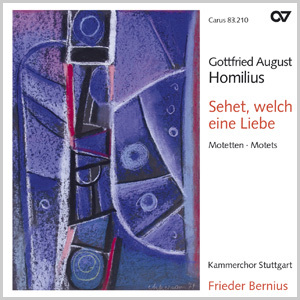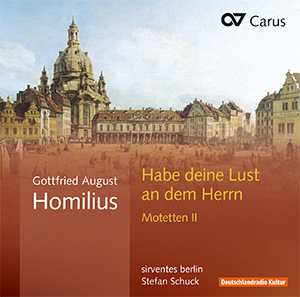
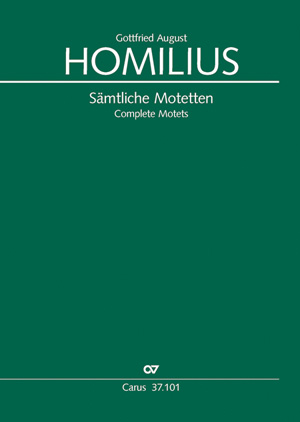
Complete Motets
 Consulter

 Ecouter
(31)
Ecouter
(31)
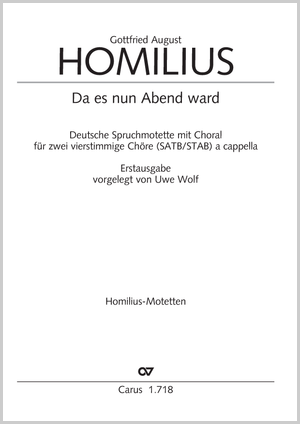
- Da es nun Abend ward
- He who weeping soweth
- Was hast du, Mensch
- Herr, wenn Trübsal da ist
- Die richtig für sich gewandelt haben (1)
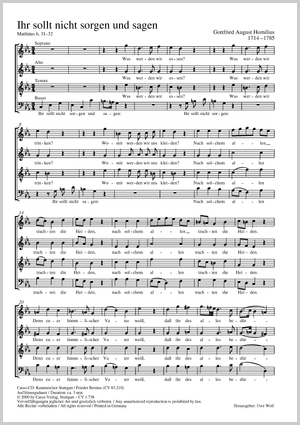
- Ihr sollt nicht sorgen und sagen
- Let all the gates be raised
- Wünschet Jerusalem Glück (2)
- So gehst du nun, mein Jesu, hin
- See now, this is God's own Lamb
- Herr, lehre uns bedenken
- Unser Leben währet siebenzig Jahr
- Blest are the departed
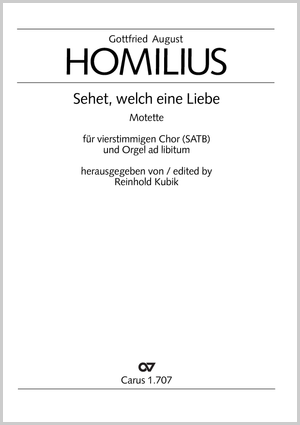
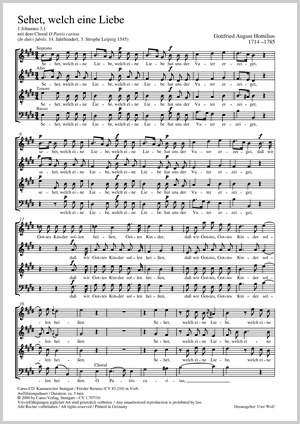
- See now, what kind of love
- Ob jemand sündiget
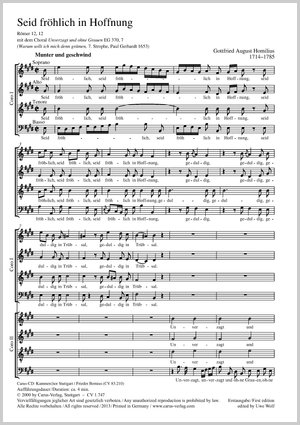
- Seid fröhlich in Hoffnung
- Unser Vater in dem Himmel
- All the starving shall be nourished
- Habe deine Lust an dem Herrn
- Kommt her und sehet an die Wunder Gottes
- Give the hungry ones thy bread
- Ich will den Herrn loben allezeit (1)
- Mir hast du Arbeit gemacht
- Dennoch bleib ich stets an dir
- Die richtig für sich gewandelt haben (2)
- Lasset euch begnügen
- Wo ist ein solcher Gott
- Der Herr ist meine Stärke
- Siehe, des Herrn Auge
- The Lord is my shepherd
- Hilf, Herr! Die Heiligen haben abgenommen
Sommaire


-
Compositeur
Gottfried August Homilius
| 1714-1785Gottfried August Homilius, the son of a pastor, was born in Rosenthal (Saxony) on 2 February 1714. In May 1735 he enrolled as a law student at Leipzig University. Likewise, it was probably at this time that Homilius was a pupil of Johann Sebastian Bach; the latter fact had been attested to by Johann Adam Hiller. Apart from Bach, Homilius also had contact with Johann Schneider, a Bach pupil and organist at the Nicolaikirche, for whom he also substituted. After unsuccesfully applying for a post as organist in Bautzen, Homilius was appointed organist at the Dresden Frauenkirche in 1742. In 1755 Homilius succeeded Theodor Christlieb Reinhold as Kreuzkantor and music director of the three main churches in Dresden, a position that he occupied until his death on 2 June 1785. Plus d'information sur la personne
-
Éditeur
Uwe Wolf
| 1961Uwe Wolf est un musicologue spécialisé dans les 17e et 18e siècles. Ses domaines de travail s'étendent de l'époque de Monteverdi et de Schütz au classicisme viennois en passant par Bach et la génération des fils et élèves de Bach. Depuis octobre 2011, il dirige le lectorat de la maison d'édition Carus. Auparavant, il a travaillé pendant plus de 20 ans dans la recherche sur Bach. Plus d'information sur la personne
Critiques
Es ist bemerkenswert und dem herausgebenden Carus-Verlag hoch anzurechnen, dass die Werke des lange Zeit in Vergessenheit geratenen und doch bedeutendsten Kirchenkomponisten des sogenannten »Empfindsamen Stiles« nicht nur als konzertante Musik, sondern dezidiert als sakrale Musik im Aufführungskontext des gottesdienstlichen und liturgischen Tuns verstanden werden, da dieser sowohl für die evangelische als auch für die katholische Kirchenmusik den Sonntagen im Kirchenjahr die passenden Motetten zuordnet.
Joachim Werz, Musica Sacra, Jan. / Feb. 2015
Les évaluations sur notre site web ne peuvent être effectuées que par des clients disposant d'un compte d'utilisateur enregistré. Il n'est pas vérifié si les produits évalués ont été effectivement achetés.
Questions fréquentes sur l'œuvre
 Il n'y a pas encore de questions et réponses concernant cette œuvre ou vous n'avez pas trouvé la réponse à votre question sur l'œuvre ? Cliquez ici et envoyez votre question spécifique à notre service clients.