Alles, was Odem hat + Psalm 117
Christoph JK Müller hat mit seiner groß angelegten Vertonung des 22. Psalms ein fesselndes Chorwerk geschaffen. Die bildgewaltige Sprache der biblischen Vorlage überträgt er in moderne, mitreißende Klänge: Das Ergebnis ist die Kombination aus eingängiger Melodik, kraftvoller Rhythmik und schlüssiger Dramaturgie. Die Komposition verhandelt eindrucksvoll den Kontrast zwischen Einsamkeit, Ausgrenzung und Anfeindung einerseits sowie Gottvertrauen, Hingabe und Beharrlichkeit andererseits – ein emotionales Ringen um Hoffnung in Krisenzeiten.
Das Werk entstand als Auftragskomposition der Landesakademie für die musizierende Jugend Baden-Württemberg, Ochsenhausen, und wurde beim internationalen Chorfestival C.H.O.I.R. uraufgeführt. Nicht nur für ambitionierte Ensembles kann Psalm 22 zu einem spannenden Repertoire-Highlight werden. Die Instrumentalbesetzung ist modular: Die vollständige Version umfasst Rhythmusgruppe (Klavier, Kontrabass, Schlagzeug), Bläser (Altsaxophon, Trompete, Tenorposaune) und einen vierstimmigen Streichersatz. Das Werk ist aber auch ohne Streicher (Small Band), ohne Bläser (nur Rhythmusgruppe) oder sogar nur mit Klavier aufführbar.
Nach 40 Minuten intensiver Musik bleiben pulsierende Rhythmen und einprägsame Melodien im Ohr – ein vielseitiges, spannungsgeladenes Erlebnis, das Aufführende wie Zuhörende noch lange begleitet und bewegt.
Découvrir
 Consulter

Acheter
Informations complémentaires sur l'œuvre
Sommaire

-
Compositeur
Heinrich Schütz
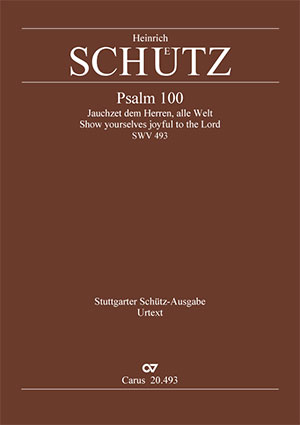
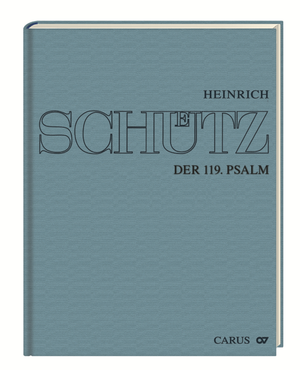
| 1585-1672Heinrich Schütz is regarded as the first German musician of European stature. As a choirboy from 1599 at the court of Landgrave Moritz of Hessen-Kassel, he received a thorough education. In 1608 he began a law degree in Marburg, but broke this off in 1609 in order, with the support of the Landgrave, to study composition with Giovanni Gabrieli, organist at St Mark’s in Venice. In 1613 Schütz returned to Kassel, but two years later was enticed away by Elector Johann Georg I of Saxony to the Dresden court as “Organist und Director der Musica”, where he held the position of Hofkapellmeister (court Kapellmeister) from 1617 until his death. Schütz’s great cycles of vocal works marked the high point of his reputation in Germany and northern Europe. But these represent only part of Schütz’s output; individual works are represented in printed collections with works by other composers, others only survive in manuscript, and much has been lost. The Stuttgart Schütz Edition makes available Schütz’s complete oeuvre, and all works are also published in practical Urtext editions. Plus d'information sur la personne
Les évaluations sur notre site web ne peuvent être effectuées que par des clients disposant d'un compte d'utilisateur enregistré. Il n'est pas vérifié si les produits évalués ont été effectivement achetés.
Aucune évaluation disponible pour ce produit.
Questions fréquentes sur l'œuvre
 Il n'y a pas encore de questions et réponses concernant cette œuvre ou vous n'avez pas trouvé la réponse à votre question sur l'œuvre ? Cliquez ici et envoyez votre question spécifique à notre service clients.