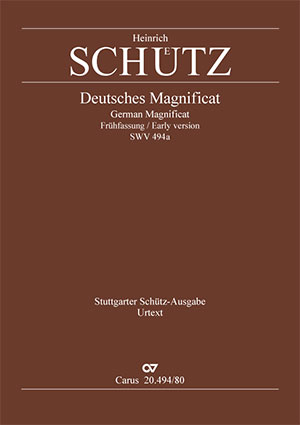
Deutsches Magnificat: Meine Seele erhebt den Herren. Gubener Fassung
Frühfassung SWV 494a
The Deutsches Magnificat SWV 494 from the Schwanengesang by Heinrich Schütz is one of the composer’s most popular works. It survives both within the Opus ultimum, but is the only work in the Schwanengesang to also survive separately – in a different version, evidently composed earlier (SWV 494a). The two versions clearly differ, particularly in the final section; Schütz did not compose a new version, but combined the existing musical components in a new and different way. In contrast with the version in the Schwanengesang, the earlier version survives complete and did not have to be reconstructed.
Découvrir
 Consulter
 Compléments
- Acheter des compléments au format téléchargement.
-
 Texte numérique (sans notes), licence d'impression incluse, fichier html, paroles, traduction en anglaisfichier html, paroles, traduction en anglais (Extrait)
Deutsches Magnificat: Meine Seele erhebt den Herren SWV 494 My soul doth magnify the Lord,
and my spirit hath rejoiced in God my Saviour.
For he hath regarded the low estate of his handmaiden:
for, behold, from henceforth
all generations shall call me blessed.
For he that is mighty hath done to me
great things; and holy is his name.
He hath shewed strength with his arm;
he hath scattered the proud
in the imagination of their hearts.
He hath put down the mighty from their seats,
and exalted them of low degree.
He hath fi lled the hungry with good things;
and the rich he hath sent empty away.
He hath helped his servant Israel,
in remembrance of his mercy;
as he spake to our fathers,
to Abraham, and to his seed for ever.
Lk 1:46-55
...
-
Texte numérique (sans notes), licence d'impression incluse, fichier html, paroles, originalfichier html, paroles, original (Extrait)
Deutsches Magnificat: Meine Seele erhebt den Herren SWV 494 Meine Seele erhebt den Herren,
und mein Geist freuet sich Gottes, meines Heilandes.
Denn er hat die Niedrigkeit seiner Magd angesehen.
Siehe, von nun an
werden mich selig preisen alle Kindeskind,
denn er hat große Ding an mir getan,
der da mächtig ist und des Name heilig ist.
Er übet Gewalt mit seinem Arm
und zerstreuet, die hoffärtig sind
in ihres Herzens Sinn.
Er stößet die Gewaltigen vom Stuhl
und erhöhet die Niedrigen.
Die Hungerigen füllet er mit Gütern
und lässet die Reichen leer.
Er denket der Barmherzigkeit
und hilft seinem Diener Israel auf.
Wie er geredt hat unsern Vätern,
Abraham und seinem Samen ewiglich.
Lk 1,46–55
...
Acheter
Informations complémentaires sur l'œuvre
-
Compositeur
Heinrich Schütz
| 1585-1672Heinrich Schütz is regarded as the first German musician of European stature. As a choirboy from 1599 at the court of Landgrave Moritz of Hessen-Kassel, he received a thorough education. In 1608 he began a law degree in Marburg, but broke this off in 1609 in order, with the support of the Landgrave, to study composition with Giovanni Gabrieli, organist at St Mark’s in Venice. In 1613 Schütz returned to Kassel, but two years later was enticed away by Elector Johann Georg I of Saxony to the Dresden court as “Organist und Director der Musica”, where he held the position of Hofkapellmeister (court Kapellmeister) from 1617 until his death. Schütz’s great cycles of vocal works marked the high point of his reputation in Germany and northern Europe. But these represent only part of Schütz’s output; individual works are represented in printed collections with works by other composers, others only survive in manuscript, and much has been lost. The Stuttgart Schütz Edition makes available Schütz’s complete oeuvre, and all works are also published in practical Urtext editions. Plus d'information sur la personne
Les évaluations sur notre site web ne peuvent être effectuées que par des clients disposant d'un compte d'utilisateur enregistré. Il n'est pas vérifié si les produits évalués ont été effectivement achetés.
Aucune évaluation disponible pour ce produit.
Questions fréquentes sur l'œuvre
 Il n'y a pas encore de questions et réponses concernant cette œuvre ou vous n'avez pas trouvé la réponse à votre question sur l'œuvre ? Cliquez ici et envoyez votre question spécifique à notre service clients.