
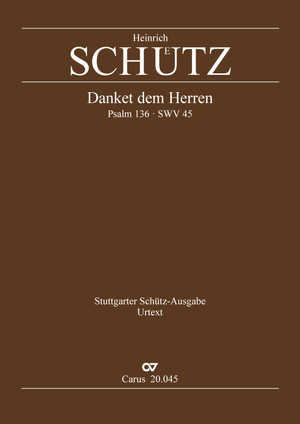
Danket dem Herren, denn er ist freundlich
from: Psalmen Davids II. Reconstruction SWV 45
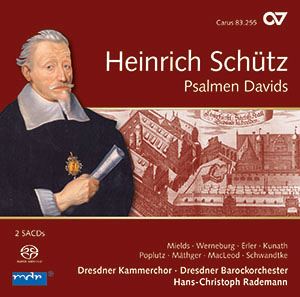
With this magnificent setting of Psalm 136 from the Psalmen Davids of 1619, Heinrich Schütz broke new ground: he brought the court trumpet ensemble into the realm of art music (similar to Michael Praetorius at around the same time). Alongside the trumpet ensemble, a five-part ripieno choir ensures musical splendor, whilst the leading role is given two two favoriti choirs, one high (SSTT) and one low (TTBB, scored for tenor and three trombones). Schütz did not write out the trumpet ensemble parts, but made do with notating just the middle part, around which the other parts were to improvise. For this critical edition, the trumpet ensemble is available separately in a reconstruction by the internationally-famous baroque trumpet specialist Edward H. Tarr. This edition is also used for the recording of the Psalm with the Dresdner Kammerchor conducted by Hans-Christoph Rademann.
Découvrir


 Ecouter
(1)
Ecouter
(1)
- Danket dem Herren, denn er ist freundlich
 Compléments
- Acheter des compléments au format téléchargement.
-
 Texte numérique (sans notes), licence d'impression incluse, fichier html, paroles, traduction en anglaisfichier html, paroles, traduction en anglais (Extrait)
O give thanks unto the Lord; for he is good:
for his mercy endureth for ever.
O give thanks unto the God of gods:
for his mercy endureth for ever.
O give thanks to the Lord of lords:
for his mercy endureth for ever.
To him who alone doeth great wonders:
for his mercy endureth for ever.
To him that by wisdom made the heavens:
for his mercy endureth for ever.
To him that stretched out the earth above the waters:
for his mercy endureth for ever.
To him that made great lights:
for his mercy endureth for ever:
The sun to rule by day:
for his mercy endureth for ever:
The moon and stars to rule by night:
for his mercy endureth for ever.
To him that smote Egypt in their firstborn:
for his mercy endureth for ever:...
-
Texte numérique (sans notes), licence d'impression incluse, fichier html, paroles, originalfichier html, paroles, original (Extrait)
Danket dem Herren; denn er ist freundlich,
denn seine Güte währet ewiglich.
Danket dem Gott aller Götter,
denn seine Güte währet ewiglich.
Danket dem Herrn aller Herren,
denn seine Güte währet ewiglich;
der große Wunder tut alleine,
denn seine Güte währet ewiglich;
der die Himmel ordentlich gemacht hat,
denn seine Güte währet ewiglich;
der die Erde auf Wasser ausgebreitet hat,
denn seine Güte währet ewiglich;
der große Lichter gemacht hat,
denn seine Güte währet ewiglich!
Die Sonn, dem Tage fürzustehen,
denn seine Güte währet ewiglich,
den Monden und Sterne, der Nacht fürzustehen:
denn seine Güte währet ewiglich;
der Ägypten schlug an ihren ersten Geburten,
denn seine Güte währet ewiglich,
und führt’ Israel heraus,
denn seine Güte währet ewiglich,
durch mächtige Hand und ausgestreckten Arm,...
-
Texte numérique (sans notes), licence d'impression incluse, fichier html, Texte introductif, en anglaisfichier html, Texte introductif, en anglais (Extrait)Text from the CD Carus 83.255
Oliver Geisler
Translation: Elizabeth Robinson“intended for singing”
The “Psalmen Davids” and the art of consolation Heinrich Schütz was fortunate. In the years around 1600 the number of portents of the end of the world increased. And this would also naturally affect the Dresden court, even if it sometimes seemed to be in a world of its own. Constellations of stars, curious events, cometary impacts – all these happenings were rapidly broadcast through the mass media of the Baroque – pamphlets and articles. And the more frequently there were signs giving cause for concern, the nearer the predicted end approached. In the mid-16th century, 2046 was marked out as the end. But at the time when Schütz took up his post in Dresden, the year 1625 was regarded as the point in time when the ‘last trumpet’ would sound. None of this happened – as stated, he was fortunate,...
-
Texte numérique (sans notes), licence d'impression incluse, fichier html, Texte introductif, en allemandfichier html, Texte introductif, en allemand (Extrait)Booklet-Text der CD Carus 83.255
Oliver Geisler
„zum singen gemeint“
Die Psalmen Davids und die Kunst des Zuspruchs Heinrich Schütz hatte Glück. In den Jahren um 1600 mehrten sich die Anzeichen für den Weltuntergang. Und der würde natürlich auch den Dresdner Hof betreffen, auch wenn dieser mitunter als eigener Kosmos erscheinen mochte. Sternenkonstellationen, kuriose Ereignisse, Kometeneinschläge – alle diese Geschehnisse verbreiteten sich rasant über die Massenmedien des Barock: Flugblätter und Sonderdrucke. Und je häufiger die besorgniserregenden Zeichen, desto näher rückte das prognostizierte Ende. Mitte des 16. Jahrhunderts war noch 2046 als Ende markiert. Zu jener Zeit, als Schütz in Dresden sein Amt antrat, galt das Jahr 1625 als Zeitpunkt, an dem die ‚letzte Posaune‘ erklingen würde. All das trat nicht ein – wie gesagt, er hatte Glück, aber eine Prognose bewahrheitete...
Acheter
Informations complémentaires sur l'œuvre
-
Compositeur
Heinrich Schütz
| 1585-1672Heinrich Schütz is regarded as the first German musician of European stature. As a choirboy from 1599 at the court of Landgrave Moritz of Hessen-Kassel, he received a thorough education. In 1608 he began a law degree in Marburg, but broke this off in 1609 in order, with the support of the Landgrave, to study composition with Giovanni Gabrieli, organist at St Mark’s in Venice. In 1613 Schütz returned to Kassel, but two years later was enticed away by Elector Johann Georg I of Saxony to the Dresden court as “Organist und Director der Musica”, where he held the position of Hofkapellmeister (court Kapellmeister) from 1617 until his death. Schütz’s great cycles of vocal works marked the high point of his reputation in Germany and northern Europe. But these represent only part of Schütz’s output; individual works are represented in printed collections with works by other composers, others only survive in manuscript, and much has been lost. The Stuttgart Schütz Edition makes available Schütz’s complete oeuvre, and all works are also published in practical Urtext editions. Plus d'information sur la personne
-
Éditeur
Uwe Wolf
| 1961Uwe Wolf est un musicologue spécialisé dans les 17e et 18e siècles. Ses domaines de travail s'étendent de l'époque de Monteverdi et de Schütz au classicisme viennois en passant par Bach et la génération des fils et élèves de Bach. Depuis octobre 2011, il dirige le lectorat de la maison d'édition Carus. Auparavant, il a travaillé pendant plus de 20 ans dans la recherche sur Bach. Plus d'information sur la personne
-
Basse continue réalisée
Paul Horn
| 1922-2016Paul Horn war ein deutscher Kirchenmusiker, Organist, Komponist und Musikwissenschaftler. Er studierte Kirchenmusik und Orgel an der Evangelischen Kirchenmusikschule Esslingen am Neckar bei Hans-Arnold Metzger und Musikwissenschaft, Theologie und Geschichte an der Universität Tübingen. Seine berufliche Laufbahn begann als Kantor an der Evangelischen Michaelskirche in Stuttgart-Degerloch. 1954 wurde er Kantor an der Evangelischen Stadtkirche Ravensburg, eine Position, die er bis zu seiner Pensionierung innehatte. Als Musikwissenschaftler arbeitete Horn bis ins hohe Alter eng mit Carus zusammen. So stammen zahlreiche Carus-Klavierauszüge aus seiner Feder. Plus d'information sur la personne
-
Arrangeur
Edward H. Tarr
| 1936-2020
Critiques
2004500
Die Vertonung des 136. Psalms Danket dem Herren, denn er ist freundlich SWV 45 ist eine der umfangreichsten und zugleich die prachtvollste Komposition innerhalb der Psalmen Davids.
Toccata 01/02/2016
Les évaluations sur notre site web ne peuvent être effectuées que par des clients disposant d'un compte d'utilisateur enregistré. Il n'est pas vérifié si les produits évalués ont été effectivement achetés.
Aucune évaluation disponible pour ce produit.
Questions fréquentes sur l'œuvre
 Il n'y a pas encore de questions et réponses concernant cette œuvre ou vous n'avez pas trouvé la réponse à votre question sur l'œuvre ? Cliquez ici et envoyez votre question spécifique à notre service clients.