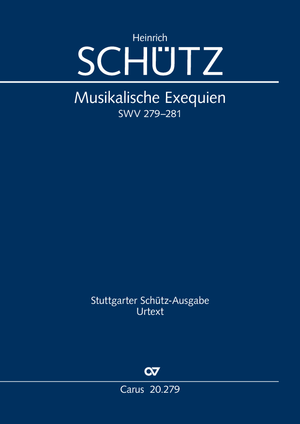
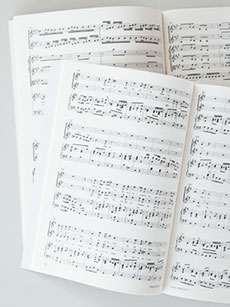
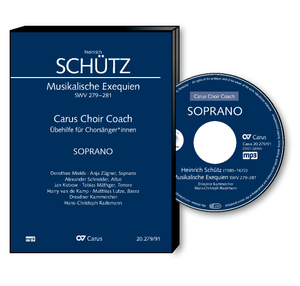
Heinrich Schuetz composed the Musikalische Exequien SWV 279–281 for the funeral of his patron Prince Heinrich Posthumus Reuß 1635/1636. Of the three parts, which were to be performed during three different sections of the funeral service, the first part, in the form of a sacred concerto for choir and soloists, is based on the numerous biblical passages which, in accordance with the instructions given by the deceased were to be recited at the coffin which the deceased himself had designed during his lifetime. This part is followed by a motet for double choir based on the text of a sermon (“Herr, wenn ich nur dich habe“), and at the conclusion of the hymn of praise to Simeon (“Herr, nun lässest du deinen Diener in Frieden fahren“), a choir apart from the main choir intones “Selig sind die Toten“ from heaven, so to speak. With this composition, written as a commission, Schuetz created one of the most artistic and heartfelt works of mourning ever written in the history of music.
Découvrir
 Ecouter
(3)
Ecouter
(3)
- Musique funéraire I
- Musique funéraire II
- Musique funéraire III
Acheter
Informations complémentaires sur l'œuvre
Sommaire


-
Compositeur
Heinrich Schütz
| 1585-1672Heinrich Schütz is regarded as the first German musician of European stature. As a choirboy from 1599 at the court of Landgrave Moritz of Hessen-Kassel, he received a thorough education. In 1608 he began a law degree in Marburg, but broke this off in 1609 in order, with the support of the Landgrave, to study composition with Giovanni Gabrieli, organist at St Mark’s in Venice. In 1613 Schütz returned to Kassel, but two years later was enticed away by Elector Johann Georg I of Saxony to the Dresden court as “Organist und Director der Musica”, where he held the position of Hofkapellmeister (court Kapellmeister) from 1617 until his death. Schütz’s great cycles of vocal works marked the high point of his reputation in Germany and northern Europe. But these represent only part of Schütz’s output; individual works are represented in printed collections with works by other composers, others only survive in manuscript, and much has been lost. The Stuttgart Schütz Edition makes available Schütz’s complete oeuvre, and all works are also published in practical Urtext editions. Plus d'information sur la personne
Les évaluations sur notre site web ne peuvent être effectuées que par des clients disposant d'un compte d'utilisateur enregistré. Il n'est pas vérifié si les produits évalués ont été effectivement achetés.
Aucune évaluation disponible pour ce produit.
Questions fréquentes sur l'œuvre
 Il n'y a pas encore de questions et réponses concernant cette œuvre ou vous n'avez pas trouvé la réponse à votre question sur l'œuvre ? Cliquez ici et envoyez votre question spécifique à notre service clients.