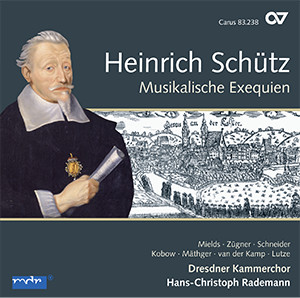
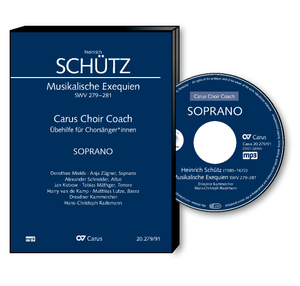
Heinrich Schuetz composed the Musikalische Exequien SWV 279–281 for the funeral of his patron Prince Heinrich Posthumus Reuß 1635/1636. Of the three parts, which were to be performed during three different sections of the funeral service, the first part, in the form of a sacred concerto for choir and soloists, is based on the numerous biblical passages which, in accordance with the instructions given by the deceased were to be recited at the coffin which the deceased himself had designed during his lifetime. This part is followed by a motet for double choir based on the text of a sermon (“Herr, wenn ich nur dich habe“), and at the conclusion of the hymn of praise to Simeon (“Herr, nun lässest du deinen Diener in Frieden fahren“), a choir apart from the main choir intones “Selig sind die Toten“ from heaven, so to speak. With this composition, written as a commission, Schuetz created one of the most artistic and heartfelt works of mourning ever written in the history of music.
Découvrir
 Consulter


 Ecouter
(2)
Ecouter
(2)
- Musique funéraire II
- Musique funéraire III
 Compléments
- Acheter des compléments au format téléchargement.
-
 Texte numérique (sans notes), licence d'impression incluse, fichier html, Texte introductif, en anglaisfichier html, Texte introductif, en anglais (Extrait)Text from the CD Carus 83.238
Oliver Geisler
Güldene SterbKunst – The “golden art” of dying Funeral music by Heinrich Schütz
Translation (abridged): Elizabeth RobinsonThe music of Heinrich Schütz is music which is close to life; a music which shares in the history and culture from which it emerged, and in which the experiences of “Sagittarius” (Schütz’s Latin name) himself have left unmistakable traces. This music is full of life – even when it celebrates death.
This does not mean that Schütz’s music should always be seen and heard against a background of suffering and death on a huge scale, as embodied in the raging of the Thirty Years’ War and the constant presence of deadly disease. On the contrary, it means that much of Schütz’s funeral music can be traced back to particular biographical events in his life. These are works which range from simple fourpart chorales to polychoral spatial music, and yet they always combine one thing: a particularly strong link between sensitivity to the text and sensuousness of sound, achieved by a simple musical message of consolation coupled with high expressivity. And all this with great personal sympathy. Schütz’s works, in which death and life, dying and
...
-
Texte numérique (sans notes), licence d'impression incluse, fichier html, Texte introductif, en allemandfichier html, Texte introductif, en allemand (Extrait)Text from the CD Carus 83.238
Oliver Geisler
Güldene SterbKunst – Trauermusiken von Heinrich SchützDie Musik von Heinrich Schütz ist eine Musik nah am Leben. Eine Musik, die teilnimmt an der Geschichte und Kultur, aus der sie hervorgeht und in der die Erfahrungen des 'Saggittarius' selbst untrügliche Spuren hinterlassen haben. Diese Musik ist nah am Leben – gerade, wenn sie das Sterben besingt.
Das meint nicht nur, dass die Musik von Schütz immer auch vor dem Hintergrund massenhaften Leidens und Sterbens angesichts eines 30 Jahre wütenden Weltkrieges und der Allgegenwart tödlicher Krankheiten zu sehen und zu hören ist. Es meint vielmehr, dass sich zahlreiche Trauermusiken Schütz' auf konkrete biografische Ereignisse im Leben Schütz' zurückführen lassen. Es sind Werke, die vom schlichten vierstimmigen Choral bis zur mehrchörigen Raummusik reichen und doch stets eines verbindet: die besonders intensive Verbindung aus Wortsorgfalt und Klangsinnlichkeit, aus schlichter musikalischer Trostpredigt und hoher Expressivität. Und all das mit großer persönlicher Anteilnahme. Jene Schütz'schen Werke, in denen Tod und Leben, Sterben und Ewigkeit, Trauer und Trost musikalisch wie theologisch besonders eindringlich
...
Acheter
Informations complémentaires sur l'œuvre
Sommaire


-
Compositeur
Heinrich Schütz
| 1585-1672Heinrich Schütz is regarded as the first German musician of European stature. As a choirboy from 1599 at the court of Landgrave Moritz of Hessen-Kassel, he received a thorough education. In 1608 he began a law degree in Marburg, but broke this off in 1609 in order, with the support of the Landgrave, to study composition with Giovanni Gabrieli, organist at St Mark’s in Venice. In 1613 Schütz returned to Kassel, but two years later was enticed away by Elector Johann Georg I of Saxony to the Dresden court as “Organist und Director der Musica”, where he held the position of Hofkapellmeister (court Kapellmeister) from 1617 until his death. Schütz’s great cycles of vocal works marked the high point of his reputation in Germany and northern Europe. But these represent only part of Schütz’s output; individual works are represented in printed collections with works by other composers, others only survive in manuscript, and much has been lost. The Stuttgart Schütz Edition makes available Schütz’s complete oeuvre, and all works are also published in practical Urtext editions. Plus d'information sur la personne
-
Éditeur
Günter Graulich
| 1926L'éditeur, cantor et pédagogue Günter Graulich est l'un des éditeurs importants de l'après-guerre en Allemagne. En 1972, il fonda avec son épouse Waltraud les Editions Carus-Verlag, qu'il fit évoluer d'un bureau de 2 personnes à une entreprise de près de 60 employés. Lui-même cantor pendant de longues années à l'église St Matthieu de Stuttgart, il dirigea pendant plus de 50 ans le Motettenchor Stuttgart. Il réalisa avec ce chœur plusieurs enregistrements sur disques vinyls et CD, et de nombreuses tournées à travers l'Europe et l'Amérique. Plus d'information sur la personne
-
Basse continue réalisée
Paul Horn
| 1922-2016Paul Horn war ein deutscher Kirchenmusiker, Organist, Komponist und Musikwissenschaftler. Er studierte Kirchenmusik und Orgel an der Evangelischen Kirchenmusikschule Esslingen am Neckar bei Hans-Arnold Metzger und Musikwissenschaft, Theologie und Geschichte an der Universität Tübingen. Seine berufliche Laufbahn begann als Kantor an der Evangelischen Michaelskirche in Stuttgart-Degerloch. 1954 wurde er Kantor an der Evangelischen Stadtkirche Ravensburg, eine Position, die er bis zu seiner Pensionierung innehatte. Als Musikwissenschaftler arbeitete Horn bis ins hohe Alter eng mit Carus zusammen. So stammen zahlreiche Carus-Klavierauszüge aus seiner Feder. Plus d'information sur la personne
-
Traducteur
Jean Lunn
Les évaluations sur notre site web ne peuvent être effectuées que par des clients disposant d'un compte d'utilisateur enregistré. Il n'est pas vérifié si les produits évalués ont été effectivement achetés.
Aucune évaluation disponible pour ce produit.
Questions fréquentes sur l'œuvre
 Il n'y a pas encore de questions et réponses concernant cette œuvre ou vous n'avez pas trouvé la réponse à votre question sur l'œuvre ? Cliquez ici et envoyez votre question spécifique à notre service clients.