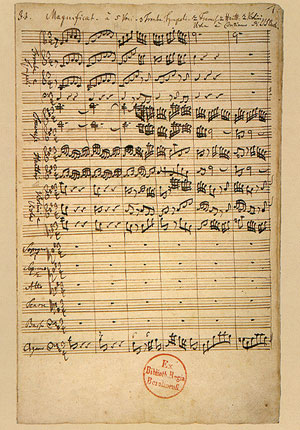
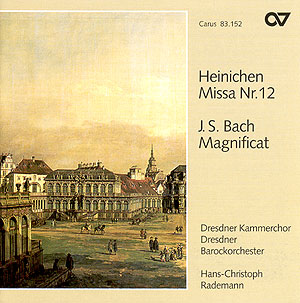
Bach écrit des œuvres particulièrement exigeantes et difficiles pendant sa première année passée à Leipzig en 1723. Le Magnificat compte aussi parmi celles-ci : d’abord créé en mi bémol majeur pour une exécution à Noël, et réécrit dans la version présente en ré majeur quelque huit années plus tard. L’œuvre requiert un chœur expérimenté. Les parties vocales sont en effet écrites comme pour des instruments et avec de nombreuses coloratures. Les lignes très mouvantes des parties avec de nombreux grands sauts d’intervalle doivent être bien exécutées et s’entrelacer dans le tissu dense des autres voix, par exemple dans les entrées serrées et imbriquées du « Omnes generationes » ou encore les longues coloratures en doubles croches du « Fecit potentiam ».
Remarque : les interludes du Magnificat ne sont pas inclus.
L’enregistrement original a été réalisé avec un accordage d’époque. Il sonne environ un demi-ton plus grave que l’accordage moderne de notre piano.Il suffit de s’exercer. Partout. A tout moment.
Que ce soit à la maison sur votre tablette ou votre PC ou en déplacement sur votre smartphone : avec carus music, the Choir Coach, vous avez toujours vos œuvres chorales avec vous pour vous entraîner ! Avec l’application chorale de carus music, vous pouvez écouter votre partition ainsi qu’un enregistrement de première qualité sur n’importe quel appareil et vous entraîner facilement à votre propre partie de chœur avec un coach. Avec carus music, la préparation de vos concerts est facile, efficace et amusante à maîtriser !
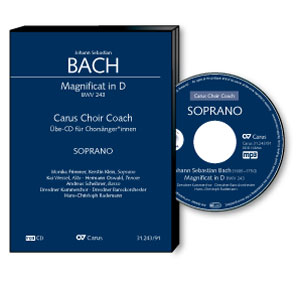
Interprètes: Monika Frimmer (soprano), Kerstin Klein (soprano), Kai Wessel (alto), Hermann Oswald (tenore), Andreas Scheibner (basso) – Dresdner Kammerchor, Dresdner Barockorchester – Hans-Christoph Rademann
Découvrir
 Ecouter
(12)
Ecouter
(12)
- Magnificat
- Et exsultavit
- Quia respexit
- Omnes generationes
- Quia fecit
- Et misericordia
- Fecit potentiam
- Deposuit potentes
- Esurientes
- Suscepit Israel
- Sicut locutus est
- Gloria patri
 S`exercer
-
 carus music, the Choir Coach
Üben mit carus music
carus music, the Choir Coach
Üben mit carus music
-
Aides à l'apprentissage
-
Aides à l'apprentissage voix soprano
- Magnificat (Choir Coach, soprano 1)
- Magnificat (Choir Coach, Slow mode, soprano 1)
- Magnificat (Choir Coach, soprano 2)
- Magnificat (Choir Coach, Slow mode, soprano 2)
- Omnes generationes (Choir Coach, soprano 1)
- Omnes generationes (Choir Coach, Slow mode, soprano 1)
- Omnes generationes (Choir Coach, soprano 2)
- Omnes generationes (Choir Coach, Slow mode, soprano 2)
- Fecit potentiam (Choir Coach, soprano 1)
- Fecit potentiam (Choir Coach, Slow mode, soprano 1)
- Fecit potentiam (Choir Coach, soprano 2)
- Fecit potentiam (Choir Coach, Slow mode, soprano 2)
- Suscepit Israel (Choir Coach, soprano 1)
- Suscepit Israel (Choir Coach, Slow mode, soprano 1)
- Suscepit Israel (Choir Coach, soprano 2)
- Suscepit Israel (Choir Coach, Slow mode, soprano 2)
- Sicut locutus est (Choir Coach, soprano 1)
- Sicut locutus est (Choir Coach, Slow mode, soprano 1)
- Sicut locutus est (Choir Coach, soprano 2)
- Sicut locutus est (Choir Coach, Slow mode, soprano 2)
- Gloria patri (Choir Coach, soprano 1)
- Gloria patri (Choir Coach, Slow mode, soprano 1)
- Gloria patri (Choir Coach, soprano 2)
- Gloria patri (Choir Coach, Slow mode, soprano 2)
-
Aides à l'apprentissage voix alto
- Magnificat (Choir Coach)
- Magnificat (Choir Coach, Slow mode)
- Omnes generationes (Choir Coach)
- Omnes generationes (Choir Coach, Slow mode)
- Fecit potentiam (Choir Coach)
- Fecit potentiam (Choir Coach, Slow mode)
- Suscepit Israel (Choir Coach)
- Suscepit Israel (Choir Coach, Slow mode)
- Sicut locutus est (Choir Coach)
- Sicut locutus est (Choir Coach, Slow mode)
- Gloria patri (Choir Coach)
- Gloria patri (Choir Coach, Slow mode)
-
Aides à l'apprentissage voix tenore
- Magnificat (Choir Coach)
- Magnificat (Choir Coach, Slow mode)
- Omnes generationes (Choir Coach)
- Omnes generationes (Choir Coach, Slow mode)
- Fecit potentiam (Choir Coach)
- Fecit potentiam (Choir Coach, Slow mode)
- Sicut locutus est (Choir Coach)
- Sicut locutus est (Choir Coach, Slow mode)
- Gloria patri (Choir Coach)
- Gloria patri (Choir Coach, Slow mode)
-
Aides à l'apprentissage voix basse
- Magnificat (Choir Coach)
- Magnificat (Choir Coach, Slow mode)
- Omnes generationes (Choir Coach)
- Omnes generationes (Choir Coach, Slow mode)
- Fecit potentiam (Choir Coach)
- Fecit potentiam (Choir Coach, Slow mode)
- Sicut locutus est (Choir Coach)
- Sicut locutus est (Choir Coach, Slow mode)
- Gloria patri (Choir Coach)
- Gloria patri (Choir Coach, Slow mode)
-
 Compléments
- Acheter des compléments au format téléchargement.
-
 Texte numérique (sans notes), licence d'impression incluse, fichier html, paroles, traduction allemandefichier html, paroles, traduction allemande (Extrait)
1. Magnificat (Coro SSATB) Hoch erhebt meine Seele den Herren.
2. Et exsultavit (Aria Soprano II) In Gott, meinem Heiland, jubelt mein Geist.
3. Quia respexit (Aria Soprano I) / 4. Omnes generationes (Coro) Er hat in Gnaden geschaut auf seine niedrige Magd,
Siehe, von nun an nennen mich selig alle Geschlechter.5. Quia fecit (Aria Basso) Großes hat der Gewaltige an mir getan,
dessen Name heilig ist.6. Et misericordia (Aria Alto, Tenore) Und sein Erbarmen währt von Geschlecht zu Geschlecht über die,
welche ihn fürchten.7. Fecit potentiam (Coro) Macht hat er geübt mit seinem Arm
und zerstreuet, die stolzen Herzens sind.8. Deposuit (Aria Tenore) Herrscher hat er vom Thron gestürzt,
...
-
Texte numérique (sans notes), licence d'impression incluse, fichier html, paroles, originalfichier html, paroles, original (Extrait)
1. Magnificat (Coro SSATB) Magnificat anima mea Dominum.
2. Et exsultavit (Aria Soprano II) Et exsultavit spiritus meus in Deo salutari meo
3. Quia respexit (Aria Soprano I) / 4. Omnes generationes (Coro) Quia respexit humilitatem ancillae suae,
ecce enim ex hoc beatam me dicent omnes generationes.5. Quia fecit (Aria Basso) Quia fecit mihi magna qui potens est,
et sanctum nomen eius.6. Et misericordia (Aria Alto, Tenore) Et misericordia a progenie in progenies
timentibus eum.7. Fecit potentiam (Coro) Fecit potentiam in bracchio suo,
dispersit superbos mente cordis sui.8. Deposuit (Aria Tenore) Deposuit potentes de sede
et exaltavit humiles....
-
Texte numérique (sans notes), licence d'impression incluse, fichier html, Texte introductif, françaisfichier html, Texte introductif, français (Extrait)Texte du livret du CD Carus 83.152
Katrin Bemmann
Traduction (abrégée) : Jean Paul MénièreDepuis le Vle siècle, le « Magnificat », chant de louange à Marie, qui vient d’apprendre qu’elle va être la mère du Christ, constitue dans la liturgie catholique le point culminant des Vêpres. Avec la Réforme, les Vêpres, et avec elle le Magnificat, ont été reprises dans la liturgie protestante.
Le Magnificat latin de Johann Sebastian Bach existe en deux versions. La première, en mi bémol majeur, fut écrite en 1723, l’année où Bach entra en fonction à Leipzig, et conçue pour les Vêpres de Noël. Conformément aux circonstances, cette version fut augmentée de quatre séquences de Noël et les flûtes à bec prenaient, en raison de leur caractère pastoral, la place des flûtes traversières. Quelques années plus tard, Bach entreprit une révision de l’œuvre. Il changea la tonalité en ré majeur, supprima les quatre pièces rajoutées et confia
...
-
Texte numérique (sans notes), licence d'impression incluse, fichier html, Texte introductif, en anglaisfichier html, Texte introductif, en anglais (Extrait)Text from the CD Carus 83.152
Katrin Bemmann
Translation (abridged): John CoombsThe “Magnificat” – the song of praise of the Virgin Mary on hearing that she is to become the mother of Christ – has formed the climactic point of the service of Vespers in the liturgy of the Catholic Church since the 6th century. Following the Reformation Vespers, including the Magnificat, retained a place in the Protestant liturgy.
Johann Sebastian Bach’s Latin Magnificat exists in two versions. The first, in E flat major, was written in 1723, the year when he took up his position in Leipzig, and was intended for use in the Christmas Vespers. In view of that intention four Christmas pieces were added to this version, and instead of flutes Bach used recorders, with their pastoral character. A few years later Bach revised the work. He transposed it to D major, removed the Christmas pieces, and replaced the recorders by flutes, whose
...
-
Texte numérique (sans notes), licence d'impression incluse, fichier html, Texte introductif, en allemandfichier html, Texte introductif, en allemand (Extrait)Booklet-Text der CD Carus 83.152
Katrin Bemmann
Das „Magnificat“ – der Lobgesang Marias, nachdem sie erfahren hat, dass sie die Mutter Christi wird – bildet seit dem 6. Jahrhundert in der Liturgie der katholischen Kirche den Höhepunkt der Vesper. Musikalisch entwickelte sich aus der einstimmigen Psalmodie nach und nach eine vielfältige Palette von Formen, sei es als Lied, mehrstimmige Motette oder kantatenähnliche Vertonung mit Instrumentalbegleitung. Mit der Reformation wurde die Vesper und damit auch das Magnificat in die protestantische Liturgie übernommen.
Von Johann Sebastian Bachs lateinischem Magnificat existieren zwei Fassungen. Die erste in Es-Dur entstand in Bachs Leipziger Antrittsjahr 1723 und war für die Weihnachtsvesper bestimmt. Dem Anlass entsprechend war diese Fassung um vier weihnachtliche Einlagesätze erweitert, und statt Traversflöten fanden Blockflöten mit ihrem pastoralen Charakter Verwendung. Einige Jahre später nahm Bach eine Überarbeitung vor. Er änderte die Tonart in D-Dur, strich die vier zusätzlichen Stücke und übertrug den nunmehr besetzten Traversflöten größere Aufgaben.
...
Acheter
Informations complémentaires sur l'œuvre
Sommaire


-
Compositeur
Johann Sebastian Bach
| 1685-1750Jean-Sébastien Bach compte parmi les compositeurs les plus importants de l'histoire de la musique occidentale. Il était issu d'une dynastie de musiciens très ramifiée, qui a donné naissance à de nombreux musiciens municipaux et organistes dans la région de Thuringe et de Saxe.
Bach vocal
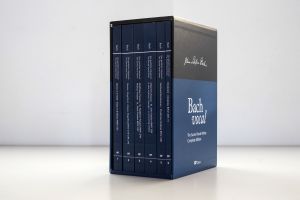
Depuis la création des éditions Carus, l’édition des œuvres de Jean-Sébastien Bach constitue pour nous une priorité particulière. À l’occasion de l’année commémorative de la Réforme, nous avons achevé le projet « Bach vocal ». La musique vocale sacrée de Bach est désormais disponible dans son intégralité sous forme d’éditions modernes « Urtext », accompagnées du matériel d’exécution. Une édition complète de toutes les partitions, présentée dans un coffret de grande qualité, est également disponible. Traduit avec DeepL.com (version gratuite)
Plus d'information sur la personne
-
Basse continue réalisée
Paul Horn
| 1922-2016Paul Horn war ein deutscher Kirchenmusiker, Organist, Komponist und Musikwissenschaftler. Er studierte Kirchenmusik und Orgel an der Evangelischen Kirchenmusikschule Esslingen am Neckar bei Hans-Arnold Metzger und Musikwissenschaft, Theologie und Geschichte an der Universität Tübingen. Seine berufliche Laufbahn begann als Kantor an der Evangelischen Michaelskirche in Stuttgart-Degerloch. 1954 wurde er Kantor an der Evangelischen Stadtkirche Ravensburg, eine Position, die er bis zu seiner Pensionierung innehatte. Als Musikwissenschaftler arbeitete Horn bis ins hohe Alter eng mit Carus zusammen. So stammen zahlreiche Carus-Klavierauszüge aus seiner Feder. Plus d'information sur la personne
-
Traducteur
Jean Lunn
Les évaluations sur notre site web ne peuvent être effectuées que par des clients disposant d'un compte d'utilisateur enregistré. Il n'est pas vérifié si les produits évalués ont été effectivement achetés.
Aucune évaluation disponible pour ce produit.
Questions fréquentes sur l'œuvre
 Il n'y a pas encore de questions et réponses concernant cette œuvre ou vous n'avez pas trouvé la réponse à votre question sur l'œuvre ? Cliquez ici et envoyez votre question spécifique à notre service clients.