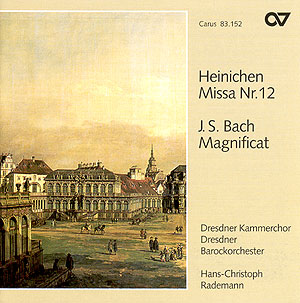
Heinichen: Missa No. 12 / Bach: Magnificat
 Ecouter
(31)
Ecouter
(31)
- Kyrie eleison I
- Christe eleison
- Kyrie eleison II
- Gloria in excelsis
- Qui tollis
- Quoniam
- Cum Sancto Spiritu
- Credo
- Et incarnatus est
- Et resurrexit
- Et in Spiritum Sanctum
- Et vitam
- Sanctus
- Pleni sunt coeli
- Benedictus
- Osanna in excelsis
- Agnus Dei I
- Agnus Dei II
- Dona nobis pacem
- Magnificat
- Et exsultavit
- Quia respexit
- Omnes generationes
- Quia fecit
- Et misericordia
- Fecit potentiam
- Deposuit potentes
- Esurientes
- Suscepit Israel
- Sicut locutus est
- Gloria patri
 Compléments
-
 Texte numérique (sans notes), licence d'impression incluse, fichier html, paroles, traduction allemandefichier html, paroles, traduction allemande (Extrait)
1. Magnificat (Coro SSATB) Hoch erhebt meine Seele den Herren.
2. Et exsultavit (Aria Soprano II) In Gott, meinem Heiland, jubelt mein Geist.
3. Quia respexit (Aria Soprano I) / 4. Omnes generationes (Coro) Er hat in Gnaden geschaut auf seine niedrige Magd,
Siehe, von nun an nennen mich selig alle Geschlechter.5. Quia fecit (Aria Basso) Großes hat der Gewaltige an mir getan,
dessen Name heilig ist.6. Et misericordia (Aria Alto, Tenore) Und sein Erbarmen währt von Geschlecht zu Geschlecht über die,
welche ihn fürchten.7. Fecit potentiam (Coro) Macht hat er geübt mit seinem Arm
und zerstreuet, die stolzen Herzens sind.8. Deposuit (Aria Tenore) Herrscher hat er vom Thron gestürzt,
...
-
Texte numérique (sans notes), licence d'impression incluse, fichier html, paroles, originalfichier html, paroles, original (Extrait)
1. Magnificat (Coro SSATB) Magnificat anima mea Dominum.
2. Et exsultavit (Aria Soprano II) Et exsultavit spiritus meus in Deo salutari meo
3. Quia respexit (Aria Soprano I) / 4. Omnes generationes (Coro) Quia respexit humilitatem ancillae suae,
ecce enim ex hoc beatam me dicent omnes generationes.5. Quia fecit (Aria Basso) Quia fecit mihi magna qui potens est,
et sanctum nomen eius.6. Et misericordia (Aria Alto, Tenore) Et misericordia a progenie in progenies
timentibus eum.7. Fecit potentiam (Coro) Fecit potentiam in bracchio suo,
dispersit superbos mente cordis sui.8. Deposuit (Aria Tenore) Deposuit potentes de sede
et exaltavit humiles....
-
Texte numérique (sans notes), licence d'impression incluse, fichier html, Texte introductif, françaisfichier html, Texte introductif, français (Extrait)Texte du livret du CD Carus 83.152
Katrin Bemmann
Traduction (abrégée) : Jean Paul MénièreDepuis le Vle siècle, le « Magnificat », chant de louange à Marie, qui vient d’apprendre qu’elle va être la mère du Christ, constitue dans la liturgie catholique le point culminant des Vêpres. Avec la Réforme, les Vêpres, et avec elle le Magnificat, ont été reprises dans la liturgie protestante.
Le Magnificat latin de Johann Sebastian Bach existe en deux versions. La première, en mi bémol majeur, fut écrite en 1723, l’année où Bach entra en fonction à Leipzig, et conçue pour les Vêpres de Noël. Conformément aux circonstances, cette version fut augmentée de quatre séquences de Noël et les flûtes à bec prenaient, en raison de leur caractère pastoral, la place des flûtes traversières. Quelques années plus tard, Bach entreprit une révision de l’œuvre. Il changea la tonalité en ré majeur, supprima les quatre pièces rajoutées et confia
...
-
Texte numérique (sans notes), licence d'impression incluse, fichier html, Texte introductif, en anglaisfichier html, Texte introductif, en anglais (Extrait)Text from the CD Carus 83.152
Katrin Bemmann
Translation (abridged): John CoombsThe “Magnificat” – the song of praise of the Virgin Mary on hearing that she is to become the mother of Christ – has formed the climactic point of the service of Vespers in the liturgy of the Catholic Church since the 6th century. Following the Reformation Vespers, including the Magnificat, retained a place in the Protestant liturgy.
Johann Sebastian Bach’s Latin Magnificat exists in two versions. The first, in E flat major, was written in 1723, the year when he took up his position in Leipzig, and was intended for use in the Christmas Vespers. In view of that intention four Christmas pieces were added to this version, and instead of flutes Bach used recorders, with their pastoral character. A few years later Bach revised the work. He transposed it to D major, removed the Christmas pieces, and replaced the recorders by flutes, whose
...
-
Texte numérique (sans notes), licence d'impression incluse, fichier html, Texte introductif, en allemandfichier html, Texte introductif, en allemand (Extrait)Booklet-Text der CD Carus 83.152
Katrin Bemmann
Das „Magnificat“ – der Lobgesang Marias, nachdem sie erfahren hat, dass sie die Mutter Christi wird – bildet seit dem 6. Jahrhundert in der Liturgie der katholischen Kirche den Höhepunkt der Vesper. Musikalisch entwickelte sich aus der einstimmigen Psalmodie nach und nach eine vielfältige Palette von Formen, sei es als Lied, mehrstimmige Motette oder kantatenähnliche Vertonung mit Instrumentalbegleitung. Mit der Reformation wurde die Vesper und damit auch das Magnificat in die protestantische Liturgie übernommen.
Von Johann Sebastian Bachs lateinischem Magnificat existieren zwei Fassungen. Die erste in Es-Dur entstand in Bachs Leipziger Antrittsjahr 1723 und war für die Weihnachtsvesper bestimmt. Dem Anlass entsprechend war diese Fassung um vier weihnachtliche Einlagesätze erweitert, und statt Traversflöten fanden Blockflöten mit ihrem pastoralen Charakter Verwendung. Einige Jahre später nahm Bach eine Überarbeitung vor. Er änderte die Tonart in D-Dur, strich die vier zusätzlichen Stücke und übertrug den nunmehr besetzten Traversflöten größere Aufgaben.
...


-
L'auteur de l'avant-propos
Katrin Bemmann
-
Chœur
Dresdner Kammerchor
Le Dresdner Kammerchor (Chœur de chambre de Dresde) – l’un des meilleurs chœurs d’Allemagne – est bien connu pour sa sonorité unique, faite d’une grande intensité et clarté. Rayonnement dynamique, homogénéité et transparence sonores souvent cités en exemple sont les points forts de cet ensemble demandé au niveau international. Le chœur a été créé en 1985 par Hans-Christoph Rademann et des étudiants du Conservatoire de musique « Carl Maria von Weber » de Dresde. De nombreuses tournées de concerts ont établi la notoriété de l’ensemble également hors d’Europe. En ont résulté des invitations régulières à d’importants festivals internationaux. Le répertoire du chœur va de la musique de la Renaissance à des compositions du 21ème siècle. Des interprétations de la musique chorale romantique et contemporaine ont été récompensées de prix spéciaux lors de concours internationaux, ainsi que du prix d’encouragement de la fondation Ernst von Siemens. En dehors de la pratique a cappella, le chœur de chambre se consacre intensément à la coopération avec le Dresdner Barockorchester et l’ensemble « Alte Musik Dresden », donnant des impulsions importantes à la pratique de la musique ancienne en Saxe. Une foule d’enregistrements pour la radio et pour le CD, ainsi que la coopération avec des orchestres allemands et étrangers viennent renforcer la renommée du Chœur de chambre de Dresde. Le CD paru aux Editions Carus de Stuttgart, avec le premier enregistrement mondial du Requiem en mi bémol majeur de Johann Adolf Hasse s’est vu décerner le prix de la Critique allemand du disque. Plus d'information sur la personne
-
Orchestre
Dresdner Barockorchester
Le Dresdner Barockorchester [Orchestre baroque de Dresde] a été créé en 1991 par des diplômés du Conservatoire de musique de Dresde. Au cours des années, les musiciens saxons ont révélé tout ce qu’il avaient de particulier à apporter à la scène de la musique ancienne : force émotionnelle et expressive, alliée à une musicalité éloquente, une interprétation sous un angle neuf, vivant. Les compositions de maîtres de chapelle et instrumentistes de la Chapelle de la cour de Dresde des 17ème et 18ème siècles comme Hasse, Heinichen, Zelenka, Quantz, Pisendel e. a. constituent un aspect important du répertoire du Dresdner Barockorchester. Le centre de gravité et le défi véritable pour l’ensemble est le vécu direct du concert. Plusieurs enregistrements pour le CD documentent autant l’art des interprètes que la pratique musicale éprise de magnificence de la cour baroque de Dresde. Des tournées ont conduit le Dresdner Barockorchester non seulement dans de nombreux centres musicaux d’Allemagne, mais aussi en Hollande, en Espagne, en Autriche et au Japon. Plus d'information sur la personne
-
Chef d'orchestre
Hans-Christoph Rademann
| 1965Conductor Hans-Christoph Rademann is an immensely versatile artist with a broad repertoire who devotes himself with equal passion and expertise both to the performance and rediscovery of early music and to the first performances and cultivation of Contemporary Music. Born in Dresden and raised in the Erzgebirge mountains, he was influenced at an early age by the great Central German kantorial and musical tradition. He was a student at the traditional Kreuzgymnasium, a member of the famous Kreuzchor, and studied choral and orchestral conducting at the Carl Maria von Weber University of Music in Dresden. During his studies, he founded the Dresdner Kammerchor and formed it into a top international choir which is still under his direction today. Since 2013, Hans-Christoph Rademann has been the academy director of the International Bach Academy Stuttgart. He regularly collaborates with leading choirs and ensembles of the international music scene. From 1999 to 2004 he was chief conductor of the NDR Choir and from 2007 to 2015 chief conductor of the RIAS Chamber Choir. Guest conducting engagements have led and continue to lead him to the Nederlandse Bachvereniging, the Collegium Vocale Gent, the Akademie für Alte Musik, the Freiburger Barockorchester, the Deutsche Radiophilharmonie Saarbrücken Kaiserslautern, the Sinfonieorchester Basel, the Orchestre Philharmonique de Luxembourg, among others. Hans-Christoph Rademann has been awarded prizes and honors for his artistic work, including the Johann Walter Plaque of the Saxon Music Council (2014), the Saxon Constitutional Medal (2008), the Sponsorship Prize as well as the Art Prize of the state capital Dresden (1994 and 2014 respectively). He received the Preis der Deutschen Schallplattenkritik several times for his numerous CD recordings (most recently in 2016), as well as the Grand Prix du Disque (2002), the Diapason d’Or (2006 & 2011), the CHOC de l’année 2011 and the Best Baroque Vocal Award 2014. In 2016 he was awarded the European Church Music Prize of the city of Schwäbisch Gmünd. His exemplary interpretation and recording of the complete works of Heinrich Schütz with the Dresdner Kammerchor in the Stuttgart Carus-Verlag, which was completed in 2019, was awarded the newly endowed Heinrich Schütz Prize as well as the OPUS KLASSIK 2020 in the same year. Hans-Christoph Rademann is professor of choral conducting at the Carl Maria von Weber University of Music in Dresden. He is also artistic director of the Musikfest Erzgebirge, ambassador of the Erzgebirge and patron of the Christian Hospice Service Dresden. Plus d'information sur la personne
-
Solist - soprano
Monika Frimmer
-
Solist - soprano
Kerstin Klein
-
Solist - alto
Kai Wessel
Kai Wessel a étudié la théorie musicale, la composition, le chant et la pratique d’exécution baroque. Il s’est produit avec des orchestres du monde entier, entre autres sous la direction de Cambreling, Christie, Corboz, Goebel, Harnoncourt, Haselböck, Henze, Herreweghe, Holliger, Koopman, McGegan, Rundel, Savall et Suzuki. Des engagements d’invité ont conduit Kai Wessel à chanter dans les plus grands festivals européens ainsi que dans les opéras de Barcelone, Nice, Dresde, Hambourg, Hanovre, Fribourg, Berlin et Bâle. Il y a chanté Theodora, Aus Deutschland, Giulio Cesare, Wie liegt die Stadt so wüste, Israel in Egypt et Actus tragicus ainsi que les créations de Schwarzerde de Klaus Huber et de Lost Highway d’Olga Neuwirth, Semele, le rôle d’Orfeo dans Orfeo ed Euridice. Plus d'information sur la personne
-
Solist - ténor
Hermann Oswald
-
Solist - basse
Andreas Scheibner
-
Solist - basse
Egbert Junghanns
Critiques
Heinichen, Johann David: Missa Nr
Mit der sukzessiven Fertigstellung der Dresdner Frauenkirche kann sich der Blick für die Dresdner Musikkultur der Barockzeit weiten. Johann David Heinichen wirkte 1717-1729 in Elbflorenz, die aktuelle Verbreitung seiner Musik hat mit deren Qualität nichts zu tun. Offensichtlich ist die hier präsentierte letzte Messe Heinichens ein besonderes Kleinod, wer so feinsinnig instrumentieren kann (Hörner!) und formal und melodisch dermaßen überzeugt, hat bestimmt sonst auch keinen Mist geschrieben. Die „Nummernmesse” teilt das Ordinarium in 19 Teile, in zwölfen ist der Chor mal mehr, mal weniger gefragt. Auf der CD erscheint immerhin der Hinweis, dass die „Music” bei Carus Stuttgart „in preparation” sei, im neuen Katalog steht sie allerdings nicht. Auf der Scheibe wird frisch und lebendig musiziert, teilweise sind berückende Vokal- und Instrumentalsoli zu hören. Der Chor singt homogen, (meist) auch in den Koloraturen exakt, in den wenigen ruhigen Phasen wohltuend zielgerichtet. Im Orchester sind speziell in der Borockszene Aktive, sowie Mitglieder der Sächsischen Staatskapelle und der Dresdner Philharmoniker vereint. Im Tutti ist das nicht störend bemerkbar, die Instrumentalsoli werden erstere übertragen bekommen haben. Die Soli (bei Bach wirkt noch Constanze Bockes, Sopran II, mit) singen in unterschiedlichen technischen Ansätzen letztlich überzeugend und, wie gesagt, manchmal sogar berückend schön. Das Verdienst des Dirigenten ist der Schwung der Produktion, von der Werkauswahl bis zum letzten Ton. Dieses Programm würde ich gerne mal als Adventskonzert hören. Unsere fugenfreudigen Chöre sind nicht überfordert!Reinhard Krämer
Quelle: Württembergische Blätter für Kirchenmusik 6/2003 „Die Interpreten agieren mit schönster Natürlichkeit, Frische und ansteckender Begeisterung.”
Quelle: Klassik heute 7/01 Lest you may someday make the mistake of underestimating the compositional skill and artistic achievement of 18th-century Dresden court composer Johann David Heinichen, you may want to listen to this recording of his D major Mass No. 12. Besides the showers of ravishing music, which often come in relatively short, less-than-two-minute downpours, you’ll enjoy colorful orchestrations, sudden and surprising shifts of mood and abrupt endings, and an overall experience that shines a welcome light on yet another corner of Baroque repertoire long hidden in the shadow of Bach. An earlier recording of another Heinichen mass by these same forces also received ClassicsToday.com’s highest rating.
My take on this is that in these masses he was not thinking of posterity or of creating grand masterpieces but rather kept things short simply in consideration of his „audience”--and yet he didn’t cheat them at all in terms of stirring, lively tunes and excitingly rhythmic choral and orchestral sections. Just listen to the terrific horn riffs in the opening of the Gloria and during the Handelian alto solo „Quoniam tu solus Sanctus” (including what sounds like an ever-so-brief quote from the Water Music!). Delightful melodic figures spring from both chorus and orchestra in the opening of the Credo, and quickly disappear in the section’s sudden, quiet ending; similar quick-but-mighty thrills await at the Credo’s final fugal „Et vitam” passage and in the lightning-fast runs in the Osanna--only 50 seconds, total--that rival any of Handel’s similar effects. And this chorus takes to the challenge without a stumble.
Oh yes, the other work on the disc is Bach’s inimitable masterpiece of a Magnificat, and these performers--chorus, orchestra, and soloists all--present the piece as if born to it. Conductor Hans-Christoph Rademann leads with authority, emphasizing crisp rhythms, beautiful sonorities, vibrant, electric energy, purposeful tempos, and nice expressive gestures--little dynamic gradations, extra-precise articulations (as in the ending of the word „Magnificat”)--that give impetus, clarity, and emotional radiance to the performance. Especially fine are the bass solo „Quia fecit”, the alto/tenor „Et misericordia”, and the „Suscepit Israel trio. No, the soprano soloist’s edgy tone in „Et exsultavit” will not engender uniform praise from all listeners, and some, like me, may wish for a slightly faster tempo in the „Quia respexit”--and of course, the „Omnes generationes” doesn’t have nearly the driving force of Gardiner’s. But this is the kind of work that probably never will allow an „ideal” performance--there’s always something you’d like to fix. But not all listeners are that fussy, thank heaven--and if you get this recording, chances are excellent that you’ll be very happy with what you hear. In keeping with what seems like Carus’ standard practice, texts are in Latin and German only, and there is (annoyingly) no basic track listing in the liner booklet--only on the back of the outer package.
David Vernier
Quelle: Classics today
Les évaluations sur notre site web ne peuvent être effectuées que par des clients disposant d'un compte d'utilisateur enregistré. Il n'est pas vérifié si les produits évalués ont été effectivement achetés.
Questions fréquentes sur l'œuvre
 Il n'y a pas encore de questions et réponses concernant cette œuvre ou vous n'avez pas trouvé la réponse à votre question sur l'œuvre ? Cliquez ici et envoyez votre question spécifique à notre service clients.