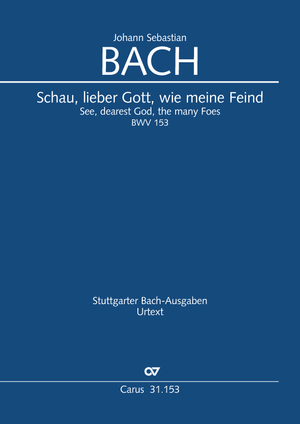
Schau, lieber Gott, wie meine Feind
Cantate pour le dimanche après le Nouvel An BWV 153, 1724
Bach chose an unconventional beginning for his nine-movement cantata Schau, lieber Gott, wie meine Feind (See, dearest God, the many foes) BWV 153, which he composed in his first year as Kantor of St. Thomas’s for the Sunday after New Year 1724. Instead of the usual opening chorus, the cantata opens with a simple four-part chorale movement. There are also chorales in the middle of the work (movement 5) and at the end. By avoiding extended or demanding choral movements, Bach probably wanted to save the voices of his choir members at St Thomas’s, who had just been involved in a demanding week of almost constant singing. This may also be why the cantata uses just three soloists (alto, tenor, bass). In the arias, each preceded by a secco recitative, the accompaniment is provided by 2 violins and viola.
Découvrir
 Consulter


 Compléments
- Acheter des compléments au format téléchargement.
-
 Texte numérique (sans notes), licence d'impression incluse, fichier html, paroles, traduction en anglaisfichier html, paroles, traduction en anglais (Extrait)1 Choral
See, dearest God, the many foes
2 Recitativo (Alto)
that constantly assail me,
so foully deal such mighty blows,
that strength I fear will fail me.
The devil, flesh and wicked world
had long my soul to hell have hurled,
did not thy grace avail me.Beloved God, with pity do thou hear me,
3 Aria (Basso)
protect me, ever hear me.
Around me here are evil beast which sore dismay me,
I live in constant fear that in their rage and hate
they will not wait
to master and to slay me.Be not dismayed, I am with thee,
be not afraid, I am with thee.
Fear thou not, I am thy God.
Help will I give, uphold thee...
-
Texte numérique (sans notes), licence d'impression incluse, fichier html, paroles, originalfichier html, paroles, original (Extrait)1 Choral
Schau, lieber Gott, wie meine Feind,
2 Recitativo (Alto)
damit ich stets muss kämpfen,
so listig und so mächtig seind,
dass sie mich leichtlich dämpfen!
Herr, wo mich deine Gnad nicht hält,
so kann der Teufel, Fleisch und Welt
mich leicht in Unglück stürzen.Mein liebster Gott, ach lass dichs doch erbarmen,
3 Aria (Basso)
ach hilf doch, hilf mir Armen!
Ich wohne hier bei lauter Löwen und bei Drachen,
und diese wollen mir durch Wut und Grimmigkeit
in kurzer Zeit
den Garaus völlig machen.Fürchte dich nicht,
ich bin mit dir.
Weiche nicht,
ich bin dein Gott;...
Acheter
Informations complémentaires sur l'œuvre
-
Compositeur
Johann Sebastian Bach
| 1685-1750Jean-Sébastien Bach compte parmi les compositeurs les plus importants de l'histoire de la musique occidentale. Il était issu d'une dynastie de musiciens très ramifiée, qui a donné naissance à de nombreux musiciens municipaux et organistes dans la région de Thuringe et de Saxe.
Bach vocal
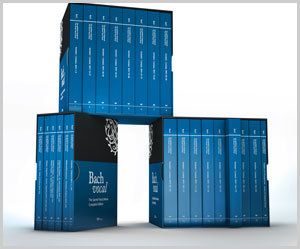
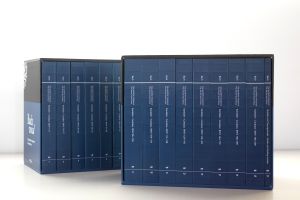
Depuis la création des éditions Carus, l’édition des œuvres de Jean-Sébastien Bach constitue pour nous une priorité particulière. À l’occasion de l’année commémorative de la Réforme, nous avons achevé le projet « Bach vocal ». La musique vocale sacrée de Bach est désormais disponible dans son intégralité sous forme d’éditions modernes « Urtext », accompagnées du matériel d’exécution. Une édition complète de toutes les partitions, présentée dans un coffret de grande qualité, est également disponible. Traduit avec DeepL.com (version gratuite)
Plus d'information sur la personne
-
Éditeur
Karin Wollschläger
Les évaluations sur notre site web ne peuvent être effectuées que par des clients disposant d'un compte d'utilisateur enregistré. Il n'est pas vérifié si les produits évalués ont été effectivement achetés.
Aucune évaluation disponible pour ce produit.
Questions fréquentes sur l'œuvre
 Il n'y a pas encore de questions et réponses concernant cette œuvre ou vous n'avez pas trouvé la réponse à votre question sur l'œuvre ? Cliquez ici et envoyez votre question spécifique à notre service clients.