

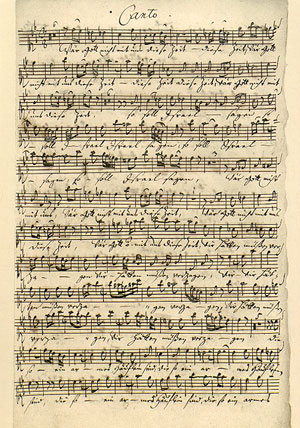
Wär Gott nicht mit uns diese Zeit
Cantate pour le 4ème dimanche après l'Epiphanie BWV 14, 1735
Découvrir
 Compléments
-
 Texte numérique (sans notes), licence d'impression incluse, fichier html, paroles, traduction en anglaisfichier html, paroles, traduction en anglais (Extrait)1 Coro
Were God not with us here today,
2 Aria (Soprano)
when foes so sore assail us,
fainthearted, would we all then say:
“Our courage surely will fail us”;
for we were but a feeble band,
despised by foes on ev’ry hand,
did not thy might avail us.Our own might is far too weak
3 Recitativo (Tenore)
from our foes itself to fend us.
Stood not he, in majesty,
there to foil their tyranny,
soon into atoms they would rend us.Yea, had not God his folk defended,
long, long ago our lives were ended,
for they would tear us limb from limb,
their fury is so fierce and grim.
Our foes would have our blood...
-
Texte numérique (sans notes), licence d'impression incluse, fichier html, paroles, originalfichier html, paroles, original (Extrait)1 Coro
Wär Gott nicht mit uns diese Zeit,
so soll Israel sagen,
wir hätten müssen verzagen,
die so ein armes Häuflein sind,
veracht‘ von so viel Menschenkind,
die an uns setzen alle.
2 Aria (Soprano) Unsre Stärke heißt zu schwach,
3 Recitativo (Tenore)
unserm Feind zu widerstehen.
Stünd uns nicht der Höchste bei,
würd uns ihre Tyrannei
bald bis an das Leben gehen.Ja, hätt es Gott nur zugegeben,
wir wären längst nicht mehr am Leben,
sie rissen uns aus Rachgier hin,
so zornig ist auf uns ihr Sinn.
Es hätt uns ihre Wut...
-
Texte numérique (sans notes), licence d'impression incluse, fichier html, Texte introductif, en anglaisfichier html, Texte introductif, en anglais (Extrait)Abridged Foreword of the Edition Carus 31.014/03
Ulrich Leisinger
Translation: John CoombsWith the appointment of Johann August Ernesti on the 16th November 1734 as headmaster of the Thomasschule and therefore successor to Matthias Gessner, who had recently received the prestigious appointment as founding rector of the University of Göttingen, the balance of power in the Leipzig Thomasschule altered considerably. As Bach knew since 1731 through his position as second master, the younger Ernesti was far more interested in the sciences than in the fine arts. It must therefore have appeared to Bach all the more important to produce new church compositions which would add lustre to what he considered to be the honourable tradition of the Thomasschule. For the Sundays and feast days of the period between Christmas Day 1734 and Epiphany 1735 he wrote the Christmas Oratorio. Which section of that work was performed on each of the Sundays after Epiphany can no longer be ascertained, but for the Sunday after Epiphany, which in 1735 fell on the 30th January, Bach produced a new, highly ambitious work, the cantata Wär Gott nicht mit uns diese Zeit (Were God not with us here today), BWV 14. This is one of the last of Bach’s
...
-
Texte numérique (sans notes), licence d'impression incluse, fichier html, Texte introductif, en allemandfichier html, Texte introductif, en allemand (Extrait)Gekürztes Vorwort der Ausgabe Carus 31.014/03
Ulrich Leisinger
Mit der Wahl von Johann August Ernesti am 16. November 1734 als Rektor der Thomasschule und damit Nachfolger von Matthias Gessner, der kurz zuvor die ehrenvolle Berufung zum Gründungsrektor der Universität Göttingen erhalten hatte, verschoben sich die Kräfteverhältnisse in der Leipziger Thomasschule erheblich. Der jüngere Ernesti war, wie Bach aus dessen Wirken als Konrektor seit 1731 wusste, an den Wissenschaften weit mehr als an den schönen Künsten interessiert. Umso wichtiger musste es Bach daher erscheinen, mit neuen, repräsentativen Kirchenkompositionen aufzuwarten, um den Stellenwert, den die Musik seiner Überzeugung nach an der ehrwürdigen Thomasschule behalten sollte, zu unterstreichen. Für die Sonn- und Festtage der Zeit vom 1. Weihnachtstag 1734 bis zum Epiphaniasfest 1735 ist das Weihnachtsoratorium entstanden. Welche Werke an den ersten Sonntagen nach dem Epiphaniasfest erklungen sind, ist heute nicht mehr auszumachen. Doch schon zum 4. Sonntag nach Epiphanias, der im Jahr 1735 am 30. Januar begangen wurde, trat Bach wiederum mit einem neuen, höchst ambitionierten Werk auf, der Kantate Wär Gott nicht mit uns diese Zeit BWV 14. Das Werk gehört
...
Acheter
Informations complémentaires sur l'œuvre
-
Compositeur
Johann Sebastian Bach
| 1685-1750Jean Sébastien Bach compte parmi les compositeurs essentiels de l'histoire de la musique occidentale. Il faisait partie d'une grande dynastie de musiciens, dont furent originaires nombre de musiciens municipaux et d'organistes dans les régions de Thuringe et de Saxe.
Bach vocal
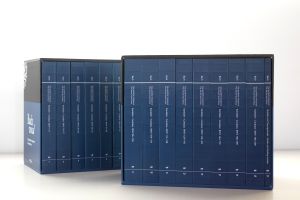
Depuis la fondation des Éditions Carus en 1972, la publication des oeuvres de Johann Sebastian Bach revêt une importance particulière. En 2017, année du 500e anniversaire de la Réforme, nous avons clôturé le projet Bach vocal. L'intégralité de la musique vocale sacrée de Bach est désormais disponible en éditions modernes des textes originaux, matériel d'exécution compris. Une édition globale de toutes les partitions dans un coffret de grande qualité est aussi proposée. Plus d'information sur la personne
-
Parolier/Librettiste
Martin Luther
| 1483-1546
-
Traducteur
Henry Drinker
Les évaluations sur notre site web ne peuvent être effectuées que par des clients disposant d'un compte d'utilisateur enregistré. Il n'est pas vérifié si les produits évalués ont été effectivement achetés.
Aucune évaluation disponible pour ce produit.
Questions fréquentes sur l'œuvre
 Il n'y a pas encore de questions et réponses concernant cette œuvre ou vous n'avez pas trouvé la réponse à votre question sur l'œuvre ? Cliquez ici et envoyez votre question spécifique à notre service clients.